British Columbia Centre for Excellence in HIV/AIDS, Vancouver, Canada.
Am J Drug Alcohol Abuse. 2012 Jan;38(1):55-62. doi: 10.3109/00952990.2011.600389. Epub 2011 Aug 11.
Innovative health programs for injection drug users (IDUs), such as supervised injecting facilities (SIFs), are often preceded by evaluations of IDUs' willingness to use the service. The validity of these surveys has not been fully evaluated. We sought to determine whether measures of willingness collected prior to the opening of a Canadian SIF accurately predicted subsequent use of the program.
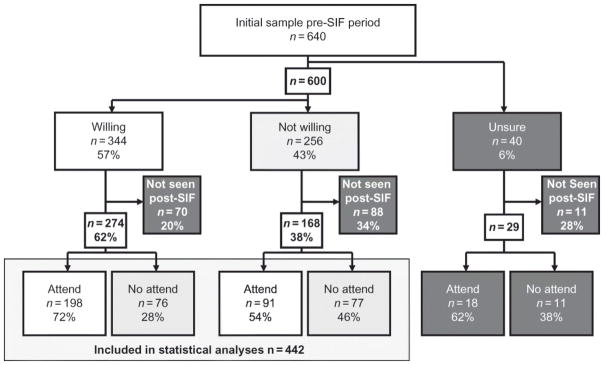
Data were derived from a prospective cohort of IDUs. The sample size for this study was 640 IDUs. Using multivariate logistic regression, it was assessed if a history of reporting willingness to use the program, were it available, was associated with subsequent use. In sub-analysis restricted to individuals who had a history of reported willingness, we used multivariate longitudinal analysis to identify factors associated with not attending the SIF.
Among 442 IDUs, 72% of those who reported initial willingness to use a SIF later attended the program, and a prior willingness to use a SIF significantly predicted later attendance (adjusted odds ratio = 1.67). In sub-analyses restricted to those who had a history of reporting willingness to use the SIF, not using the program was predicted by not frequenting the neighborhood where the SIF was located.
Our findings indicate that reported willingness measures collected from IDUs regarding potential SIF program participation prior to its opening independently predicted later attendance even when variables that were likely determinants of willingness were adjusted for. These data suggest that willingness measures are reasonably valid tools for planning the delivery of health services among IDU populations.
为注射吸毒者(IDUs)提供创新性的健康计划,例如监督注射设施(SIFs),通常需要先评估 IDUs 使用该服务的意愿。这些调查的有效性尚未得到充分评估。我们旨在确定在加拿大 SIF 开放之前收集的意愿措施是否准确预测了随后对该计划的使用。
数据来自于一项前瞻性 IDU 队列研究。本研究的样本量为 640 名 IDU。使用多变量逻辑回归,评估在有 SIF 的情况下报告愿意使用该计划的历史是否与随后的使用相关。在仅限于有报告使用意愿历史的个体的亚分析中,我们使用多变量纵向分析来确定与未参加 SIF 相关的因素。
在 442 名 IDU 中,有 72%的人报告最初愿意使用 SIF,后来参加了该计划,并且先前愿意使用 SIF 显著预测了后来的参加(调整后的优势比= 1.67)。在仅限于有报告使用 SIF 意愿历史的亚分析中,不使用该计划的预测因素是不常去 SIF 所在的社区。
我们的研究结果表明,在 SIF 开放之前从 IDU 那里收集的关于潜在 SIF 计划参与的报告意愿措施,即使在调整了可能决定意愿的变量后,也独立预测了后来的参加。这些数据表明,意愿措施是在 IDU 人群中规划健康服务提供的合理有效工具。