Department of Internal Medicine B, Rambam Health Care Campus, 1 Ha'aliya St, POB, 9602 Bat Galim, Haifa 31096, Israel.
Crit Care. 2011 Aug 11;15(4):R194. doi: 10.1186/cc10355.
Community acquired pneumonia (CAP) is a major cause of morbidity and mortality. While there is much data about risk factors for severe outcome in the general population, there is less focus on younger group of patients. Therefore, we aimed to detect simple prognostic factors for severe morbidity and mortality in young patients with CAP.
Patients of 60 years old or younger, who were diagnosed with CAP (defined as pneumonia identified 48 hours or less from hospitalization) between March 1, 2005 and December 31, 2008 were retrospectively analyzed for risk factors for complicated hospitalization and 90-day mortality.
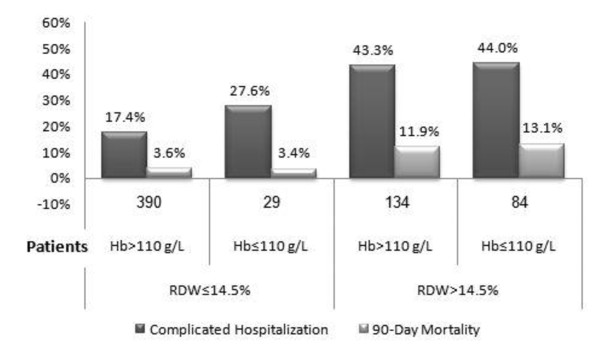
The cohort included 637 patients. 90-day mortality rate was 6.6% and the median length of stay was 5 days. In univariate analysis, male patients and those with co-morbid conditions tended to have complicated disease. In multivariate analysis, variables associated with complicated hospitalization included post chest radiation state, prior neurologic damage, blood urea nitrogen (BUN) > 10.7 mmol/L and red cell distribution width (RDW) > 14.5%; whereas, variables associated with an increased risk of 90-day mortality included age ≥ 51 years, prior neurologic damage, immunosuppression, and the combination of abnormal white blood cells (WBC) and elevated RDW. Complicated hospitalization and mortality rate were significantly higher among patients with increased RDW regardless of the white blood cell count. Elevated RDW was associated with a significant increase in complicated hospitalization and 90-day mortality rates irrespective to hemoglobin levels.
In young patients with CAP, elevated RDW levels are associated with significantly higher rates of mortality and severe morbidity. RDW as a prognostic marker was unrelated with hemoglobin levels.
ClinicalTrials.Gov NCT00845312.
社区获得性肺炎(CAP)是发病率和死亡率的主要原因。虽然有很多关于一般人群中严重后果的危险因素的数据,但对年轻患者群体的关注较少。因此,我们旨在检测年轻 CAP 患者严重发病率和死亡率的简单预后因素。
回顾性分析 2005 年 3 月 1 日至 2008 年 12 月 31 日期间诊断为 CAP(定义为住院后 48 小时或更短时间内发现的肺炎)的年龄在 60 岁或以下的患者,以确定其住院并发症和 90 天死亡率的危险因素。
该队列包括 637 名患者。90 天死亡率为 6.6%,中位住院时间为 5 天。在单变量分析中,男性患者和合并症患者往往病情复杂。多变量分析显示,与住院并发症相关的变量包括胸部放疗后状态、既往神经损伤、血尿素氮(BUN)>10.7mmol/L 和红细胞分布宽度(RDW)>14.5%;而与 90 天死亡率增加相关的变量包括年龄≥51 岁、既往神经损伤、免疫抑制以及异常白细胞(WBC)和升高的 RDW 组合。无论白细胞计数如何,RDW 升高的患者住院并发症和死亡率均显著升高。RDW 升高与住院并发症和 90 天死亡率的显著增加相关,与血红蛋白水平无关。
在年轻的 CAP 患者中,升高的 RDW 水平与死亡率和严重发病率显著增加相关。RDW 作为预后标志物与血红蛋白水平无关。
ClinicalTrials.gov NCT00845312。