Institute for Translational Neuroscience, University of Minnesota, Minneapolis, Minnesota 55455, USA.
J Biol Chem. 2011 Oct 7;286(40):34606-16. doi: 10.1074/jbc.M111.238527. Epub 2011 Aug 11.
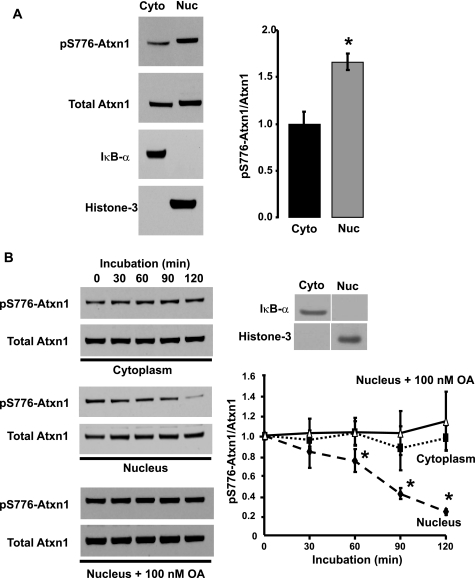
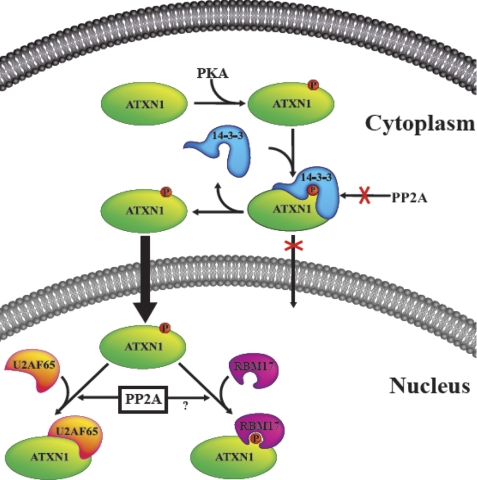
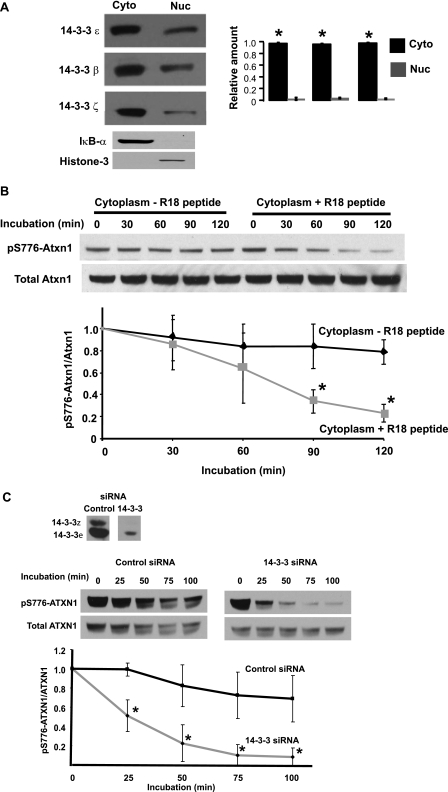
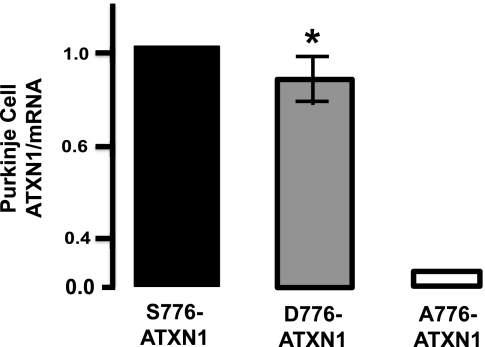
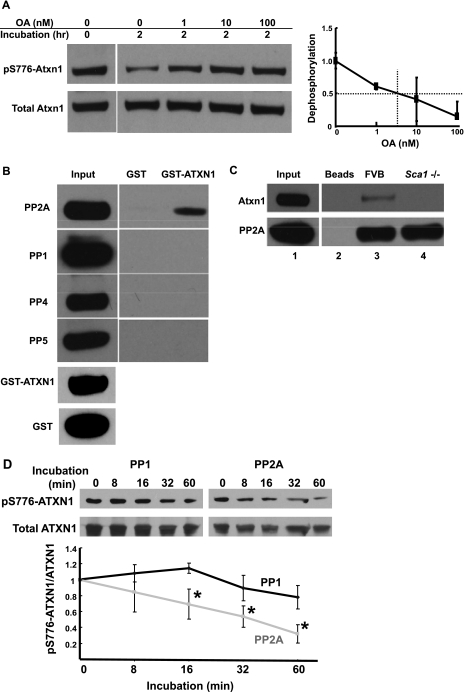
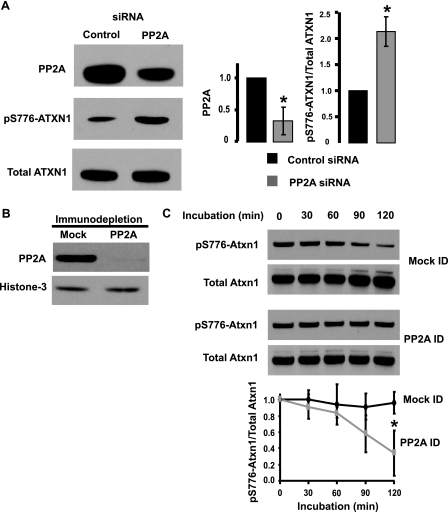
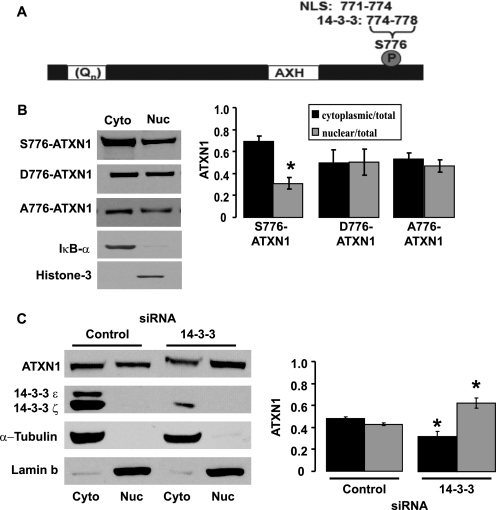
Spinocerebellar ataxia type 1 (SCA1) is a lethal neurodegenerative disorder caused by expansion of a polyglutamine tract in ATXN1. A prominent site of pathology in SCA1 is cerebellar Purkinje neurons where mutant ATXN1 must enter the nucleus to cause disease. In SCA1, phosphorylation of ATXN1 at Ser-776 modulates disease. Interestingly, Ser-776 is located within a region of ATXN1 that harbors several functional motifs including binding sites for 14-3-3, and splicing factors RBM17 and U2AF65. The interaction of ATXN1 with these proteins is thought to be regulated by the phosphorylation status of Ser-776. In addition, Ser-776 is adjacent to the NLS in ATXN1. Although pS776-ATXN1 is enriched in nuclear extracts of cerebellar cells, the vast majority of 14-3-3 is in the cytoplasmic fraction. We found that dephosphorylation of cytoplasmic pS776-ATXN1 is blocked by virtue of it being in a complex with 14-3-3. In addition, data suggest that binding of 14-3-3 to cytoplasmic ATXN1 impeded its transport to the nucleus, suggesting that 14-3-3 must disassociate from ATXN1 for transport of ATXN1 to the nucleus. Consistent with this hypothesis is the observation that once in the nucleus pS776 is able to be dephosphorylated. Evidence is presented that PP2A is the pS776-ATXN1 phosphatase in the mammalian cerebellum. In the nucleus, we propose that dephosphorylation of pS776-ATXN1 by PP2A regulates the interaction of ATXN1 with the splicing factors RBM17 and U2AF65.
脊髓小脑共济失调 1 型(SCA1)是一种致命的神经退行性疾病,由 ATXN1 中多聚谷氨酰胺链的扩展引起。SCA1 的一个主要病变部位是小脑浦肯野神经元,突变的 ATXN1 必须进入细胞核才能引起疾病。在 SCA1 中,ATXN1 在 Ser-776 的磷酸化调节疾病。有趣的是,Ser-776 位于 ATXN1 的一个区域内,该区域包含几个功能基序,包括与 14-3-3 的结合位点,以及剪接因子 RBM17 和 U2AF65。ATXN1 与这些蛋白的相互作用被认为受 Ser-776 的磷酸化状态调节。此外,Ser-776 紧邻 ATXN1 的核定位信号(NLS)。尽管 pS776-ATXN1 在小脑细胞的核提取物中富集,但绝大多数的 14-3-3 存在于细胞质部分。我们发现,由于 pS776-ATXN1 与 14-3-3 形成复合物,细胞质中 pS776-ATXN1 的去磷酸化被阻断。此外,数据表明,14-3-3 与细胞质中的 ATXN1 结合阻碍了其向核内的运输,表明 14-3-3 必须与 ATXN1 解离才能将 ATXN1 运输到核内。这一假说与观察结果一致,即一旦进入细胞核,pS776 就能够被去磷酸化。有证据表明,在哺乳动物小脑中,PP2A 是 pS776-ATXN1 的磷酸酶。在核内,我们提出,PP2A 对 pS776-ATXN1 的去磷酸化调节 ATXN1 与剪接因子 RBM17 和 U2AF65 的相互作用。