Progeria Research Team, Centre for Cell and Chromosome Biology, Biosciences, School of Health Sciences and Social Care, Brunel University, West London, UB8 3PH, UK.
Genome Biol. 2011 Aug 12;12(8):R74. doi: 10.1186/gb-2011-12-8-r74.
Hutchinson-Gilford progeria syndrome (HGPS) is a premature ageing syndrome that affects children leading to premature death, usually from heart infarction or strokes, making this syndrome similar to normative ageing. HGPS is commonly caused by a mutation in the A-type lamin gene, LMNA (G608G). This leads to the expression of an aberrant truncated lamin A protein, progerin. Progerin cannot be processed as wild-type pre-lamin A and remains farnesylated, leading to its aberrant behavior during interphase and mitosis. Farnesyltransferase inhibitors prevent the accumulation of farnesylated progerin, producing a less toxic protein.
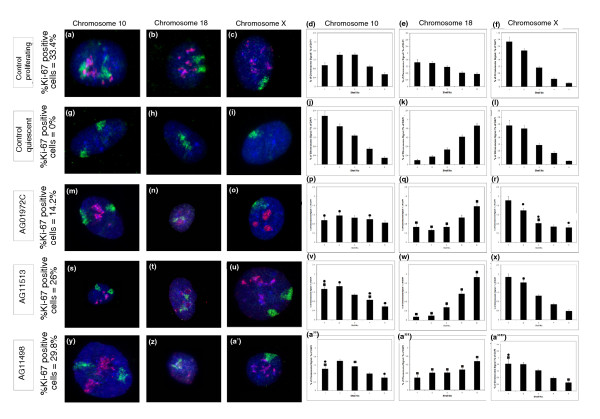
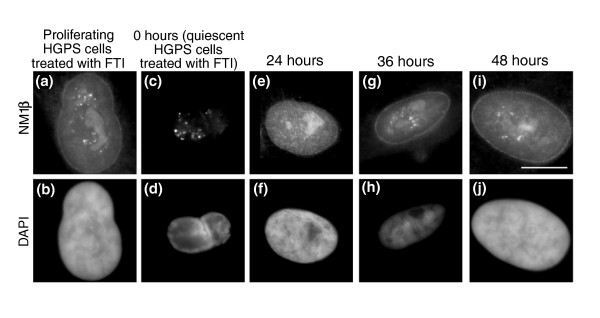
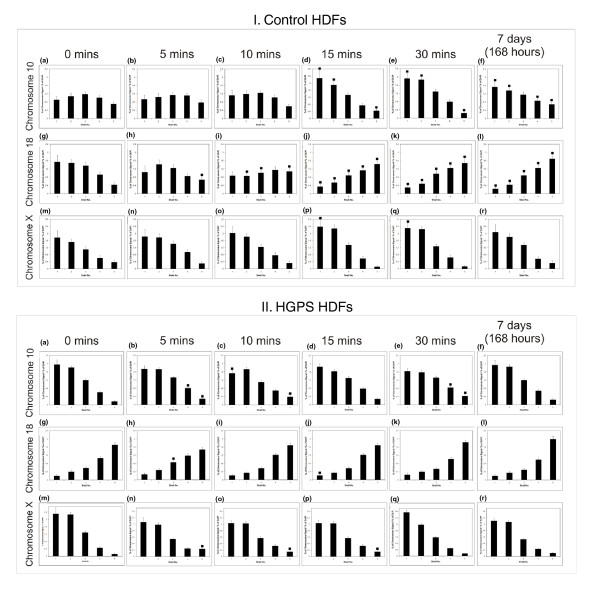
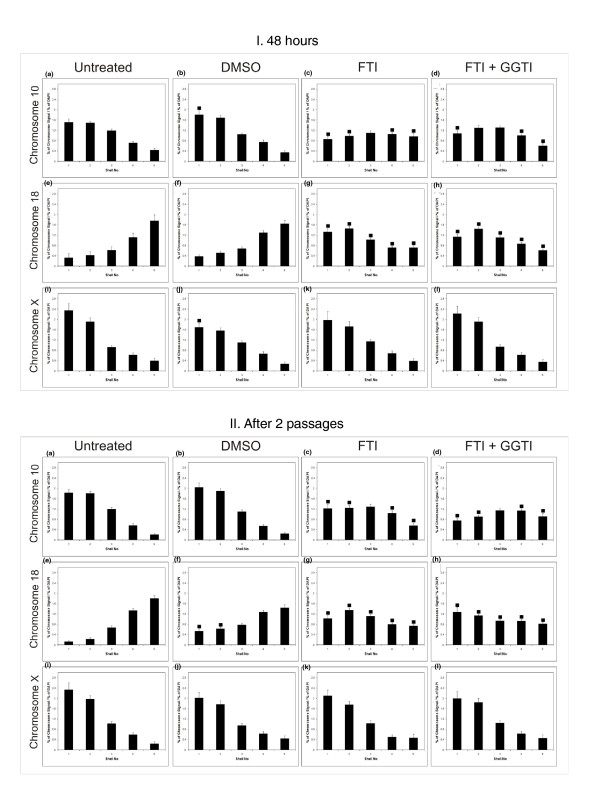
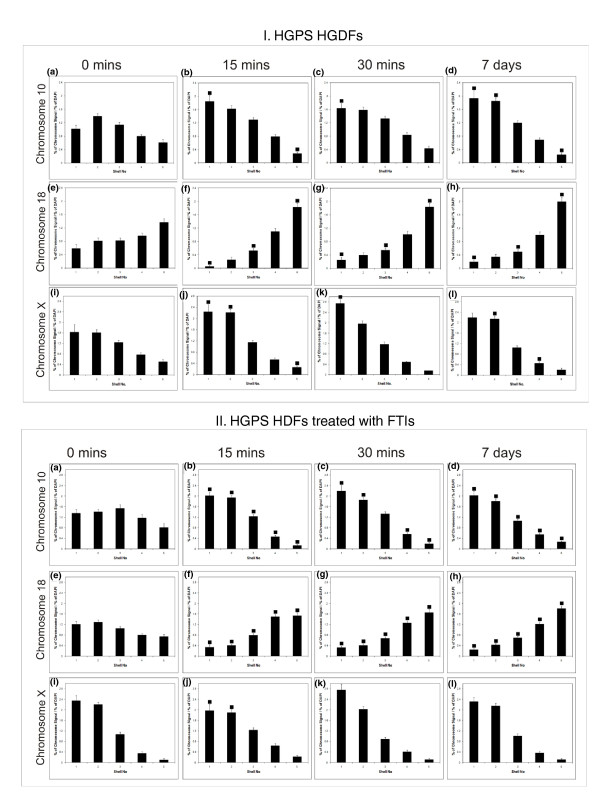
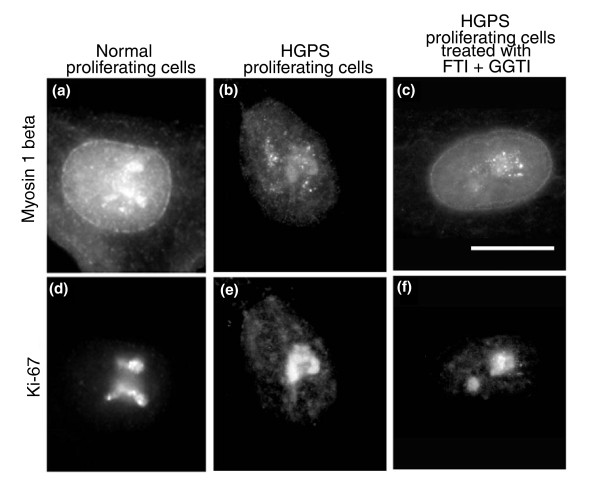
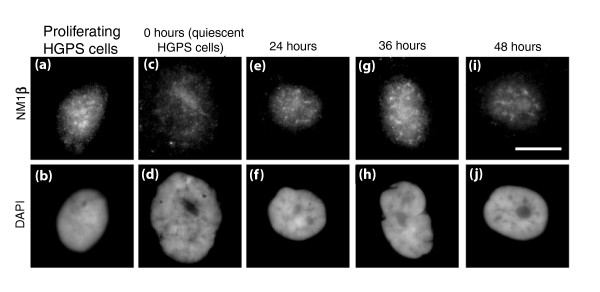
We have found that in proliferating fibroblasts derived from HGPS patients the nuclear location of interphase chromosomes differs from control proliferating cells and mimics that of control quiescent fibroblasts, with smaller chromosomes toward the nuclear interior and larger chromosomes toward the nuclear periphery. For this study we have treated HGPS fibroblasts with farnesyltransferase inhibitors and analyzed the nuclear location of individual chromosome territories. We have found that after exposure to farnesyltransferase inhibitors mis-localized chromosome territories were restored to a nuclear position akin to chromosomes in proliferating control cells. Furthermore, not only has this treatment afforded chromosomes to be repositioned but has also restored the machinery that controls their rapid movement upon serum removal. This machinery contains nuclear myosin 1β, whose distribution is also restored after farnesyltransferase inhibitor treatment of HGPS cells.
This study not only progresses the understanding of genome behavior in HGPS cells but demonstrates that interphase chromosome movement requires processed lamin A.
亨廷顿氏舞蹈症(Huntington's disease,HD)是一种影响儿童的早老综合征,导致早逝,通常是由于心肌梗死或中风,使这种综合征与正常衰老相似。Huntington 氏舞蹈症通常是由 A 型层粘连蛋白基因(LMNA)(G608G)的突变引起的。这导致异常截断的层粘连蛋白 A 蛋白,即 progerin 的表达。Progerin 不能像野生型前层粘连蛋白那样被加工,并且仍然被法尼基化,导致其在间期和有丝分裂期间的异常行为。法尼基转移酶抑制剂可防止法尼基化 progerin 的积累,产生毒性较小的蛋白质。
我们发现,在源自 HGPS 患者的增殖成纤维细胞中,间期染色体的核定位与对照增殖细胞不同,类似于对照静止成纤维细胞,较小的染色体朝向核内部,较大的染色体朝向核外部。对于这项研究,我们用法尼基转移酶抑制剂处理 HGPS 成纤维细胞,并分析了个体染色体区室的核定位。我们发现,在用法尼基转移酶抑制剂处理后,错误定位的染色体区室被恢复到类似于增殖对照细胞中染色体的核位置。此外,这种治疗不仅使染色体能够重新定位,而且还恢复了控制其在血清去除后快速运动的机制。该机制包含核肌球蛋白 1β,其在 HGPS 细胞用法尼基转移酶抑制剂处理后分布也得到恢复。
这项研究不仅推进了对 HGPS 细胞中基因组行为的理解,而且还证明了间期染色体运动需要经过处理的层粘连蛋白 A。