Department of Medical Parasitology, Medical Faculty, Université Cheikh Anta Diop, Dakar, Senegal.
Malar J. 2011 Aug 12;10:237. doi: 10.1186/1475-2875-10-237.
The use of artemisinin-based combination therapy (ACT) is currently recommended for treating uncomplicated malaria. The objective was to assess the efficacy and safety of repeated administrations of two fixed-dose presentations of ACT--artesunate plus amodiaquine (ASAQ) and artemether-lumefantrine (AL)--in subsequent episodes of Plasmodium falciparum malaria.
A randomized comparative study was conducted in a rural community of central Senegal from August 2007 to January 2009. Children and adults with uncomplicated P. falciparum malaria were randomized to receive open-label ASAQ once daily or AL twice daily for three days. Drug doses were given according to body weight. Treatments for first episodes were supervised. For subsequent episodes, only the first intake of study drug was supervised. ECGs and audiograms were performed in patients ≥ 12 years of age. Primary outcome was adequate clinical and parasitological response rate (ACPR) after polymerase chain reaction (PCR) correction on day 28 for the first episode.
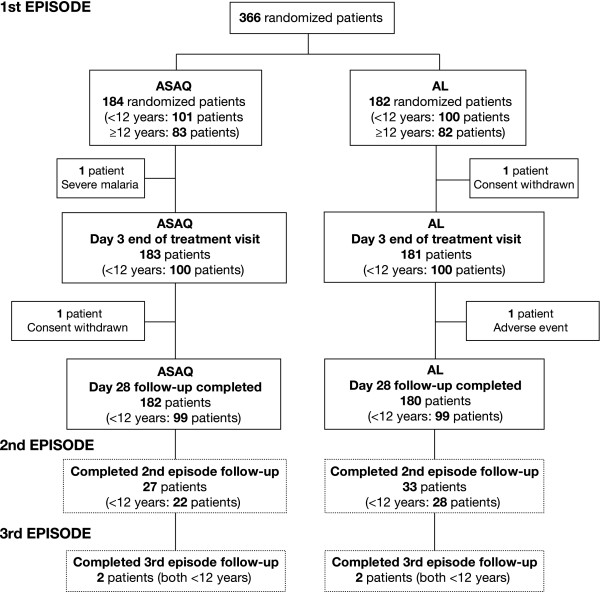
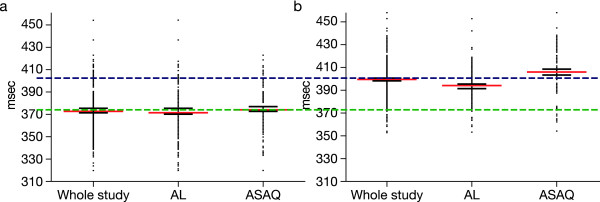
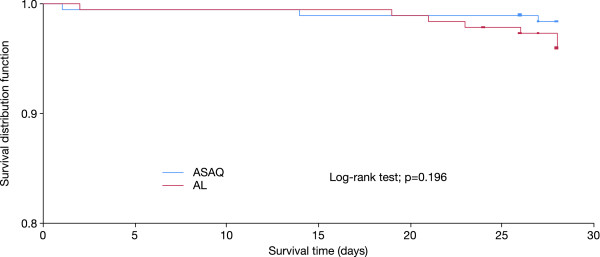
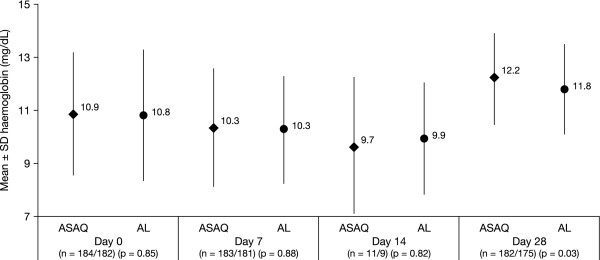
A total of 366 patients were enrolled in the two groups (ASAQ 184, AL 182) and followed up during two malaria transmission seasons. In the intent-to-treat population, PCR-corrected ACPRs at day 28 for the first episode were 98.4% and 96.2%, respectively, in the ASAQ and AL groups. For the per-protocol population (ASAQ 183, AL 182), PCR-corrected ACPRs at day 28 for the first episode were 98.9% and 96.7%, respectively. A 100% ACPR rate was obtained at day 28 in the 60 and four patients, respectively, who experienced second and third episodes. Treatment-related adverse events were reported in 11.7% of the patients, without significant differences between the two groups. A better improvement of haemoglobin at day 28 was noted in the ASAQ versus the AL group (12.2 versus 11.8 g/dL; p = 0.03). No sign of ototoxicity was demonstrated. A prolongation of the QTc interval was observed in both groups during treatment with no clinical consequence.
Study results confirmed the satisfactory efficacy and safety profile of ASAQ and AL. Moreover, in patients who were treated at least twice, repeated administration of ASAQ or AL did not identify any major safety issues.
ClinicalTrials.gov identifier NCT00540410.
目前推荐使用青蒿素为基础的联合疗法(ACT)治疗无并发症疟疾。本研究旨在评估两种固定剂量青蒿素复方制剂——青蒿琥酯阿莫地喹(ASAQ)和青蒿琥酯甲氟喹(AL)——在后续间日疟原虫疟疾发作时的疗效和安全性。
2007 年 8 月至 2009 年 1 月在塞内加尔中部一个农村社区进行了一项随机对照研究。患有无并发症恶性疟的儿童和成人被随机分配接受每日一次的 ASAQ 或每日两次的 AL 治疗 3 天。药物剂量根据体重给药。首次发作时接受治疗监督。对于后续发作,仅监督研究药物的首次摄入。≥12 岁的患者进行心电图和听力图检查。主要结局是聚合酶链反应(PCR)校正后第 28 天的首次发作的适当临床和寄生虫学应答率(ACPR)。
两组(ASAQ 184 例,AL 182 例)共 366 例患者入组,并在两个疟疾传播季节进行随访。意向治疗人群中,PCR 校正后第 28 天的首次发作的 ACPR 分别为 98.4%和 96.2%,ASAQ 组和 AL 组。对于方案人群(ASAQ 183 例,AL 182 例),PCR 校正后第 28 天的首次发作的 ACPR 分别为 98.9%和 96.7%。60 例和 4 例患者分别在第二次和第三次发作时获得了 100%的 ACPR 率。两组患者的治疗相关不良事件发生率分别为 11.7%,无显著差异。与 AL 组相比,ASAQ 组在第 28 天的血红蛋白改善更好(12.2 与 11.8 g/dL;p=0.03)。未发现耳毒性迹象。在两组中,治疗期间 QTc 间期延长,但无临床后果。
研究结果证实了 ASAQ 和 AL 的满意疗效和安全性。此外,在至少接受两次治疗的患者中,重复给予 ASAQ 或 AL 未发现任何重大安全性问题。
ClinicalTrials.gov 标识符 NCT00540410。