Division of Malaria and Parasitic Diseases, National Institute of Health, Korea Centers for Disease Control and Prevention, Cheongwon-gun 363-951, Republic of Korea.
Malar J. 2012 May 25;11:174. doi: 10.1186/1475-2875-11-174.
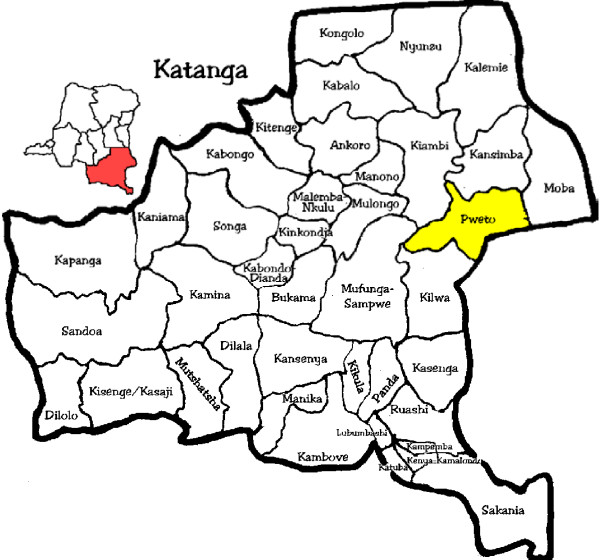
In 2005, the Democratic Republic of Congo (DRC) adopted artesunate and amodiaquine (ASAQ) as first-line anti-malarial treatment. In order to compare the efficacy of the fixed-dose formulation ASAQ versus artemether-lumefantrine (AL), a randomized, non-inferiority open-label trial was conducted in Katanga.
Children aged six and 59 months with uncomplicated Plasmodium falciparum malaria were enrolled and randomly allocated into one of the two regimens. The risk of recurrent parasitaemia by day 42, both unadjusted and adjusted by PCR genotyping to distinguish recrudescence from new infection, was analysed.
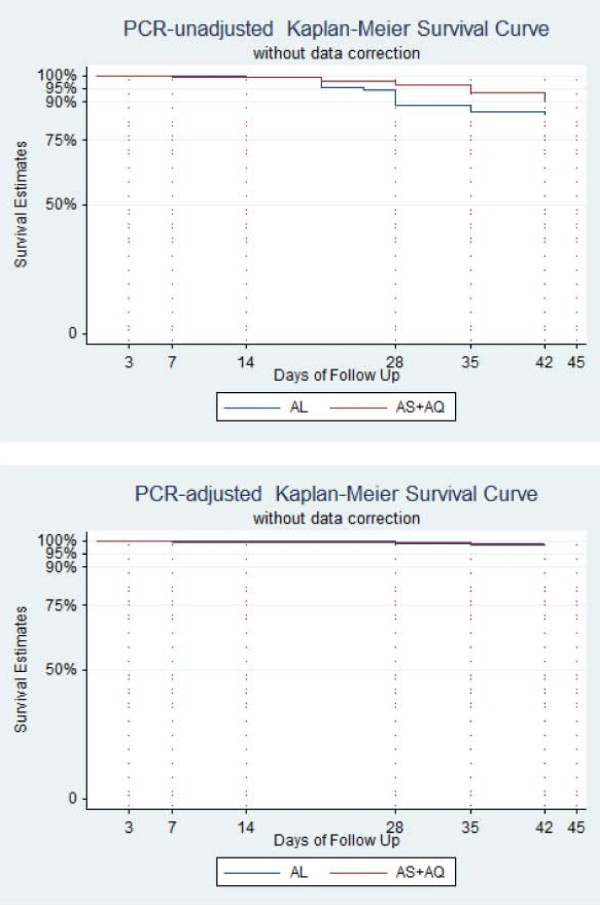
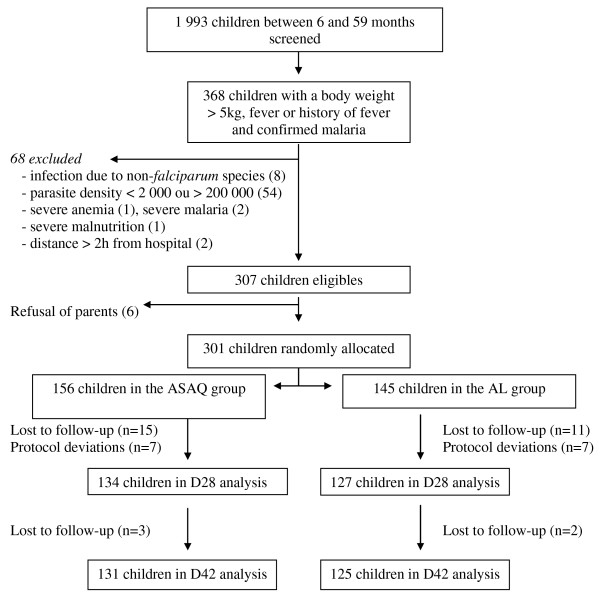
Between April 2008 and March 2009, 301 children were included: 156 with ASAQ and 145 with AL. No early treatment failures were reported. Among the 256 patients followed-up at day 42, 32 patients developed late clinical or parasitological failure (9.9% (13/131) in the ASAQ group and 15.2% (19/125) in the AL group). After PCR correction, cure rates were 98.3% (95%CI, 94.1-99.8) in the ASAQ group and 99.1% (95%CI, 94.9-99.9) in the AL group (difference -0.7%, one sided 95% CI -3.1). Kaplan-Meier PCR-adjusted cure rates were similar. Both treatment regimens were generally well tolerated.
Both ASAQ and AL are highly effective and currently adequate as the first-line treatment of uncomplicated falciparum malaria in this area of Katanga, DRC. However, in a very large country, such as DRC, and because of possible emergence of resistance from other endemic regions, surveillance of efficacy of artemisinin-based combination treatments, including other evaluations of the resistance of ASAQ, need to be done in other provinces.
The protocol was registered with the clinicaltrials.gov, open clinical trial registry under the identifier number NCT01567423.
2005 年,刚果民主共和国(DRC)采用青蒿琥酯和阿莫地喹(ASAQ)作为一线抗疟治疗药物。为了比较固定剂量配方 ASAQ 与青蒿琥酯-甲氟喹(AL)的疗效,在加丹加省进行了一项随机、非劣效性、开放性标签试验。
招募年龄在 6 至 59 个月、患有无并发症恶性疟原虫疟疾的儿童,并将其随机分配到两种方案之一。通过聚合酶链反应基因分型来分析第 42 天无复发性寄生虫血症的风险,该方法既可以未经调整分析,也可以调整分析以区分复发和新感染。
2008 年 4 月至 2009 年 3 月,共有 301 名儿童入组:ASAQ 组 156 名,AL 组 145 名。没有报告早期治疗失败。在随访至第 42 天的 256 名患者中,有 32 名患者出现晚期临床或寄生虫学失败(ASAQ 组 9.9%(13/131),AL 组 15.2%(19/125))。经 PCR 校正后,ASAQ 组的治愈率为 98.3%(95%CI,94.1-99.8),AL 组为 99.1%(95%CI,94.9-99.9)(差异-0.7%,单侧 95%CI-3.1%)。Kaplan-Meier PCR 校正后的治愈率相似。两种治疗方案均具有良好的耐受性。
ASAQ 和 AL 均具有高度疗效,目前是刚果民主共和国加丹加地区治疗无并发症恶性疟的一线治疗药物。然而,在像刚果民主共和国这样的大国,并且由于可能会从其他流行地区出现抗药性,需要对基于青蒿素的联合治疗的疗效进行监测,包括对 ASAQ 抗药性的其他评估,在其他省份也需要进行此类监测。
该方案在 clinicaltrials.gov 注册,开放性临床试验注册登记号为 NCT01567423。