Molecular and Cellular Biology Graduate Program, University of Washington, Seattle, Washington 98195, USA.
Genetics. 2011 Oct;189(2):521-32. doi: 10.1534/genetics.111.129841. Epub 2011 Aug 11.
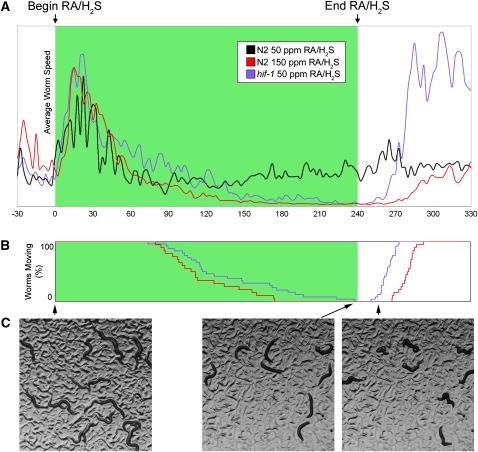
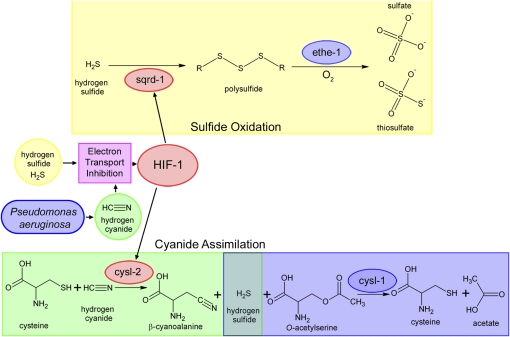
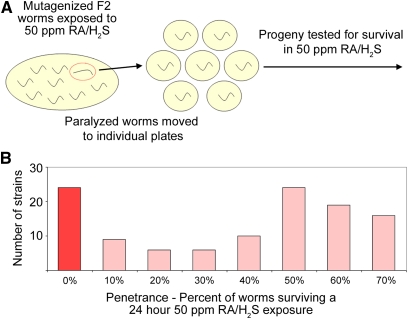
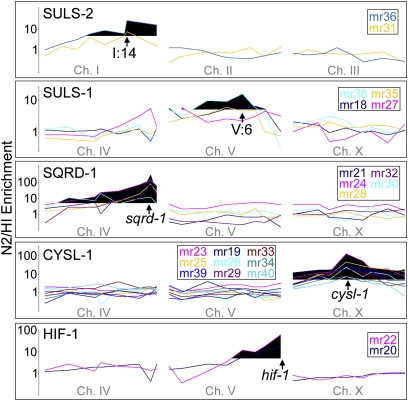
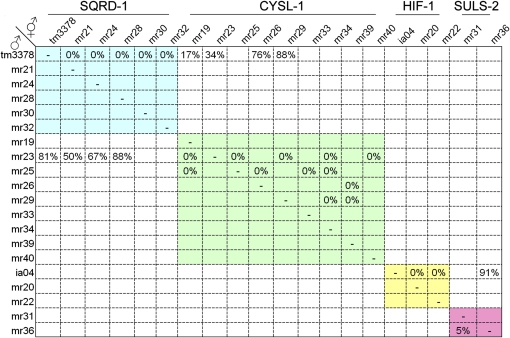
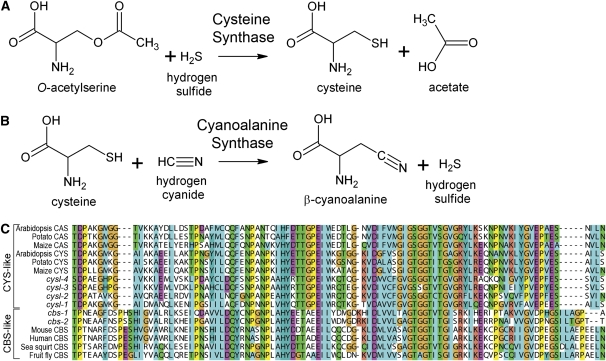
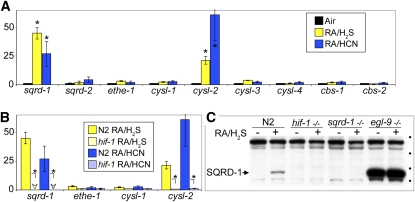
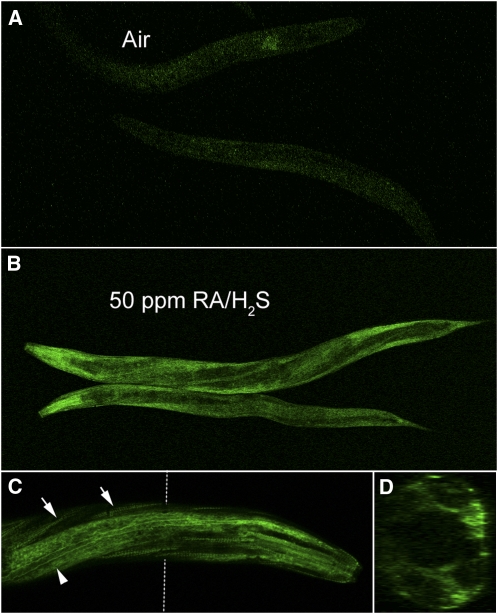
Hydrogen sulfide (H2S), an endogenously produced small molecule, protects animals from various stresses. Recent studies demonstrate that animals exposed to H2S are long lived, resistant to hypoxia, and resistant to ischemia-reperfusion injury. We performed a forward genetic screen to gain insights into the molecular mechanisms Caenorhabditis elegans uses to appropriately respond to H2S. At least two distinct pathways appear to be important for this response, including the H2S-oxidation pathway and the hydrogen cyanide (HCN)-assimilation pathway. The H2S-oxidation pathway requires two distinct enzymes important for the oxidation of H2S: the sulfide:quinone reductase sqrd-1 and the dioxygenase ethe-1. The HCN-assimilation pathway requires the cysteine synthase homologs cysl-1 and cysl-2. A low dose of either H2S or HCN can activate hypoxia-inducible factor 1 (HIF-1), which is required for C. elegans to respond to either gas. sqrd-1 and cysl-2 represent the entry points in the H2S-oxidation and HCN-assimilation pathways, respectively, and expression of both of these enzymes is highly induced by HIF-1 in response to both H2S and HCN. In addition to their role in appropriately responding to H2S and HCN, we found that cysl-1 and cysl-2 are both essential mediators of innate immunity against fast paralytic killing by Pseudomonas. Furthermore, in agreement with these data, we showed that growing worms in the presence of H2S is sufficient to confer resistance to Pseudomonas fast paralytic killing. Our results suggest the hypoxia-independent hif-1 response in C. elegans evolved to respond to the naturally occurring small molecules H2S and HCN.
硫化氢(H2S)是一种内源性产生的小分子,可保护动物免受各种应激。最近的研究表明,暴露于 H2S 的动物寿命更长,对缺氧、缺血再灌注损伤具有抗性。我们进行了正向遗传筛选,以深入了解秀丽隐杆线虫(Caenorhabditis elegans)适当应对 H2S 的分子机制。至少有两种不同的途径似乎对这种反应很重要,包括 H2S 氧化途径和氢氰酸(HCN)同化途径。H2S 氧化途径需要两种不同的酶,它们对 H2S 的氧化很重要:硫化物:醌还原酶 sqrd-1 和双加氧酶 ethe-1。HCN 同化途径需要半胱氨酸合酶同源物 cysl-1 和 cysl-2。低剂量的 H2S 或 HCN 都可以激活缺氧诱导因子 1(HIF-1),这是秀丽隐杆线虫对这两种气体产生反应所必需的。sqrd-1 和 cysl-2 分别代表 H2S 氧化和 HCN 同化途径的入口点,这两种酶的表达都高度诱导 HIF-1 对 H2S 和 HCN 的反应。除了在适当应对 H2S 和 HCN 方面的作用外,我们还发现 cysl-1 和 cysl-2 都是秀丽隐杆线虫固有免疫对假单胞菌快速瘫痪杀伤的重要介导物。此外,与这些数据一致,我们表明在 H2S 存在的情况下培养蠕虫足以赋予其对假单胞菌快速瘫痪杀伤的抗性。我们的结果表明,秀丽隐杆线虫中缺氧非依赖的 hif-1 反应是为了应对自然发生的小分子 H2S 和 HCN 而进化的。