Cancer Control and Population Science Research Program, Huntsman Cancer Institute, Salt Lake City, UT 84112, USA.
Cancer Epidemiol Biomarkers Prev. 2011 Sep;20(9):1838-49. doi: 10.1158/1055-9965.EPI-11-0239. Epub 2011 Aug 15.
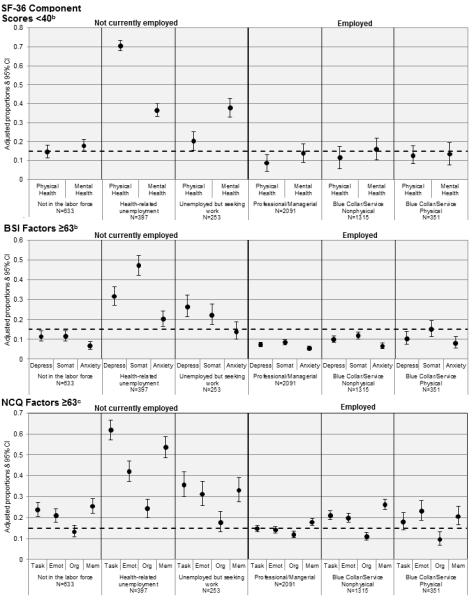
We examined the relationship of physical, mental, and neurocognitive function with employment and occupational status in the Childhood Cancer Survivor Study.
We included survivors 25 years or older with available short form-36 (physical and mental health component scores), brief symptom inventory (depression, anxiety, and somatization), and neurocognitive questionnaire (task efficiency, emotional regulation, organization, and memory). We generated relative risks (RR) from generalized linear models for these measures on unemployment (n = 5,386) and occupation (n = 3,763) outcomes adjusted for demographic and cancer-related factors and generated sex-stratified models.
Poor physical health was associated with an almost eightfold higher risk of health-related unemployment (P < 0.001) compared to survivors with normal physical health. Male survivors with somatization and memory problems were approximately 50% (P < 0.05 for both) more likely to report this outcome, whereas task efficiency limitations were significant for both sexes (males: RR = 2.43, P < 0.001; females: RR = 2.28, P < 0.001). Employed female survivors with task efficiency, emotional regulation, and memory limitations were 13% to 20% (P < 0.05 for all) less likely to work in professional or managerial occupations than unaffected females.
Physical problems may cause much of the health-related unemployment among childhood cancer survivors. Whereas both male and female survivors with neurocognitive deficits--primarily in task efficiencies--are at risk for unemployment, employed female survivors with neurocognitive deficits may face poor occupational outcomes more often than males.
Childhood cancer survivors are at risk for poor employment outcomes. Screening and intervention for physical, mental, and neurocognitive limitations could improve employment outcomes for this population.
我们研究了身体、心理和神经认知功能与就业和职业状况在儿童癌症幸存者研究中的关系。
我们纳入了年龄在 25 岁或以上且有简易 36 项健康调查(身体和心理健康组成部分评分)、简明症状问卷(抑郁、焦虑和躯体化)和神经认知问卷(任务效率、情绪调节、组织和记忆)的幸存者。我们根据一般线性模型生成这些措施在失业(n = 5386)和职业(n = 3763)结果上的相对风险(RR),并根据人口统计学和癌症相关因素进行调整,并生成了性别分层模型。
与身体状况正常的幸存者相比,身体状况不佳与健康相关的失业风险增加近八倍(P < 0.001)。有躯体化和记忆问题的男性幸存者报告这种结果的可能性约增加 50%(两者均为 P < 0.05),而任务效率受限对两性均有显著意义(男性:RR = 2.43,P < 0.001;女性:RR = 2.28,P < 0.001)。患有任务效率、情绪调节和记忆障碍的在职女性幸存者从事专业或管理职业的可能性比未受影响的女性低 13%至 20%(均为 P < 0.05)。
身体问题可能导致儿童癌症幸存者中大部分与健康相关的失业。患有神经认知缺陷的男性和女性幸存者(主要是在任务效率方面)都面临失业风险,而患有神经认知缺陷的在职女性幸存者可能比男性更常面临较差的职业结果。
儿童癌症幸存者面临较差的就业结果。对身体、心理和神经认知障碍进行筛查和干预可能会改善这一人群的就业结果。