Frobisher Clare, Lancashire Emma R, Jenkinson Helen, Winter David L, Kelly Julie, Reulen Raoul C, Hawkins Michael M
Department of Public Health, Epidemiology and Biostatistics, Centre for Childhood Cancer Survivor Studies, Institute of Applied Health Research, University of Birmingham, Birmingham, B15 2TT, United Kingdom.
Department of Public Health, Epidemiology and Biostatistics, WAVES study office, Institute of Applied Health Research, University of Birmingham, Birmingham, B15 2TT, United Kingdom.
Int J Cancer. 2017 Jun 15;140(12):2678-2692. doi: 10.1002/ijc.30696. Epub 2017 Apr 7.
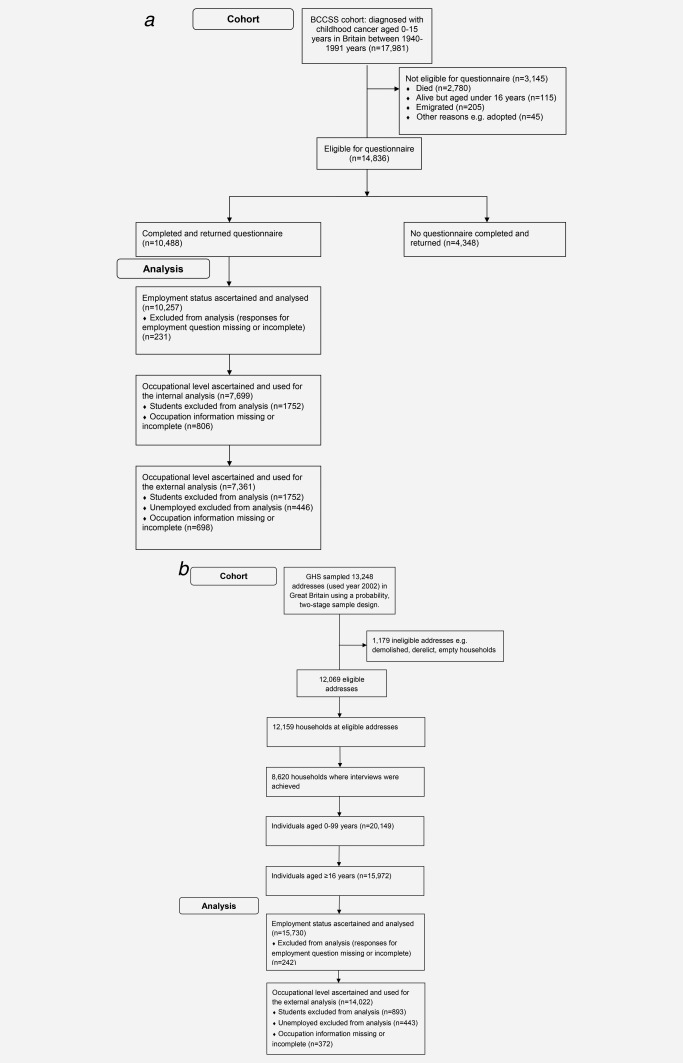
The British Childhood Cancer Survivor Study (BCCSS) provides the first detailed investigation of employment and occupation to be undertaken in a large population-based cohort. Previous studies have been limited by design issues such as using small numbers of survivors with specific diagnoses, and involved limited assessment of employment status and occupational level. The BCCSS includes 17,981 5-year survivors of childhood cancer. Employment status and occupational level were ascertained by questionnaire from eligible survivors (n = 14,836). Multivariate logistic regression was used to explore factors associated with employment and occupation, and to compare survivors to their demographic peers in the general population. Employment status was available for 10,257 survivors. Gender, current age, cancer type, radiotherapy, age at diagnosis and epilepsy were consistently associated with being: employed; unable to work; in managerial or non-manual occupations. Overall, survivors were less likely to be working than expected (OR (99% CI): 0.89 (0.81-0.98)), and this deficit was greatest for irradiated CNS neoplasm survivors (0.34 (0.28-0.41)). Compared to the general population, survivors were fivefold more likely to be unable to work due to illness/disability; the excess was 15-fold among CNS neoplasm survivors treated with radiotherapy. Overall survivors were less likely to be in managerial occupations than expected (0.85 (0.77-0.94)). However, bone sarcoma survivors were more likely to be in these occupations than expected (1.37 (1.01-1.85)) and also similarly for non-manual occupations (1.90 (1.37-2.62)). Survivors of retinoblastoma (1.55 (1.20-2.01)) and 'other' neoplasm group (1.62 (1.30-2.03)) were also more likely to be in non-manual occupations than expected.
英国儿童癌症幸存者研究(BCCSS)首次对大量基于人群的队列中的就业和职业情况进行了详细调查。以往的研究因设计问题受到限制,比如使用特定诊断的少量幸存者,且就业状况和职业水平评估有限。BCCSS纳入了17981名儿童癌症5年幸存者。通过问卷调查确定了符合条件的幸存者(n = 14836)的就业状况和职业水平。采用多变量逻辑回归来探究与就业和职业相关的因素,并将幸存者与其在一般人群中的人口统计学同龄人进行比较。10257名幸存者的就业状况数据可用。性别、当前年龄、癌症类型、放疗、诊断时年龄和癫痫与以下情况始终相关:就业;无法工作;从事管理或非体力职业。总体而言,幸存者工作的可能性低于预期(比值比(99%可信区间):0.89(0.81 - 0.98)),这种不足在接受放疗的中枢神经系统肿瘤幸存者中最为明显(0.34(0.28 - 0.41))。与一般人群相比,幸存者因疾病/残疾无法工作的可能性高出五倍;在接受放疗的中枢神经系统肿瘤幸存者中,这一比例高出15倍。总体而言,幸存者从事管理职业的可能性低于预期(0.85(0.77 - 0.94))。然而,骨肉瘤幸存者从事这些职业的可能性高于预期(1.37(1.01 - 1.85)),从事非体力职业的情况也类似(1.90(1.37 - 2.62))。视网膜母细胞瘤幸存者(1.55(1.20 - 2.01))和“其他”肿瘤组(1.62(1.30 - 2.03))从事非体力职业的可能性也高于预期。