Division of Obstetrics and Gynecology, Department of Clinical and Experimental Medicine, Faculty of Health Sciences, Linköping University, SE-581 83 Linköping, Sweden.
Reprod Health. 2011 Aug 16;8:23. doi: 10.1186/1742-4755-8-23.
Women aged 40-44 years in 2005 ought to have been subjected to much more influence on attitudes and knowledge on contraceptive methods during their fertile period than women who were in the same age span in 1975 when the abortion laws were introduced.
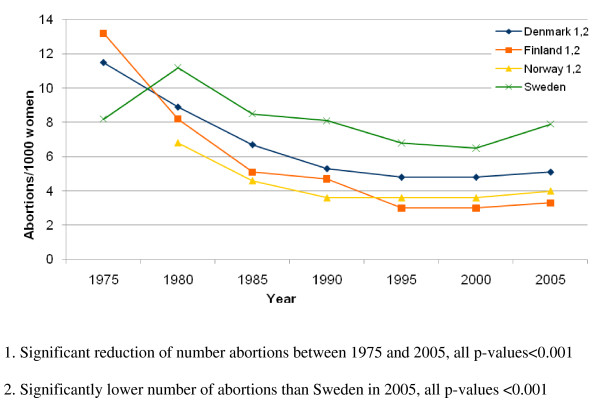
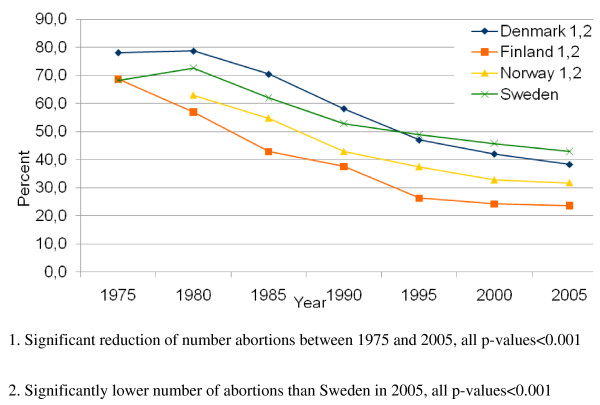
From official statistics, the rates of induced abortion and birth rates in women aged 40-44 years were collected for Sweden, Denmark, Norway and Finland for each five-year during the period 1975-2005.
With the exception of Sweden all other studied Scandinavian countries have lowered their abortion rates since 1975 (p<0.001) and reduced the proportion of induced abortions in relation to birth rate (p<0.001). In 2005 these countries also had lower rates of induced abortion than Sweden in the age group 40-44 years (p<0.001).
There is a significant change in rates of induced abortion in women aged 40-44 years in Finland, Norway, Denmark, and at status quo in Sweden. 40-44 years in Finland, Norway, Denmark, and at status quo in Sweden. This indicates that family planning programs works well in the Nordic countries. The differences found may be assumed to possible diverging focus on attitudes or ethical considerations.
2005 年时,40-44 岁的女性应该比 1975 年引入堕胎法时同年龄段的女性受到更多关于避孕方法的态度和知识的影响。
从官方统计数据中,收集了瑞典、丹麦、挪威和芬兰的 40-44 岁女性的人工流产率和出生率数据,每个年龄段的数据都是在 1975-2005 年期间的每五年进行收集的。
除瑞典外,所有其他研究的斯堪的纳维亚国家自 1975 年以来都降低了堕胎率(p<0.001),并减少了与出生率相关的人工流产比例(p<0.001)。2005 年,这些国家 40-44 岁年龄组的人工流产率也低于瑞典(p<0.001)。
芬兰、挪威、丹麦的 40-44 岁女性的人工流产率有显著变化,而瑞典则处于稳定状态。这表明计划生育方案在北欧国家运作良好。所发现的差异可能归因于对态度或伦理考虑的不同关注。