Department of Obstetrics and Gynaecology, University of Tartu, L, Puusepa 8, Tartu 51014, Estonia.
BMC Womens Health. 2014 Jul 9;14:81. doi: 10.1186/1472-6874-14-81.
The study aimed to describe the overall and age-specific trends of induced abortions from 1996 to 2011 with an emphasis on socio-demographic characteristics and contraceptive use of women having had repeat abortions in Estonia.
Data were retrieved from the Estonian Medical Birth and Abortion Registry and Statistics Estonia. Total induced abortion numbers, rates, ratios and age-specific rates are presented for 1996-2011. The percentage change in the number of repeat abortions within selected socio-demographic subgroups, contraception use and distribution of induced abortions among Estonians and non-Estonians for the first, second, third, fourth and subsequent abortions were calculated for the periods 1996-2003 and 2004-2011.
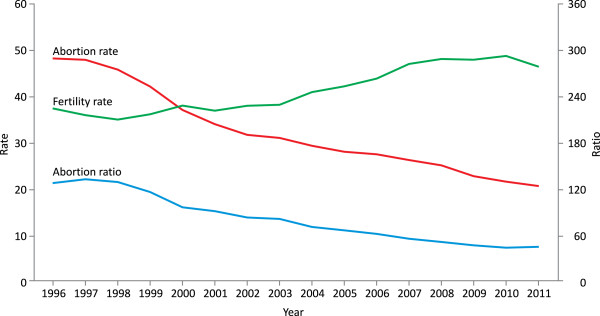
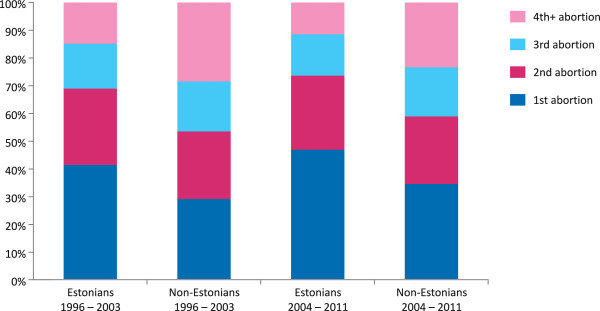
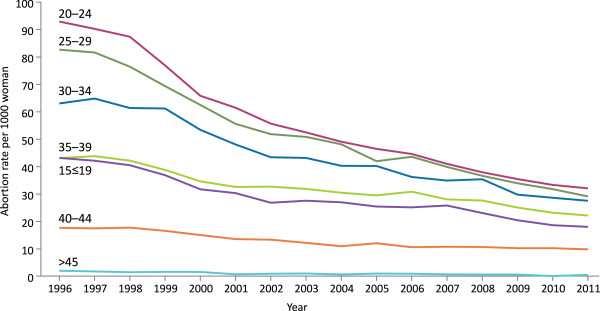
Observed trends over the 16-year study period indicated a considerable decline in induced abortions with a reduction in abortion rate of 57.1%, which was mainly attributed to younger cohorts. The percentage of women undergoing repeat abortions fell steadily from 63.8% during 1996-2003 to 58.0% during 2004-2011. The percentage of women undergoing repeat abortions significantly decreased over the 16 years within all selected socio-demographic subgroups except among women with low educational attainment and students. Within each time period, a greater percentage of non-Estonians than Estonians underwent repeat abortions and obtained third and subsequent abortions. Most women did not use any contraceptive method prior to their first or subsequent abortion.
A high percentage of women obtaining repeat abortions reflects a high historical abortion rate. If current trends continue, a rapid decline in repeat abortions may be predicted. To decrease the burden of sexual ill health, routine contraceptive counselling, as standard care in the abortion process, should be seriously addressed with an emphasis on those groups--non-Estonians, women with lower educational attainment, students and women with children--vulnerable with respect to repeat abortion.
本研究旨在描述 1996 年至 2011 年期间人工流产的总体和特定年龄趋势,重点关注在爱沙尼亚有重复堕胎史的女性的社会人口特征和避孕措施使用情况。
数据来自爱沙尼亚医疗生育和堕胎登记处和爱沙尼亚统计中心。报告了 1996-2011 年期间的总人工流产数量、发生率、比例和特定年龄组的发生率。计算了在选定的社会人口亚组内重复堕胎数量、避孕措施使用情况以及爱沙尼亚人和非爱沙尼亚人在首次、第二次、第三次、第四次和后续堕胎中的分布百分比变化,时间范围分别为 1996-2003 年和 2004-2011 年。
在 16 年的研究期间观察到的趋势表明,人工流产数量显著下降,流产率下降了 57.1%,这主要归因于年轻人群。重复堕胎的女性比例从 1996-2003 年的 63.8%稳步下降到 2004-2011 年的 58.0%。在所有选定的社会人口亚组中,除了教育程度较低的女性和学生外,16 年内重复堕胎的女性比例都显著下降。在每个时期,非爱沙尼亚人比爱沙尼亚人更有可能进行重复堕胎,并获得第三次和后续堕胎。大多数女性在首次或后续堕胎前没有使用任何避孕方法。
高比例的女性进行重复堕胎反映了较高的历史堕胎率。如果当前趋势持续下去,重复堕胎的数量可能会迅速下降。为了减少性健康不良的负担,应认真解决常规避孕咨询问题,将其作为堕胎过程中的标准护理,特别关注那些容易发生重复堕胎的群体,如非爱沙尼亚人、教育程度较低的女性、学生和有子女的女性。