Monash Injury Research Institute, Monash University, Victoria 3800, Australia.
BMC Geriatr. 2011 Aug 18;11:45. doi: 10.1186/1471-2318-11-45.
Community-dwelling older people aged 65+ years sustain falls frequently; these can result in physical injuries necessitating medical attention including emergency department care and hospitalisation. Certain health conditions and impairments have been shown to contribute independently to the risk of falling or experiencing a fall injury, suggesting that individuals with these conditions or impairments should be the focus of falls prevention. Since older people commonly have multiple conditions/impairments, knowledge about which conditions/impairments coexist in at-risk individuals would be valuable in the implementation of a targeted prevention approach. The objective of this study was therefore to examine the prevalence and patterns of comorbidity in this population group.
We analysed hospitalisation data from Victoria, Australia's second most populous state, to estimate the prevalence of comorbidity in patients hospitalised at least once between 2005-6 and 2007-8 for treatment of acute fall-related injuries. In patients with two or more comorbid conditions (multicomorbidity) we used an agglomerative hierarchical clustering method to cluster comorbidity variables and identify constellations of conditions.
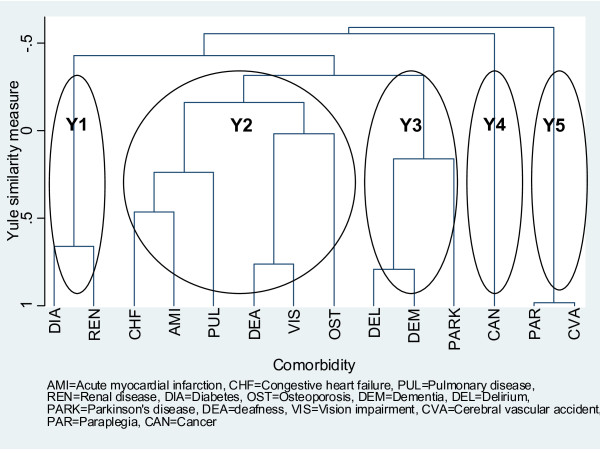
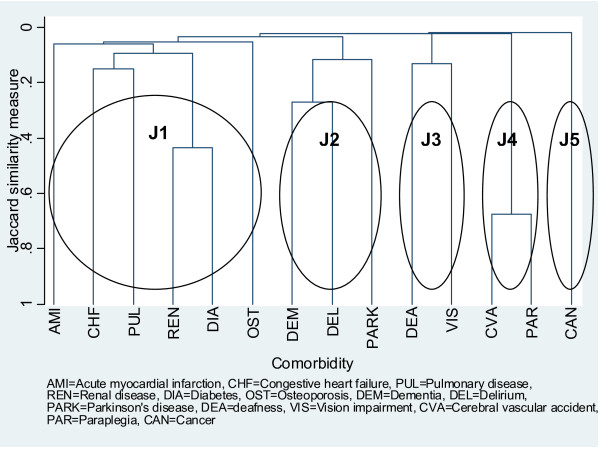
More than one in four patients had at least one comorbid condition and among patients with comorbidity one in three had multicomorbidity (range 2-7). The prevalence of comorbidity varied by gender, age group, ethnicity and injury type; it was also associated with a significant increase in the average cumulative length of stay per patient. The cluster analysis identified five distinct, biologically plausible clusters of comorbidity: cardiopulmonary/metabolic, neurological, sensory, stroke and cancer. The cardiopulmonary/metabolic cluster was the largest cluster among the clusters identified.
The consequences of comorbidity clustering in terms of falls and/or injury outcomes of hospitalised patients should be investigated by future studies. Our findings have particular relevance for falls prevention strategies, clinical practice and planning of follow-up services for these patients.
居住在社区中的 65 岁及以上老年人经常发生跌倒;这些跌倒可能导致需要医疗关注的身体伤害,包括急诊护理和住院治疗。某些健康状况和损伤已被证明独立增加跌倒或跌倒受伤的风险,这表明有这些状况或损伤的个体应成为跌倒预防的重点。由于老年人通常有多种状况/损伤,了解处于风险中的个体中哪些状况/损伤共存将有助于实施有针对性的预防方法。因此,本研究的目的是检查该人群群体的共病患病率和模式。
我们分析了澳大利亚第二大人口州维多利亚州的住院数据,以估计 2005-6 年至 2007-8 年期间因急性跌倒相关伤害接受至少一次住院治疗的患者的共病患病率。对于患有两种或多种合并症(多重合并症)的患者,我们使用聚集层次聚类方法对合并症变量进行聚类,并确定疾病的组合。
超过四分之一的患者至少有一种合并症,而患有合并症的患者中,有三分之一患有多重合并症(范围为 2-7)。合并症的患病率因性别、年龄组、种族和伤害类型而异;它还与每位患者平均累积住院时间的显著增加相关。聚类分析确定了五个不同的、生物学上合理的合并症簇:心肺/代谢、神经、感觉、中风和癌症。心肺/代谢簇是所确定的簇中最大的簇。
未来的研究应调查住院患者合并症聚类在跌倒和/或伤害结果方面的后果。我们的研究结果对跌倒预防策略、临床实践和这些患者的随访服务规划具有特殊意义。