Center for Advanced Imaging, West Virginia University Morgantown, WV, USA.
Front Hum Neurosci. 2011 Aug 5;5:68. doi: 10.3389/fnhum.2011.00068. eCollection 2011.
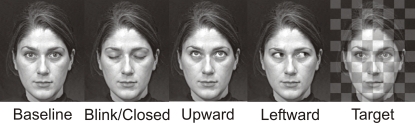
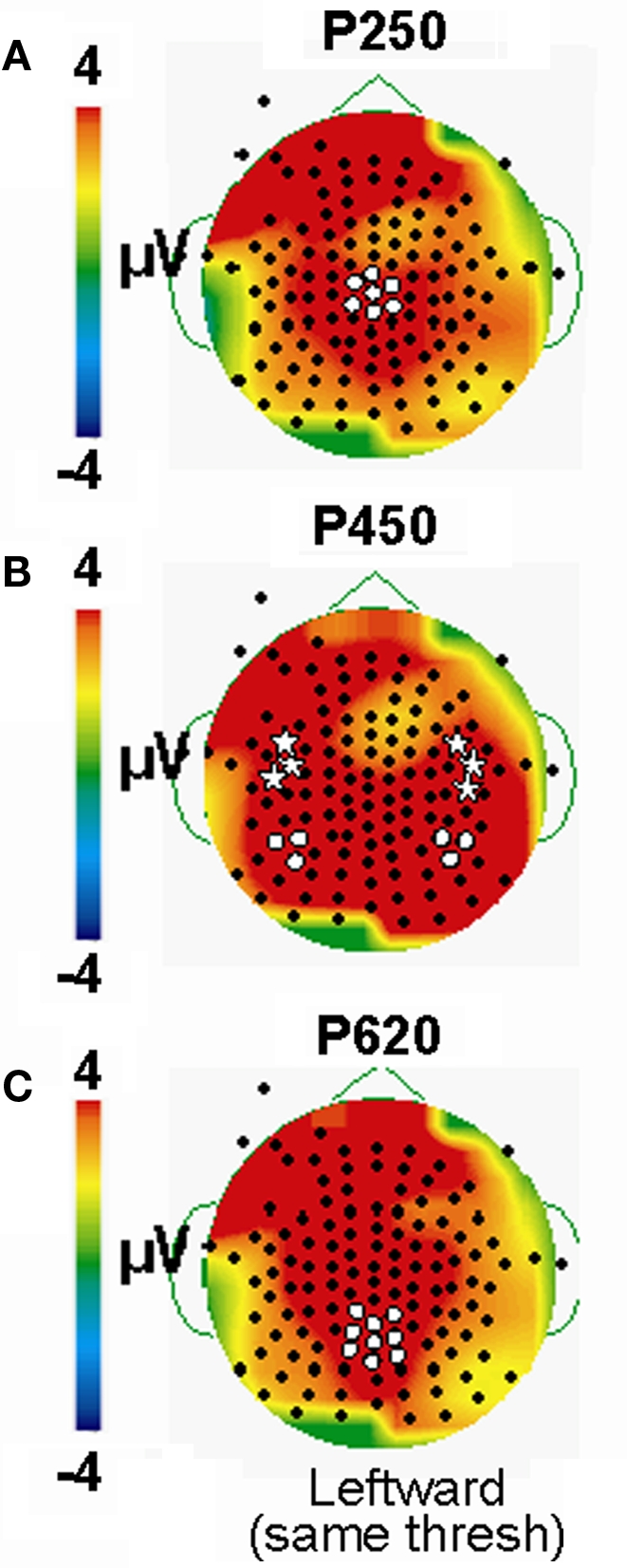
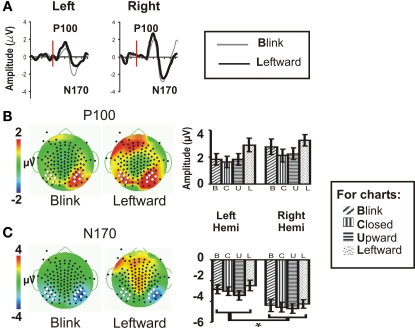
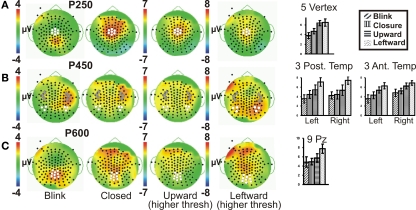
Facial movements have the potential to be powerful social signals. Previous studies have shown that eye gaze changes and simple mouth movements can elicit robust neural responses, which can be altered as a function of potential social significance. Eye blinks are frequent events and are usually not deliberately communicative, yet blink rate is known to influence social perception. Here, we studied event-related potentials (ERPs) elicited to observing non-task relevant blinks, eye closure, and eye gaze changes in a centrally presented natural face stimulus. Our first hypothesis (H1) that blinks would produce robust ERPs (N170 and later ERP components) was validated, suggesting that the brain may register and process all types of eye movement for potential social relevance. We also predicted an amplitude gradient for ERPs as a function of gaze change, relative to eye closure and then blinks (H2). H2 was only partly validated: large temporo-occipital N170s to all eye change conditions were observed and did not significantly differ between blinks and other conditions. However, blinks elicited late ERPs that, although robust, were significantly smaller relative to gaze conditions. Our data indicate that small and task-irrelevant facial movements such as blinks are measurably registered by the observer's brain. This finding is suggestive of the potential social significance of blinks which, in turn, has implications for the study of social cognition and use of real-life social scenarios.
面部运动具有成为强大社会信号的潜力。先前的研究表明,注视方向的改变和简单的嘴部运动可以引起强烈的神经反应,而这些反应可以根据潜在的社会意义而改变。眨眼是频繁发生的事件,通常不是故意的交流,但眨眼频率已知会影响社会感知。在这里,我们研究了在中央呈现自然面部刺激中观察到的非任务相关眨眼、闭眼和注视方向变化时诱发的事件相关电位(ERP)。我们的第一个假设(H1)是眨眼会产生强烈的 ERP(N170 和后来的 ERP 成分),这表明大脑可能会注册和处理所有类型的眼球运动,以寻找潜在的社会相关性。我们还预测了 ERP 的幅度梯度作为注视变化的函数,相对于闭眼,然后是眨眼(H2)。H2 仅部分得到验证:观察到所有眼动变化条件下的大型颞枕部 N170,并且眨眼和其他条件之间没有显著差异。然而,眨眼引发了后期 ERP,尽管很强烈,但与注视条件相比明显较小。我们的数据表明,观察者的大脑可以测量到小的、与任务无关的面部运动,如眨眼。这一发现表明眨眼具有潜在的社会意义,这反过来又对社会认知研究和真实社交场景的使用具有启示意义。