Hudek-Knezević Jasna, Kalebić Maglica Barbara, Krapić Nada
University of Rijeka, Faculty of Arts and Sciences, Department of Psychology, Slavka Krautzeka b.b., 51000 Rijeka, Croatia.
Croat Med J. 2011 Aug 15;52(4):538-49. doi: 10.3325/cmj.2011.52.538.
To examine to what extent personality traits (extraversion, agreeableness, conscientiousness, neuroticism, and openness), organizational stress, and attitudes toward work and interactions between personality and either organizational stress or attitudes toward work prospectively predict 3 components of burnout.
The study was carried out on 118 hospital nurses. Data were analyzed by a set of hierarchical regression analyses, in which personality traits, measures of organizational stress, and attitudes toward work, as well as interactions between personality and either organizational stress or attitudes toward work were included as predictors, while 3 indices of burnout were measured 4 years later as criteria variables.
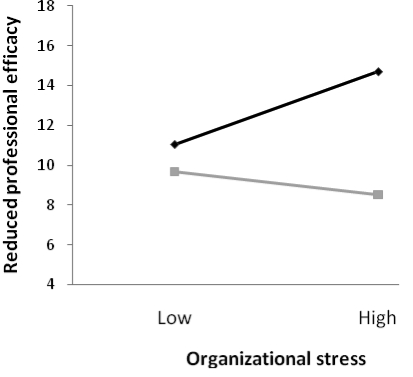
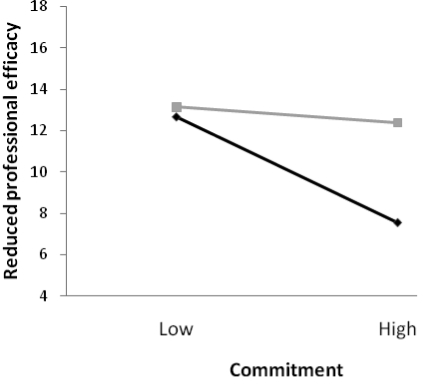
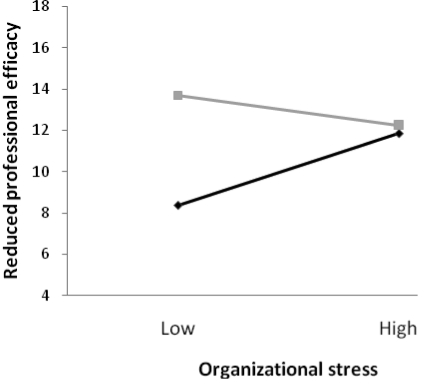
Personality traits proved to be significant but weak prospective predictors of burnout and as a group predicted only reduced professional efficacy (R(2)=0.10), with agreeableness being a single negative predictor. Organizational stress was positive, affective-normative commitment negative predictor, while continuance commitment was not related to any dimension of burnout. We found interactions between neuroticism as well as conscientiousness and organizational stress, measured as role conflict and work overload, on reduced professional efficacy (βNRCWO=-0.30; βcRCWO=-0.26). We also found interactions between neuroticism and affective normative commitment (β=0.24) and between openness and continuance commitment on reduced professional efficacy (β=-0.23), as well as interactions between conscientiousness and continuance commitment on exhaustion.
Although contextual variables were strong prospective predictors and personality traits weak predictors of burnout, the results suggested the importance of the interaction between personality and contextual variables in predicting burnout.
探讨人格特质(外向性、宜人性、尽责性、神经质和开放性)、组织压力以及工作态度,以及人格与组织压力或工作态度之间的相互作用在多大程度上能够前瞻性地预测职业倦怠的三个组成部分。
对118名医院护士进行了研究。通过一系列分层回归分析对数据进行分析,其中人格特质、组织压力测量指标、工作态度,以及人格与组织压力或工作态度之间的相互作用作为预测变量,而4年后测量的职业倦怠的三个指标作为标准变量。
人格特质被证明是职业倦怠的显著但较弱的前瞻性预测因素,作为一个整体,仅预测职业效能降低(R² = 0.10),宜人性是唯一的负向预测因素。组织压力是正向预测因素,情感规范承诺是负向预测因素,而持续承诺与职业倦怠的任何维度均无关联。我们发现神经质以及尽责性与以角色冲突和工作负荷衡量的组织压力之间的相互作用对职业效能降低有影响(βNRCWO = -0.30;βcRCWO = -0.26)。我们还发现神经质与情感规范承诺之间的相互作用(β = 0.24)以及开放性与持续承诺之间的相互作用对职业效能降低有影响(β = -0.23),以及尽责性与持续承诺之间的相互作用对耗竭有影响。
尽管情境变量是职业倦怠的强大前瞻性预测因素,而人格特质是较弱的预测因素,但结果表明人格与情境变量之间的相互作用在预测职业倦怠方面具有重要性。