Department of Obstetrics, Gynecology, and Reproductive Sciences, University of Pittsburgh, Pittsburgh, Pennsylvania, United States of America.
PLoS One. 2011;6(8):e23136. doi: 10.1371/journal.pone.0023136. Epub 2011 Aug 12.
Measurement of immune mediators and antimicrobial activity in female genital tract secretions may provide biomarkers predictive of risk for HIV-1 acquisition and surrogate markers of microbicide safety. However, optimal methods for sample collection do not exist. This study compared collection methods.
Secretions were collected from 48 women (24 with bacterial vaginosis [BV]) using vaginal and endocervical Dacron and flocked swabs. Cervicovaginal lavage (CVL) was collected with 10 mL of Normosol-R (n = 20), saline (n = 14), or water (n = 14). The concentration of gluconate in Normosol-R CVL was determined to estimate the dilution factor. Cytokine and antimicrobial mediators were measured by Luminex or ELISA and corrected for protein content. Endogenous anti-HIV-1 and anti-E. coli activity were measured by TZM-bl assay or E. coli growth.
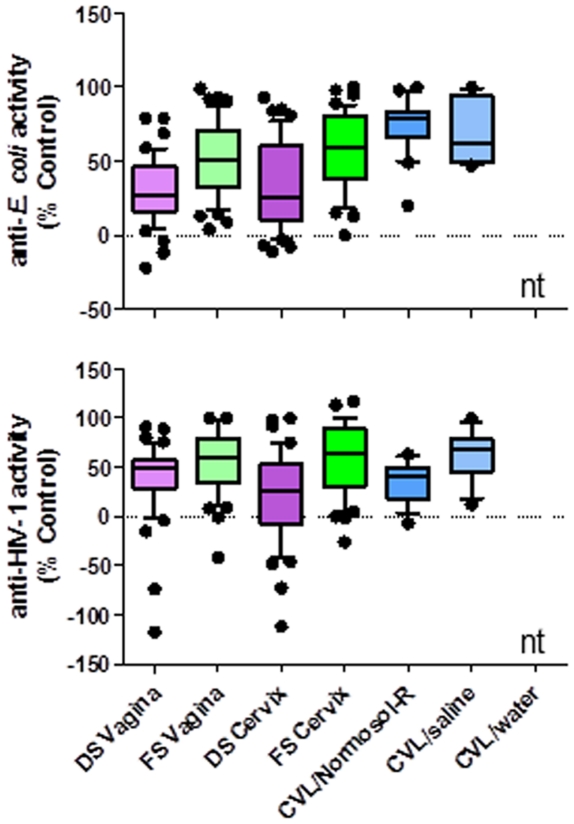
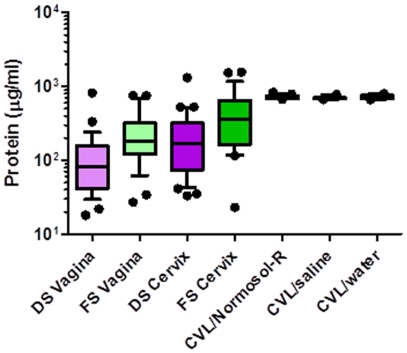
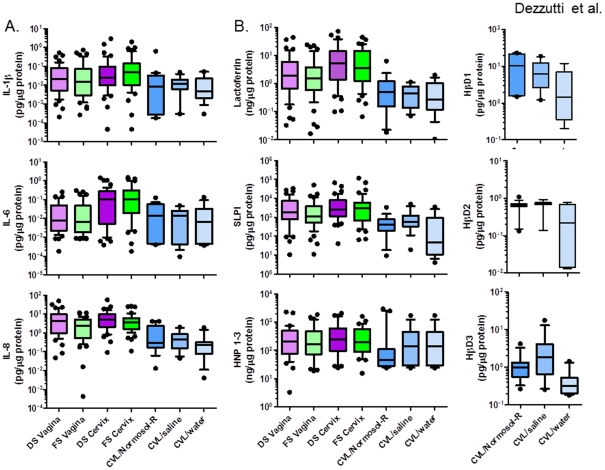
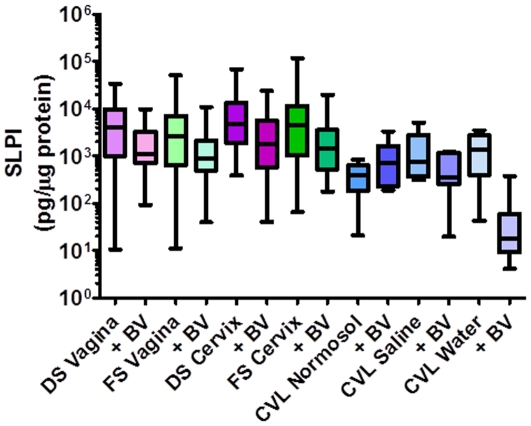
Higher concentrations of protein were recovered by CVL, despite a 10-fold dilution of secretions, as compared to swab eluents. After protein correction, endocervical swabs recovered the highest mediator levels regardless of BV status. Endocervical and vaginal flocked swabs recovered significantly higher levels of anti-HIV-1 and anti-E. coli activity than Dacron swabs (P<0.001). BV had a significant effect on CVL mediator recovery. Normosol-R tended to recover higher levels of most mediators among women with BV, whereas saline or water tended to recover higher levels among women without BV. Saline recovered the highest levels of anti-HIV-1 activity regardless of BV status.
Endocervical swabs and CVL collected with saline provide the best recovery of most mediators and would be the optimal sampling method(s) for clinical trials.
测量女性生殖道分泌物中的免疫介质和抗菌活性可能提供预测 HIV-1 感染风险的生物标志物和杀微生物剂安全性的替代标志物。然而,目前不存在最佳的样本采集方法。本研究比较了不同的采集方法。
使用阴道和宫颈 Dacron 和纤维拭子收集 48 名女性(24 名患有细菌性阴道病 [BV])的分泌物。使用 10mL 的 Normosol-R(n=20)、生理盐水(n=14)或水(n=14)进行宫颈阴道灌洗(CVL)。测定 Normosol-R CVL 中葡萄糖酸盐的浓度以估计稀释因子。通过 Luminex 或 ELISA 测量细胞因子和抗菌介质,并根据蛋白含量进行校正。通过 TZM-bl 测定或大肠杆菌生长来测量内源性抗 HIV-1 和抗大肠杆菌活性。
与拭子洗脱液相比,CVL 尽管将分泌物稀释了 10 倍,但仍能回收更高浓度的蛋白。经蛋白校正后,无论 BV 状态如何,宫颈拭子均能回收最高的介质水平。宫颈和阴道纤维拭子比 Dacron 拭子回收的抗 HIV-1 和抗大肠杆菌活性显著更高(P<0.001)。BV 对 CVL 介质的回收有显著影响。在患有 BV 的女性中,Normosol-R 倾向于回收更高水平的大多数介质,而在没有 BV 的女性中,生理盐水或水倾向于回收更高水平的介质。生理盐水无论 BV 状态如何,均能回收最高水平的抗 HIV-1 活性。
宫颈拭子和用生理盐水采集的 CVL 能最好地回收大多数介质,是临床试验的最佳采样方法。