Université Paris Diderot, Sorbonne Paris Cité, Microbiology Department, Saint-Louis Hospital, APHP, Paris, France.
PLoS One. 2011;6(8):e23514. doi: 10.1371/journal.pone.0023514. Epub 2011 Aug 17.
Influenza-like illness (ILI) may be caused by a variety of pathogens. Clinical observations are of little help to recognise myxovirus infection and implement appropriate prevention measures. The limited use of molecular tools underestimates the role of other common pathogens.
During the early weeks of the 2009-2010 flu pandemic, a clinical and virological survey was conducted in adult and paediatric patients with ILI referred to two French University hospitals in Paris and Tours. Aims were to investigate the different pathogens involved in ILI and describe the associated symptoms.
H1N1v pandemic influenza diagnosis was performed with real time RT-PCR assay. Other viral aetiologies were investigated by the molecular multiplex assay RespiFinder19®. Clinical data were collected prospectively by physicians using a standard questionnaire.
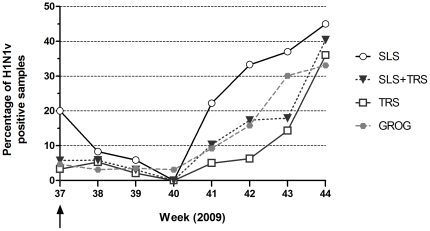
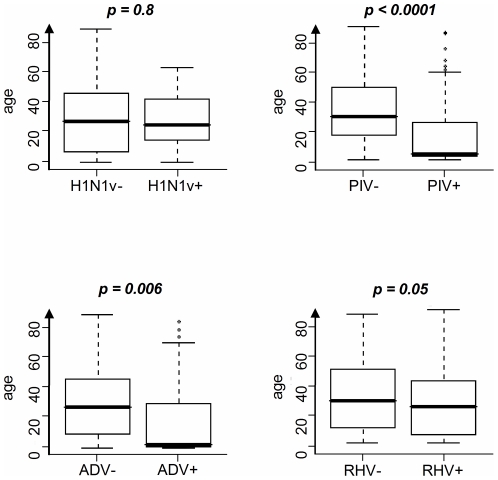
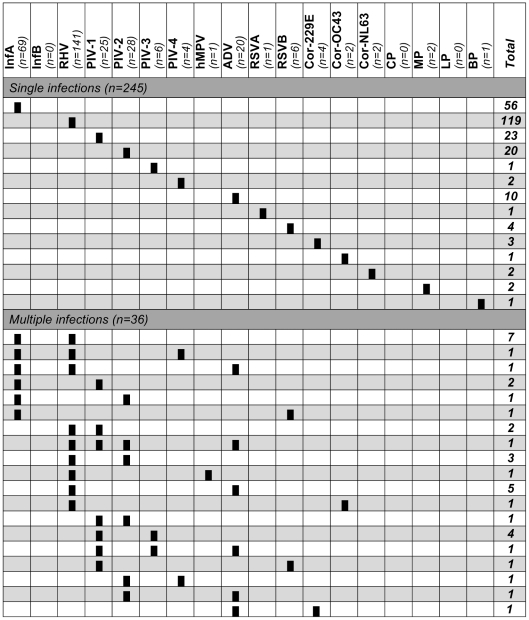
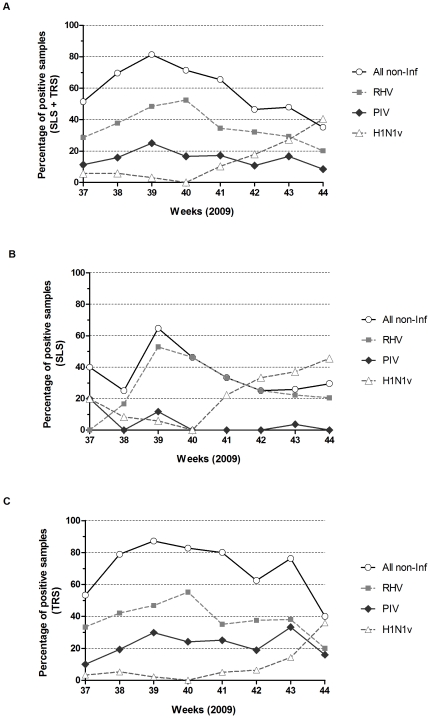
From week 35 to 44, endonasal swabs were collected in 413 patients. Overall, 68 samples (16.5%) were positive for H1N1v. In 13 of them, other respiratory pathogens were also detected. Among H1N1v negative samples, 213 (61.9%) were positive for various respiratory agents, 190 in single infections and 23 in mixed infections. The most prevalent viruses in H1N1v negative single infections were rhinovirus (62.6%), followed by parainfluenza viruses (24.2%) and adenovirus (5.3%). 70.6% of H1N1v cases were identified in patients under 40 years and none after 65 years. There was no difference between clinical symptoms observed in patients infected with H1N1v or with other pathogens.
Our results highlight the high frequency of non-influenza viruses involved in ILI during the pre-epidemic period of a flu alert and the lack of specific clinical signs associated with influenza infections. Rapid diagnostic screening of a large panel of respiratory pathogens may be critical to define and survey the epidemic situation and to provide critical information for patient management.
流感样疾病(ILI)可能由多种病原体引起。临床观察对于识别黏液病毒感染和实施适当的预防措施帮助不大。分子工具的有限使用低估了其他常见病原体的作用。
在 2009-2010 年流感大流行的早期几周,对巴黎和图尔的两家法国大学医院的ILI 成年和儿科患者进行了临床和病毒学调查。目的是调查ILI 涉及的不同病原体,并描述相关症状。
使用实时 RT-PCR 检测方法进行 H1N1v 大流行流感诊断。通过分子多重检测方法 RespiFinder19® 检测其他病毒病因。临床数据由医生使用标准问卷前瞻性收集。
从第 35 周到第 44 周,共采集了 413 例患者的鼻内拭子。总体而言,68 份样本(16.5%)H1N1v 阳性。其中 13 份样本还检测到其他呼吸道病原体。在 H1N1v 阴性样本中,213 份(61.9%)为各种呼吸道病原体阳性,190 份为单一感染,23 份为混合感染。H1N1v 阴性单一感染中最常见的病毒是鼻病毒(62.6%),其次是副流感病毒(24.2%)和腺病毒(5.3%)。70.6%的 H1N1v 病例发生在 40 岁以下的患者中,65 岁以上的患者中没有。感染 H1N1v 或其他病原体的患者的临床症状无差异。
我们的研究结果强调了在流感预警的流行前期,ILI 中非流感病毒的高频率以及与流感感染相关的缺乏特异性临床症状。对大量呼吸道病原体进行快速诊断筛查对于确定和监测疫情以及为患者管理提供关键信息可能至关重要。