Department of Infectious Disease, Shenyang center for Disease Control and Prevention, Shenyang110031, Liaoning Province, PR China.
Department of Occupational and Environmental Health, School of Public Health, China Medical University, No.77 Puhe Road, Shenyang North New Area, Shenyang110122, P.R. China.
Epidemiol Infect. 2020 Feb 14;148:e29. doi: 10.1017/S0950268820000151.
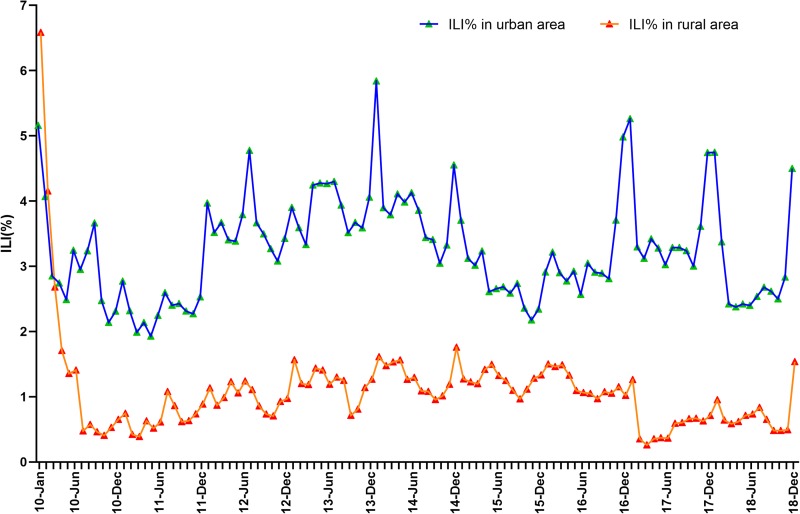
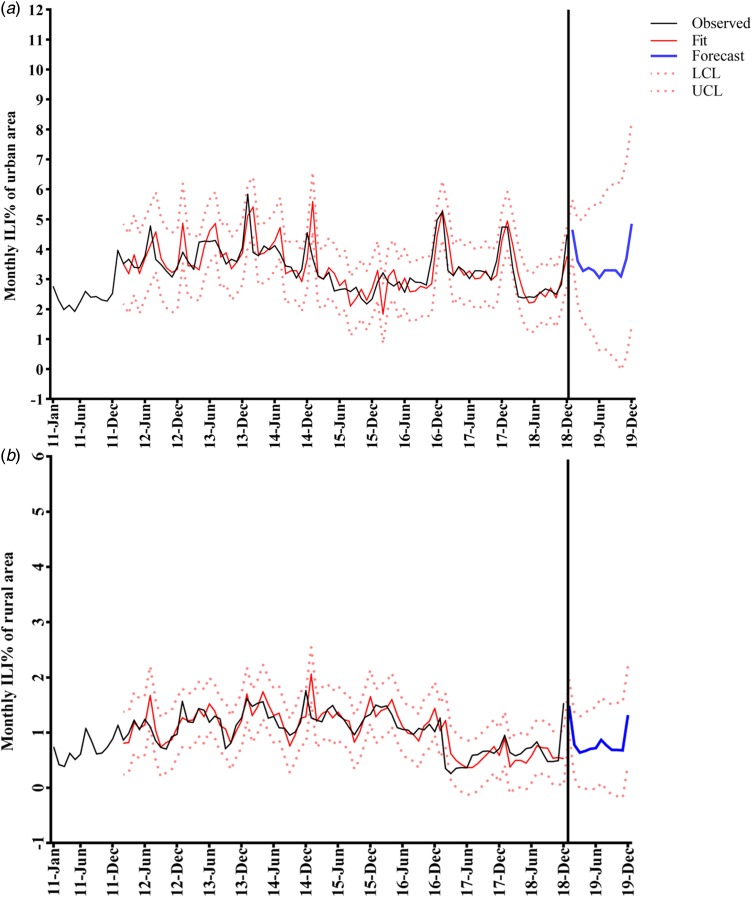
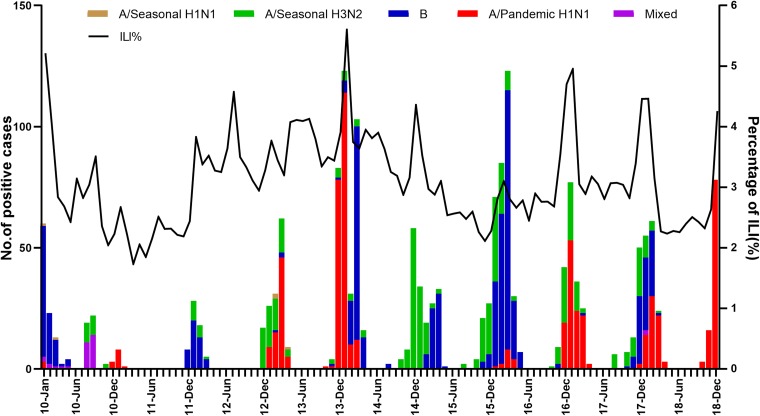
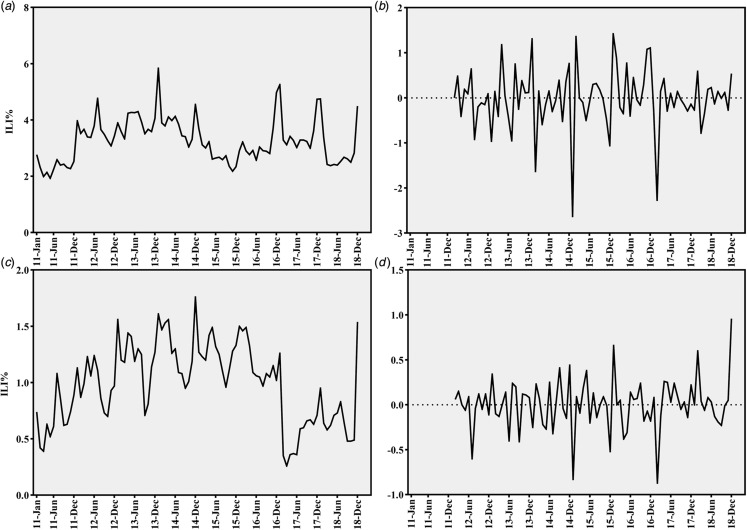
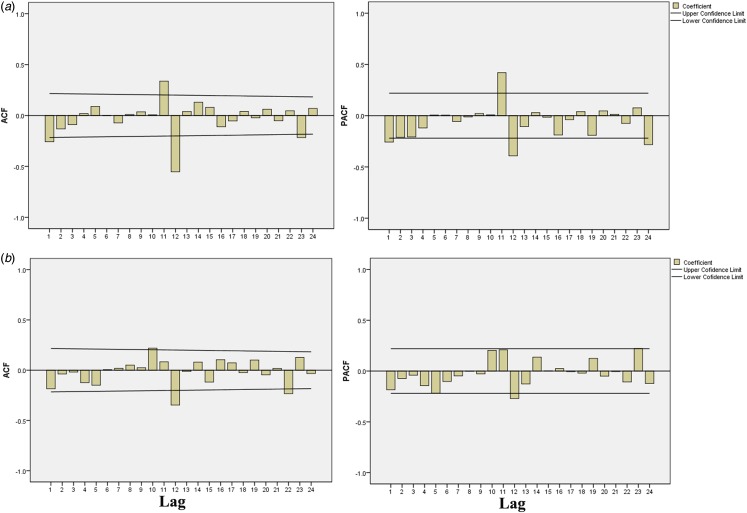
In recent years, there have been a significant influenza activity and emerging influenza strains in China, resulting in an increasing number of influenza virus infections and leading to public health concerns. The aims of this study were to identify the epidemiological and aetiological characteristics of influenza and establish seasonal autoregressive integrated moving average (SARIMA) models for forecasting the percentage of visits for influenza-like illness (ILI%) in urban and rural areas of Shenyang. Influenza surveillance data were obtained for ILI cases and influenza virus positivity from 18 sentinel hospitals. The SARIMA models were constructed to predict ILI% for January-December 2019. During 2010-2018, the influenza activity was higher in urban than in rural areas. The age distribution of ILI cases showed the highest rate in young children aged 0-4 years. Seasonal A/H3N2, influenza B virus and pandemic A/H1N1 continuously co-circulated in winter and spring seasons. In addition, the SARIMA (0, 1, 0) (0, 1, 2)12 model for the urban area and the SARIMA (1, 1, 1) (1, 1, 0)12 model for the rural area were appropriate for predicting influenza incidence. Our findings suggested that there were regional and seasonal distinctions of ILI activity in Shenyang. A co-epidemic pattern of influenza strains was evident in terms of seasonal influenza activity. Young children were more susceptible to influenza virus infection than adults. These results provide a reference for future influenza prevention and control strategies in the study area.
近年来,中国流感活动频繁,出现了新的流感株,导致流感病毒感染人数不断增加,引起了公众健康的关注。本研究旨在确定流感的流行病学和病原学特征,并建立季节性自回归综合移动平均(SARIMA)模型,以预测沈阳市城乡流感样病例(ILI%)的百分比。从 18 家哨点医院获取ILI 病例和流感病毒阳性的流感监测数据。构建 SARIMA 模型以预测 2019 年 1 月至 12 月的 ILI%。2010-2018 年期间,城市的流感活动高于农村地区。ILI 病例的年龄分布显示,0-4 岁的幼儿发病率最高。季节性 A/H3N2、B 型流感病毒和大流行 A/H1N1 型流感病毒在冬春季节持续共同流行。此外,城市地区的 SARIMA(0,1,0)(0,1,2)12 模型和农村地区的 SARIMA(1,1,1)(1,1,0)12 模型均适用于预测流感发病率。研究结果表明,沈阳市ILI 活动存在地区和季节性差异。季节性流感活动中存在流感株的共同流行模式。儿童比成年人更容易感染流感病毒。这些结果为研究区域未来的流感防控策略提供了参考。