Le Jette V, Pedersen Line B, Riisgaard Helle, Lykkegaard Jesper, Nexøe Jørgen, Lemmergaard Jeanette, Søndergaard Jens
a Research Unit of General Practice, Department of Public Health , University of Southern Denmark , Odense C , Denmark.
b COHERE, Department of Business and Economics , University of Southern Denmark , Odense M , Denmark.
Scand J Prim Health Care. 2016 Dec;34(4):327-335. doi: 10.1080/02813432.2016.1249057. Epub 2016 Nov 2.
To assess general practitioners' (GPs') information-seeking behaviour and perceived importance of sources of scientific medical information and to investigate associations with GP characteristics.
A national cross-sectional survey was distributed electronically in December 2013.
Danish general practice.
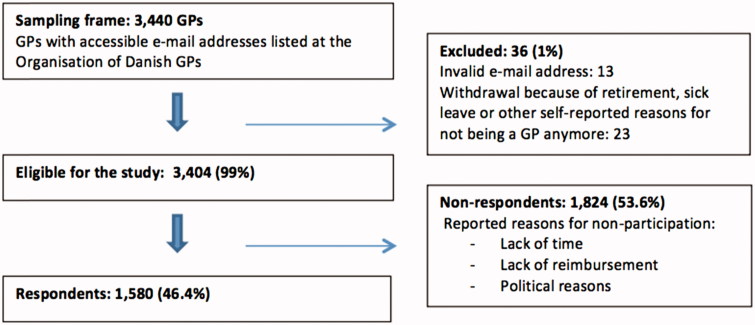
A population of 3440 GPs (corresponding to approximately 96% of all Danish GPs).
GPs' use and perceived importance of information sources. Multilevel mixed-effects logit models were used to investigate associations with GP characteristics after adjusting for relevant covariates.
A total of 1580 GPs (46.4%) responded to the questionnaire. GPs' information-seeking behaviour is associated with gender, age and practice form. Single-handed GPs use their colleagues as an information source significantly less than GPs working in partnership practices and they do not use other sources more frequently. Compared with their younger colleagues, GPs aged above 44 years are less likely to seek information from colleagues, guidelines and websites, but more likely to seek information from medical journals. Male and female GPs seek information equally frequently. However, whereas male GPs are more likely than female GPs to find that pharmaceutical sales representative and non-refundable CME meetings are important, they are less likely to find that colleagues, refundable CME meetings, guidelines and websites are important.
Results from this study indicate that GP characteristics should be taken into consideration when disseminating scientific medical information, to ensure that patients receive medically updated, high-quality care. KEY POINTS Research indicates that information-seeking behaviour is associated with GP characteristics. Further insights could provide opportunities for targeting information dissemination strategies. Single-handed GPs seek information from colleagues less frequently than GPs in partnerships and do not use other sources more frequently. GPs aged above 44 years do not seek information as frequently as their younger colleagues and prefer other information sources. Male and female GPs seek information equally frequently, but do not consider information sources equally important in keeping medically updated.
评估全科医生(GP)的信息寻求行为以及对科学医学信息来源的感知重要性,并调查与全科医生特征的关联。
2013年12月以电子方式进行了一项全国性横断面调查。
丹麦全科医疗。
3440名全科医生(约占丹麦所有全科医生的96%)。
全科医生对信息来源的使用情况及感知重要性。在调整相关协变量后,使用多水平混合效应逻辑回归模型研究与全科医生特征的关联。
共有1580名全科医生(46.4%)回复了问卷。全科医生的信息寻求行为与性别、年龄和执业形式有关。个体执业的全科医生将同事作为信息来源的频率明显低于合伙执业的全科医生,且他们也没有更频繁地使用其他来源。与年轻同事相比,44岁以上的全科医生从同事、指南和网站获取信息的可能性较小,但从医学期刊获取信息的可能性较大。男性和女性全科医生寻求信息的频率相同。然而,男性全科医生比女性全科医生更有可能认为药品销售代表和非退款继续医学教育会议很重要,而他们不太可能认为同事、退款继续医学教育会议、指南和网站很重要。
本研究结果表明,在传播科学医学信息时应考虑全科医生的特征,以确保患者获得最新的、高质量的医疗服务。要点研究表明,信息寻求行为与全科医生特征有关。进一步的见解可为针对性的信息传播策略提供机会。个体执业的全科医生从同事那里获取信息的频率低于合伙执业的全科医生,且不更频繁地使用其他来源。44岁以上的全科医生寻求信息的频率不如年轻同事高,且更喜欢其他信息来源。男性和女性全科医生寻求信息的频率相同,但在保持医学知识更新方面对信息来源的重视程度不同。