Swedish University of Agricultural Sciences, Department of Clinical Sciences, Uppsala, Sweden.
Vaccine. 2011 Nov 3;29(47):8719-30. doi: 10.1016/j.vaccine.2011.07.146. Epub 2011 Aug 22.
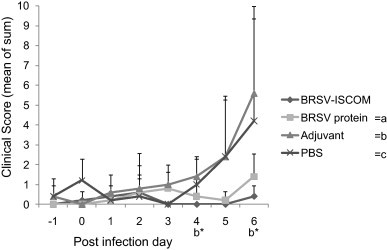
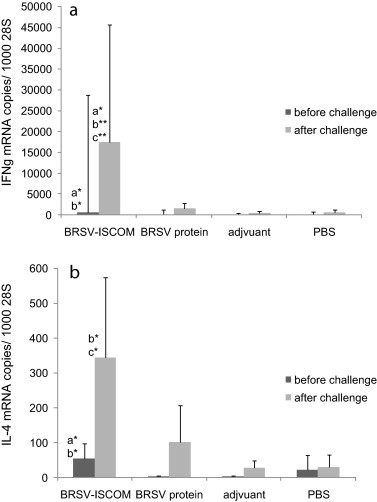
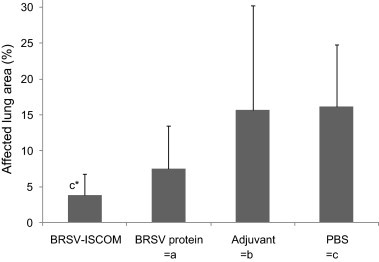
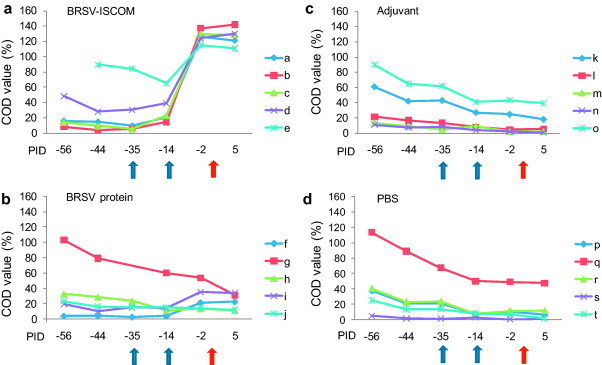
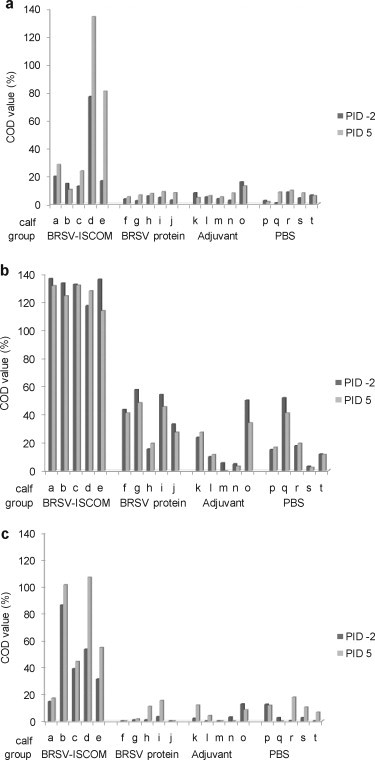
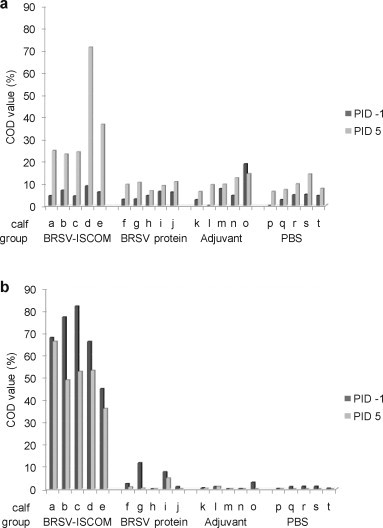
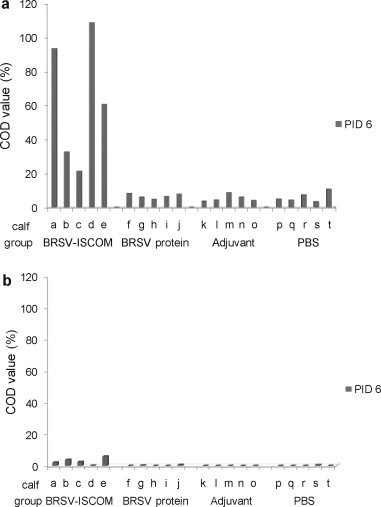
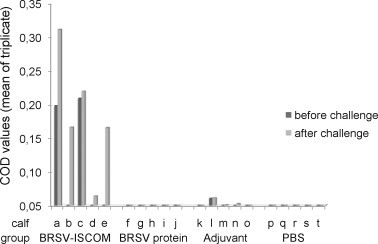
Bovine respiratory syncytial virus (BRSV) is a major cause of bronchiolitis and pneumonia in cattle and causes yearly outbreaks with high morbidity in Europe. Commercial vaccines against this virus needs improvement of efficacy, especially in calves with BRSV-specific maternally derived antibodies (MDA). We previously reported that an experimental BRSV-ISCOM vaccine, but not a commercial vaccine, induced strong clinical and virological protection in calves with MDA, immunized at 7-15 weeks of age. The aim of the present study was to characterize the immune responses, as well as to investigate the efficacy and safety in younger animals, representing the target population for vaccination. Four groups of five 3-8 week old calves with variable levels of BRSV-specific MDA were immunized s.c. twice at a 3 weeks interval with (i) BRSV immunostimulating complexes (BRSV-ISCOMs), (ii) BRSV-protein, (iii) adjuvant, or (iv) PBS. All calves were challenged with virulent BRSV by aerosol 2 weeks later and euthanized on day 6 after infection. The cellular and humoral responses were monitored as well as the clinical signs, the viral excretion and the pathology following challenge. Despite presence of MDA at the time of the immunization, only a minimum of clinical signs were observed in the BRSV-ISCOM group after challenge. In contrast, in all control groups, clinical signs of disease were observed in most of the animals (respiratory rates up to 76min(-1) and rectal temperatures up to 41°C). The clinical protection was associated to a highly significant reduction of virus replication in the upper and lower respiratory tract of calves, rapid systemic and local antibody responses and T helper cell responses dominated by IFNγ production. Animals that did not shed virus detectable by PCR or cell culture following challenge possessed particularly high levels of pulmonary IgA. The protective immunological responses to BRSV proteins and the ability to overcome the inhibiting effect of MDA were dependent on ISCOM borne antigen presentation.
牛呼吸道合胞体病毒(BRSV)是导致欧洲牛支气管肺炎和肺炎的主要原因,每年都会爆发,发病率很高。针对这种病毒的商业疫苗需要提高效力,特别是在具有 BRSV 特异性母源抗体(MDA)的小牛中。我们之前报道过,一种实验性的 BRSV-ISCOM 疫苗,但不是商业疫苗,能够在 7-15 周龄时具有 MDA 的小牛中诱导出强烈的临床和病毒学保护。本研究的目的是描述免疫反应,并研究在更年轻的动物中的效力和安全性,这些动物代表了疫苗接种的目标人群。将 4 组 5 只 3-8 周龄、MDA 水平不同的小牛分别皮下免疫 2 次,间隔 3 周,用(i)BRSV 免疫刺激复合物(BRSV-ISCOMs)、(ii)BRSV 蛋白、(iii)佐剂或(iv)PBS。所有小牛在 2 周后用病毒气溶胶攻击,并在感染后第 6 天安乐死。监测细胞和体液反应以及临床症状、病毒排出量和挑战后的病理学。尽管在免疫时存在 MDA,但在 BRSV-ISCOM 组中,只有最小的临床症状在挑战后观察到。相比之下,在所有对照组中,大多数动物都出现了疾病的临床症状(呼吸频率高达 76min(-1)和直肠温度高达 41°C)。临床保护与上呼吸道和下呼吸道中病毒复制的显著降低相关,小牛体内快速的系统和局部抗体反应以及以 IFNγ产生为主的 T 辅助细胞反应。在挑战后通过 PCR 或细胞培养检测不到病毒的动物具有特别高的肺部 IgA 水平。对 BRSV 蛋白的保护免疫反应以及克服 MDA 抑制作用的能力依赖于 ISCOM 载体抗原呈递。