Brown Steven A, Schmitt Karen, Eckert Anne
Department of Pharmacology and Toxicology, University of Zurich, Switzerland.
Aging (Albany NY). 2011 Aug;3(8):813-7. doi: 10.18632/aging.100366.
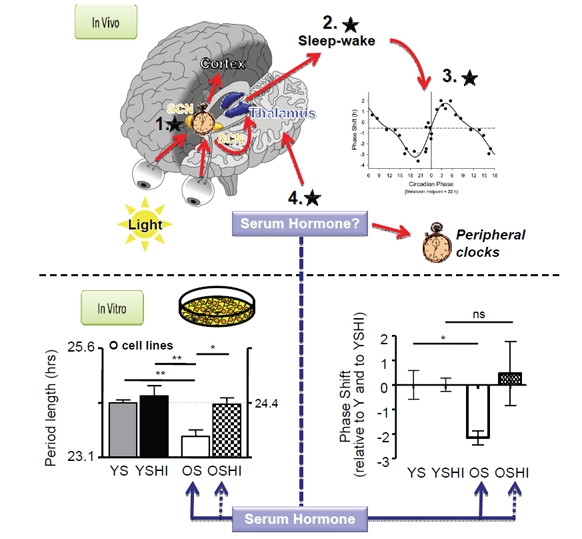
The relationship between aging and daily "circadian" behavior in humans is bidirectional: on the one hand, dysfunction of circadian clocks promotes age-related maladies; on the other, aging per se leads to changes and disruption in circadian behavior and physiology. For the latter case, recent research suggests that changes to both homeostatic and circadian sleep regulatory mechanisms may play a role. Could hormonal changes be in part responsible?
衰老与人类日常“昼夜节律”行为之间的关系是双向的:一方面,生物钟功能障碍会引发与年龄相关的疾病;另一方面,衰老本身会导致昼夜节律行为和生理的变化与紊乱。对于后一种情况,最近的研究表明,稳态和昼夜节律睡眠调节机制的变化可能都起到了作用。激素变化会是部分原因吗?