Institute of Molecular Biology and Genetics, School of Biological Sciences & Institute of Bioinformatics (BIOMAX), Seoul National University, Seoul, Republic of Korea.
Nucleic Acids Res. 2011 Nov 1;39(20):e140. doi: 10.1093/nar/gkr617. Epub 2011 Aug 31.
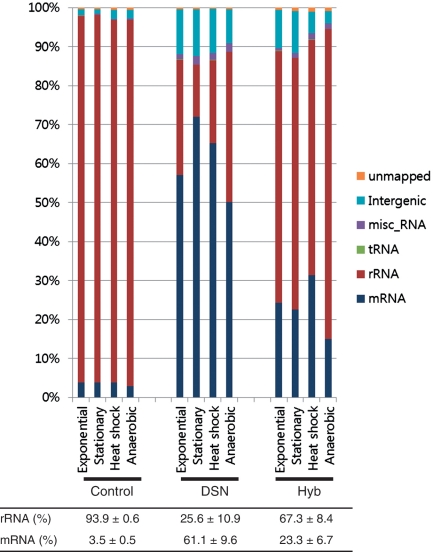
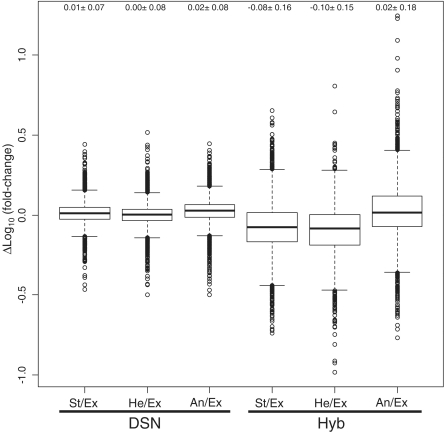
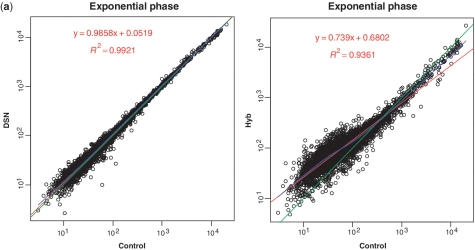
Next-generation sequencing has great potential for application in bacterial transcriptomics. However, unlike eukaryotes, bacteria have no clear mechanism to select mRNAs over rRNAs; therefore, rRNA removal is a critical step in sequencing-based transcriptomics. Duplex-specific nuclease (DSN) is an enzyme that, at high temperatures, degrades duplex DNA in preference to single-stranded DNA. DSN treatment has been successfully used to normalize the relative transcript abundance in mRNA-enriched cDNA libraries from eukaryotic organisms. In this study, we demonstrate the utility of this method to remove rRNA from prokaryotic total RNA. We evaluated the efficacy of DSN to remove rRNA by comparing it with the conventional subtractive hybridization (Hyb) method. Illumina deep sequencing was performed to obtain transcriptomes from Escherichia coli grown under four growth conditions. The results clearly showed that our DSN treatment was more efficient at removing rRNA than the Hyb method was, while preserving the original relative abundance of mRNA species in bacterial cells. Therefore, we propose that, for bacterial mRNA-seq experiments, DSN treatment should be preferred to Hyb-based methods.
下一代测序技术在细菌转录组学中有很大的应用潜力。然而,与真核生物不同,细菌没有明确的机制来选择 mRNA 而不是 rRNA;因此,rRNA 的去除是基于测序的转录组学中的关键步骤。双链特异性核酸酶(DSN)是一种酶,在高温下,它优先降解双链 DNA 而不是单链 DNA。DSN 处理已成功用于从真核生物的富含 mRNA 的 cDNA 文库中归一化相对转录丰度。在这项研究中,我们证明了该方法在去除原核总 RNA 中的 rRNA 的有效性。我们通过将其与传统的消减杂交(Hyb)方法进行比较来评估 DSN 去除 rRNA 的效果。使用 Illumina 深度测序从在四种生长条件下生长的大肠杆菌中获得转录组。结果清楚地表明,与 Hyb 方法相比,我们的 DSN 处理在去除 rRNA 方面更有效,同时保留了细菌细胞中 mRNA 种类的原始相对丰度。因此,我们建议在细菌 mRNA-seq 实验中,DSN 处理应优先于基于 Hyb 的方法。