Radiology, Memorial University of Newfoundland, St. John's, NL, Canada.
Eur J Nucl Med Mol Imaging. 2011 Dec;38(12):2247-56. doi: 10.1007/s00259-011-1887-9. Epub 2011 Sep 1.
The aim was to compare late-time extrapolation of plasma clearance (CL) from Tikhonov adaptively regularized gamma variate fitting (Tk-GV) and from mono-exponential (E1) fitting.
Ten (51)Cr-ethylenediaminetetraacetic acid bolus IV studies in adults--8 with ascites--assessed for liver transplantation, with 12-16 plasma samples drawn from 5-min to 24-h, were fit with Tk-GV and E1 models and CL results were compared using Passing-Bablok fitting.
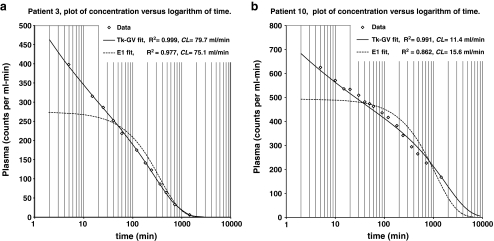
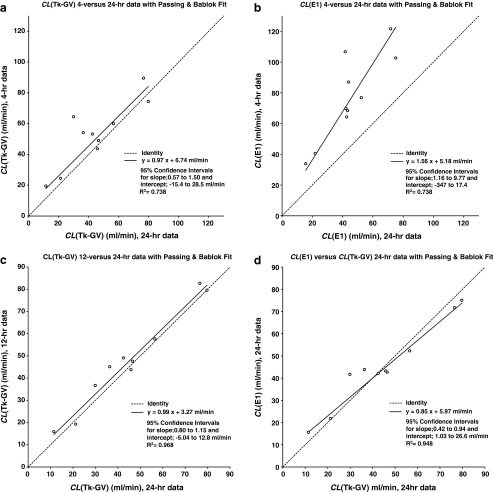
The 24-h CL(Tk-GV) values ranged from 11.4 to 79.7 ml/min. Linear regression of 4- versus 24-h CL(Tk-GV) yielded no significant departure from a slope of 1, whereas the 4- versus 24-h CL(E1) slope, 1.56, was significantly increased. For CL(Tk-GV-24-h) versus CL(E1-24-h), there was a biased slope and intercept (0.85, 5.97 ml/min). Moreover, the quality of fitting of 24-h data was significantly better for Tk-GV than for E1, as follows. For 10 logarithm of concentration curves, higher r values were obtained for each Tk-GV fit (median 0.998) than for its corresponding E1 fit (median 0.965), with p < 0.0001 (paired t-test of z-statistics from Fisher r-z transformations). The E1 fit quality degraded with increasing V/W [volume of distribution (l) per kg body weight, p = 0.003]. However, Tk-GV fit quality versus V/W was uncorrelated (p = 0.8).
CL(E1) values were dependent on sample time and the quality of fit was poor and degraded with increasing ascites, consistent with current opinion that CL(E1) is contraindicated in ascitic patients. CL(Tk-GV) was relatively more accurate and the good quality of fit was unaffected by ascites. CL(Tk-GV) was the preferred method for the accurate calculation of CL and was useful despite liver failure and ascites.
旨在比较 Tikhonov 自适应正则化伽马变量拟合(Tk-GV)和单指数(E1)拟合从晚期时间外推血浆清除率(CL)。
对 10 例(51 例)成人(51 例)进行(51 例)51Cr-乙二胺四乙酸静脉推注 IV 研究-有腹水的 8 例)进行肝移植评估,从 5 分钟到 24 小时抽取 12-16 个血浆样本,用 Tk-GV 和 E1 模型拟合,并使用 Passing-Bablok 拟合比较 CL 结果。
24 小时 CL(Tk-GV)值范围为 11.4 至 79.7 ml/min。4 小时与 24 小时 CL(Tk-GV)的线性回归没有明显偏离斜率 1,而 4 小时与 24 小时 CL(E1)的斜率为 1.56,明显增加。对于 CL(Tk-GV-24-h)与 CL(E1-24-h),斜率和截距存在偏差(0.85、5.97 ml/min)。此外,Tk-GV 对 24 小时数据的拟合质量明显优于 E1,如下所示。对于 10 个对数浓度曲线,每个 Tk-GV 拟合的 r 值(中位数 0.998)均高于其相应的 E1 拟合(中位数 0.965),p<0.0001(配对 t 检验 Fisher r-z 转换的 z 统计量)。E1 拟合质量随 V/W [体重(kg)的分布体积,p=0.003]增加而降低。然而,Tk-GV 拟合质量与 V/W 无关(p=0.8)。
CL(E1)值取决于样本时间,拟合质量差,随着腹水的增加而恶化,这与目前认为 CL(E1)在腹水患者中禁忌的观点一致。CL(Tk-GV)相对更准确,良好的拟合质量不受腹水影响。CL(Tk-GV)是准确计算 CL 的首选方法,即使在肝功能衰竭和腹水的情况下也很有用。