Centre for GeoGenetics, Natural History Museum, University of Copenhagen, Øster Voldgade 5-7, DK-1350 Copenhagen K, Denmark.
BMC Genomics. 2011 Sep 1;12:440. doi: 10.1186/1471-2164-12-440.
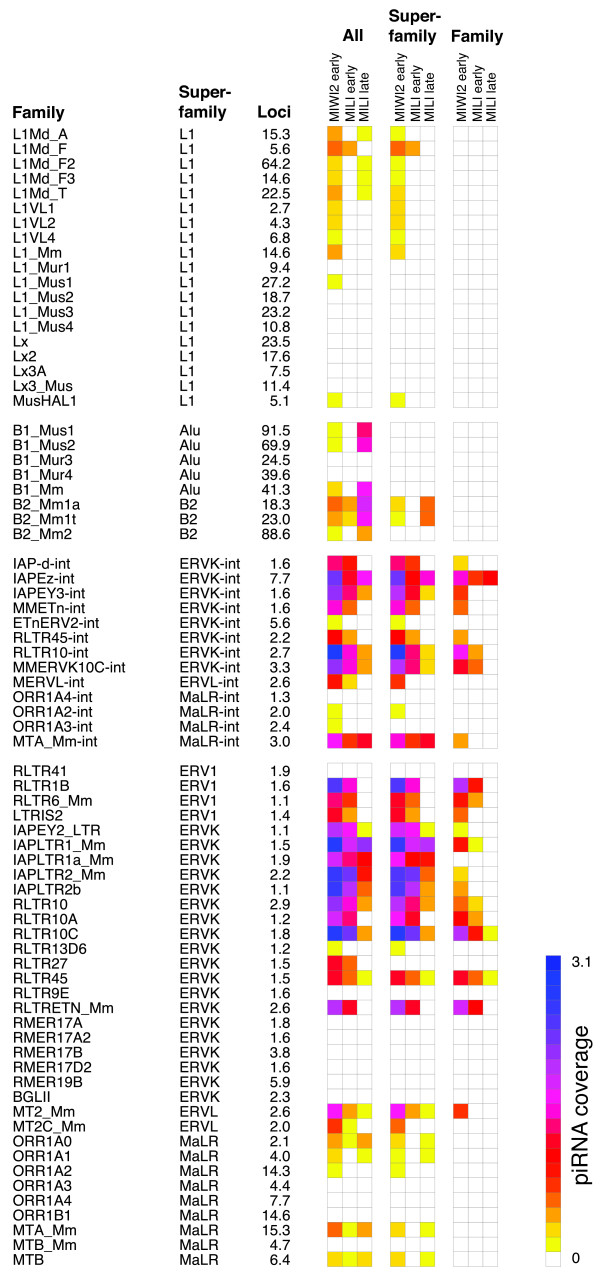
Piwi-associated RNAs (piRNAs) bind transcripts from retrotransposable elements (RTE) in mouse germline cells and seemingly act as guides for genomic methylation, thereby repressing the activity of RTEs. It is currently unknown if and how Piwi proteins distinguish RTE transcripts from other cellular RNAs. During germline development, the main target of piRNAs switch between different types of RTEs. Using the piRNA targeting of RTEs as an indicator of RTE activity, and considering the entire population of genomic RTE loci along with their age and location, this study aims at further elucidating the dynamics of RTE activity during mouse germline development.
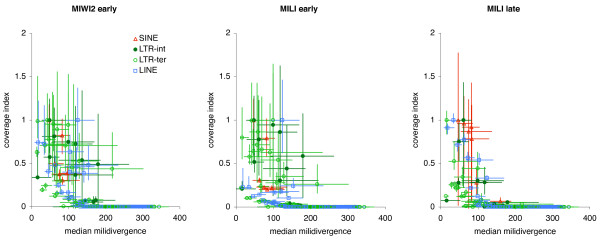
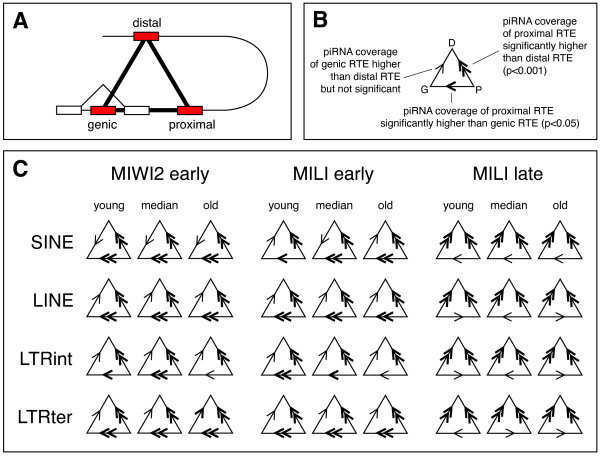
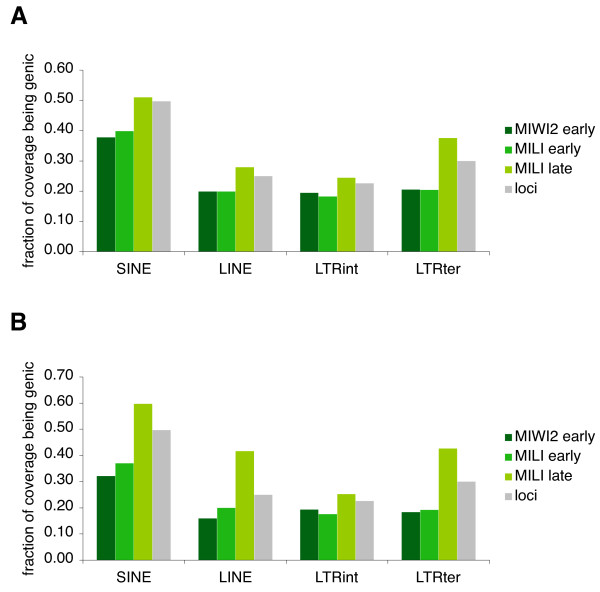
Due to the inherent sequence redundancy between RTE loci, assigning piRNA targeting to specific loci is problematic. This limits the analysis, although certain features of piRNA targeting of RTE loci are apparent. As expected, young RTEs display a much higher level of piRNA targeting than old RTEs. Further, irrespective of age, RTE loci near protein-coding coding genes are targeted to a greater extent than RTE loci far from genes. During development, a shift in piRNA targeting is observed, with a clear increase in the relative piRNA targeting of RTEs residing within boundaries of protein-coding gene transcripts.
Reanalyzing published piRNA sequences and taking into account the features of individual RTE loci provide novel insight into the activity of RTEs during development. The obtained results are consistent with some degree of proportionality between what transcripts become substrates for Piwi protein complexes and the level by which the transcripts are present in the cell. A transition from active transcription of RTEs to passive co-transcription of RTE sequences residing within protein-coding transcripts appears to take place in postnatal development. Hence, the previously reported increase in piRNA targeting of SINEs in postnatal testis development does not necessitate widespread active transcription of SINEs, but may simply be explained by the prevalence of SINEs residing in introns.
Piwi 相关 RNA(piRNAs)与逆转录转座子(RTE)在小鼠生殖细胞中的转录本结合,并似乎作为基因组甲基化的指导,从而抑制 RTE 的活性。目前尚不清楚 Piwi 蛋白是否以及如何区分 RTE 转录本与其他细胞 RNA。在生殖细胞发育过程中,piRNAs 的主要靶标在不同类型的 RTE 之间切换。本研究以 piRNA 靶向 RTE 作为 RTE 活性的指标,并考虑基因组 RTE 基因座的整个群体及其年龄和位置,旨在进一步阐明 RTE 在小鼠生殖细胞发育过程中的活性动态。
由于 RTE 基因座之间存在固有序列冗余,因此将 piRNA 靶向特定基因座的分配存在问题。尽管 RTE 基因座的 piRNA 靶向具有某些特征,但这限制了分析。不出所料,年轻的 RTE 比旧的 RTE 显示出更高水平的 piRNA 靶向。此外,无论年龄大小,靠近蛋白质编码基因的 RTE 基因座比远离基因的 RTE 基因座受到更大程度的靶向。在发育过程中,观察到 piRNA 靶向的转变,蛋白质编码基因转录本边界内的 RTE 的相对 piRNA 靶向明显增加。
重新分析已发表的 piRNA 序列并考虑单个 RTE 基因座的特征,为 RTE 在发育过程中的活性提供了新的见解。所得结果与 Piwi 蛋白复合物的转录本成为底物的程度与转录本在细胞中存在的水平之间存在一定程度的比例性。从 RTE 的活跃转录到蛋白质编码转录本中 RTE 序列的被动共转录的转变似乎发生在出生后发育过程中。因此,先前报道的出生后睾丸发育中 SINE 的 piRNA 靶向增加并不一定需要 SINE 的广泛活跃转录,而可能仅仅是由于 SINE 普遍存在于内含子中。