Natural History Museum of Denmark, Centre for GeoGenetics, University of Copenhagen Copenhagen, Denmark.
Department of Virology and the Danish National Biobank, Statens Serum Institut Copenhagen, Denmark.
Front Genet. 2014 May 30;5:156. doi: 10.3389/fgene.2014.00156. eCollection 2014.
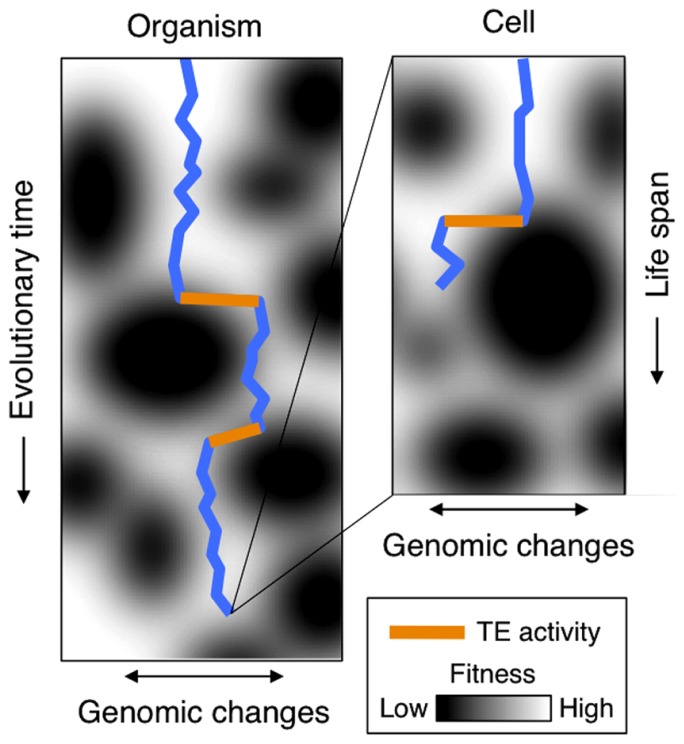
Transposable elements (TEs) are ubiquitous in eukaryotic genomes. Barbara McClintock's famous notion of TEs acting as controlling elements modifying the genetic response of an organism upon exposure to stressful environments has since been solidly supported in a series of model organisms. This requires the TE activity response to possess an element of specificity and be targeted toward certain parts of the genome. We propose that a similar TE response is present in human cells, and that this stress response may drive the onset of human cancers. As such, TE-driven cancers may be viewed as an evolutionary by-product of organisms' abilities to genetically adapt to environmental stress.
转座元件(TEs)在真核生物基因组中普遍存在。芭芭拉·麦克林托克(Barbara McClintock)著名的观点认为,TEs 作为控制元件,在生物体暴露于应激环境时,改变其遗传反应,这一观点在一系列模式生物中得到了有力支持。这就要求 TE 活性反应具有一定的特异性,并针对基因组的某些特定部分。我们提出,在人类细胞中也存在类似的 TE 反应,这种应激反应可能会导致人类癌症的发生。因此,TE 驱动的癌症可以被视为生物体适应环境应激的遗传能力的一种进化副产品。