INSERM UMR-S839 Paris, France.
Front Neuroanat. 2011 Aug 5;5:48. doi: 10.3389/fnana.2011.00048. eCollection 2011.
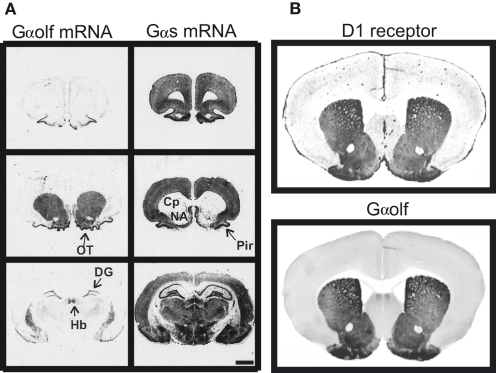
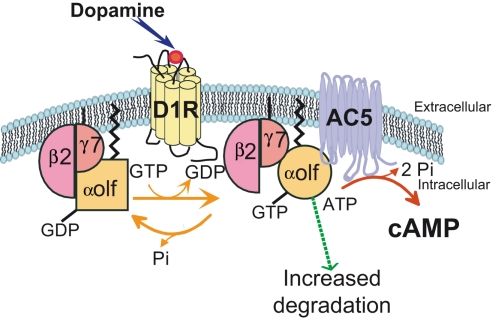
In the principal neurons of striatum (medium spiny neurons, MSNs), cAMP pathway is primarily activated through the stimulation of dopamine D1 and adenosine A(2A) receptors, these receptors being mainly expressed in striatonigral and striatopallidal MSNs, respectively. Since cAMP signaling pathway could be altered in various physiological and pathological circumstances, including drug addiction and Parkinson's disease, it is of crucial importance to identify the molecular components involved in the activation of this pathway. In MSNs, cAMP pathway activation is not dependent on the classical Gs GTP-binding protein but requires a specific G protein subunit heterotrimer containing Gαolf/β2/γ7 in particular association with adenylyl cyclase type 5. This assembly forms an authentic functional signaling unit since loss of one of its members leads to defects of cAMP pathway activation in response to D1 or A(2A) receptor stimulation, inducing dramatic impairments of behavioral responses dependent on these receptors. Interestingly, D1 receptor (D1R)-dependent cAMP signaling is modulated by the neuronal levels of Gαolf, indicating that Gαolf represents the rate-limiting step in this signaling cascade and could constitute a critical element for regulation of D1R responses. In both Parkinsonian patients and several animal models of Parkinson's disease, the lesion of dopamine neurons produces a prolonged elevation of Gαolf levels. This observation gives an explanation for the cAMP pathway hypersensitivity to D1R stimulation, occurring despite an unaltered D1R density. In conclusion, alterations in the highly specialized assembly of Gαolf/β2/γ7 subunits can happen in pathological conditions, such as Parkinson's disease, and it could have important functional consequences in relation to changes in D1R signaling in the striatum.
在纹状体的主要神经元(中型棘神经元,MSNs)中,cAMP 途径主要通过多巴胺 D1 和腺苷 A(2A)受体的刺激而激活,这些受体主要在纹状体黑质和纹状体苍白球 MSNs 中表达。由于 cAMP 信号通路在各种生理和病理情况下都可能发生改变,包括药物成瘾和帕金森病,因此确定参与该途径激活的分子成分至关重要。在 MSNs 中,cAMP 途径的激活不依赖于经典的 Gs GTP 结合蛋白,而是需要一种特定的 G 蛋白亚基异三聚体,该异三聚体特别与腺苷酸环化酶 5 相关。这种组装形成了一个真正的功能信号单元,因为其成员之一的缺失会导致对 D1 或 A(2A)受体刺激的 cAMP 途径激活缺陷,从而导致依赖这些受体的行为反应出现严重障碍。有趣的是,D1 受体(D1R)依赖性 cAMP 信号受 Gαolf 的神经元水平调节,表明 Gαolf 代表该信号级联中的限速步骤,并且可以成为调节 D1R 反应的关键因素。在帕金森病患者和几种帕金森病动物模型中,多巴胺神经元的损伤会导致 Gαolf 水平的长期升高。这种观察结果解释了尽管 D1R 密度没有改变,但 cAMP 途径对 D1R 刺激的超敏性。总之,在病理条件下,如帕金森病,Gαolf/β2/γ7 亚基的高度特化组装可能会发生改变,并且可能对纹状体中 D1R 信号的变化产生重要的功能后果。