Jung Kyung Hwa, Bernabé Kerlly, Moors Kathleen, Yan Beizhan, Chillrud Steven N, Whyatt Robin, Camann David, Kinney Patrick L, Perera Frederica P, Miller Rachel L
Division of Pulmonary, Allergy and Critical Care of Medicine, College of Physicians and Surgeons, Columbia University, PH8E, 630 W. 168 St. New York, NY 10032, USA.
Atmosphere (Basel). 2011 May 16;2(2):96-109. doi: 10.3390/atmos2020096.
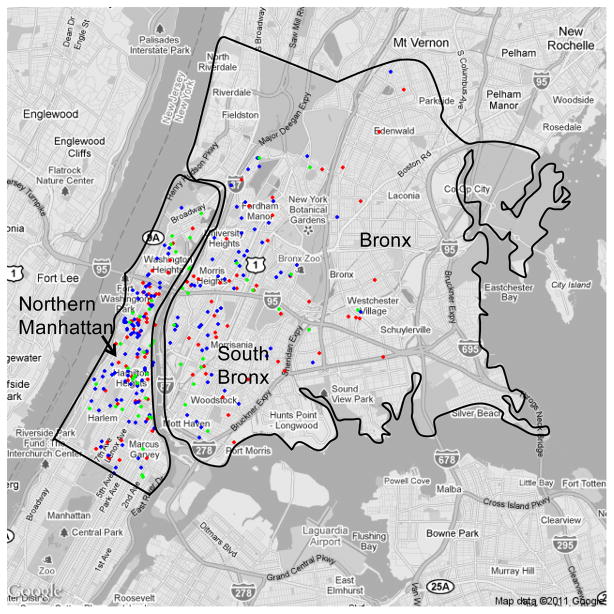
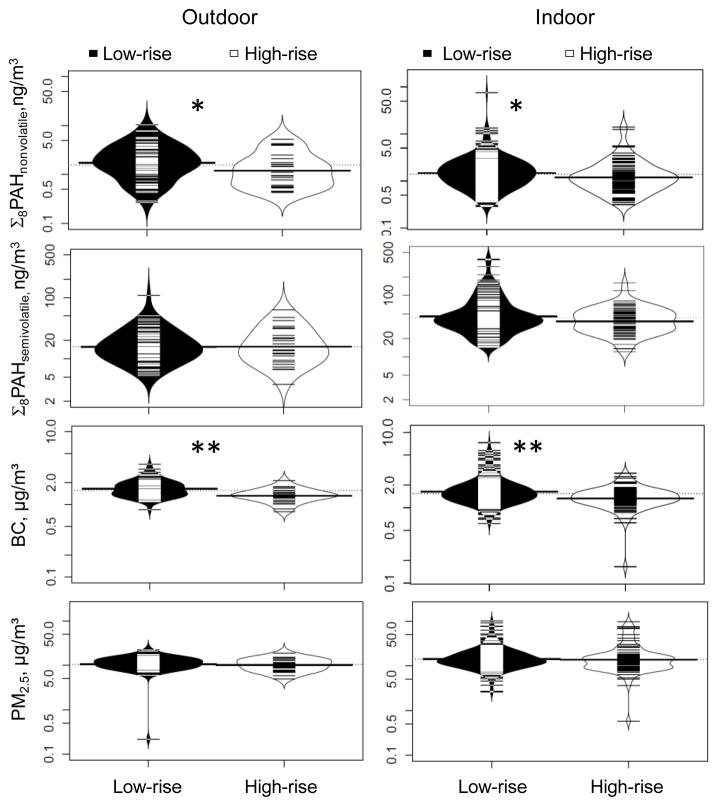
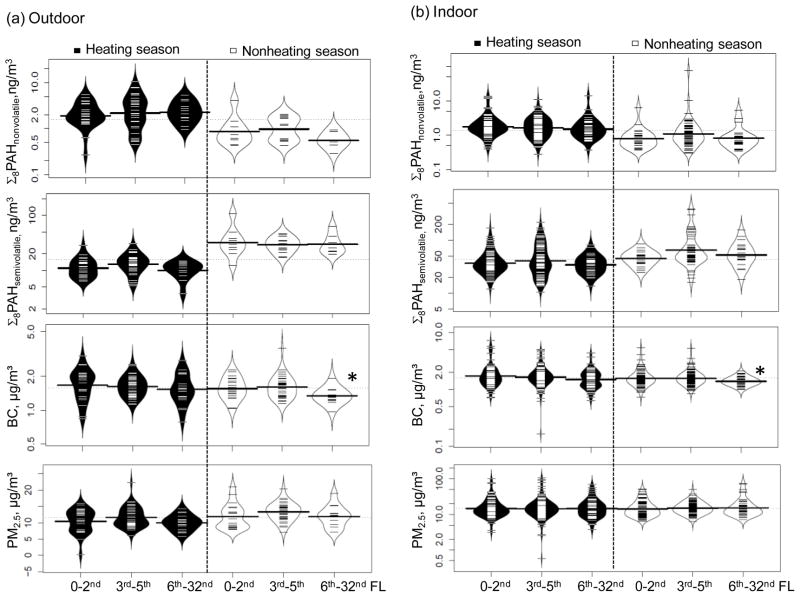
Consideration of the relationship between residential floor level and concentration of traffic-related airborne pollutants may predict individual residential exposure among inner city dwellers more accurately. Our objective was to characterize the vertical gradient of residential levels of polycyclic aromatic hydrocarbons (PAH; dichotomized into Σ(8)PAH(semivolatile) (MW 178-206), and Σ(8)PAH(nonvolatile) (MW 228-278), black carbon (BC), PM(2.5) (particulate matter) by floor level (FL), season and building type. We hypothesize that PAH, BC and PM(2.5) concentrations may decrease with higher FL and the vertical gradients of these compounds would be affected by heating season and building type. PAH, BC and PM(2.5) were measured over a two-week period outdoor and indoor of the residences of a cohort of 5-6 year old children (n = 339) living in New York City's Northern Manhattan and the Bronx. Airborne-pollutant levels were analyzed by three categorized FL groups (0-2nd, 3rd-5th, and 6th-32nd FL) and two building types (low-rise versus high-rise apartment building). Indoor Σ(8)PAH(nonvolatile) and BC levels declined with increasing FL. During the nonheating season, the median outdoor Σ(8)PAH(nonvolatile,) but not Σ(8)PAH(semivolatile), level at 6th-2nd FL was 1.5-2 times lower than levels measured at lower FL. Similarly, outdoor and indoor BC concentrations at 6th-32nd FL were significantly lower than those at lower FL only during the nonheating season (p < 0.05). In addition, living in a low-rise building was associated significantly with higher levels of Σ(8)PAH(nonvolatile) and BC. These results suggest that young inner city children may be exposed to varying levels of air pollutants depending on their FL, season, and building type.
考虑住宅楼层与交通相关空气传播污染物浓度之间的关系,可能会更准确地预测市中心居民个体的住宅暴露情况。我们的目标是按楼层、季节和建筑类型来描述多环芳烃(PAH;分为Σ(8)PAH(半挥发性)(分子量178 - 206)和Σ(8)PAH(非挥发性)(分子量228 - 278))、黑碳(BC)、细颗粒物(PM(2.5))的住宅水平垂直梯度。我们假设PAH、BC和PM(2.5)浓度可能会随着楼层升高而降低,并且这些化合物的垂直梯度会受到供暖季节和建筑类型的影响。在纽约市曼哈顿北部和布朗克斯区,对一组5 - 6岁儿童(n = 339)居住的住宅进行了为期两周的室外和室内PAH、BC和PM(2.5)测量。通过三个分类楼层组(0 - 2楼、3 - 5楼和6 - 32楼)和两种建筑类型(低层与高层公寓楼)分析空气污染物水平。室内Σ(8)PAH(非挥发性)和BC水平随楼层升高而下降。在非供暖季节,6 - 2楼的室外Σ(8)PAH(非挥发性)中位数水平,但不是Σ(8)PAH(半挥发性),比低楼层测量水平低1.5 - 2倍。同样,仅在非供暖季节,6 - 32楼的室外和室内BC浓度显著低于低楼层(p < 0.05)。此外,居住在低层建筑中与较高水平的Σ(8)PAH(非挥发性)和BC显著相关。这些结果表明,市中心的幼儿可能会根据其楼层、季节和建筑类型接触到不同水平的空气污染物。