Department of Radiology, Charité, Medical School, Humboldt Universität zu Berlin and Freie Universität Berlin, Berlin, Germany.
PLoS One. 2011;6(8):e23494. doi: 10.1371/journal.pone.0023494. Epub 2011 Aug 22.
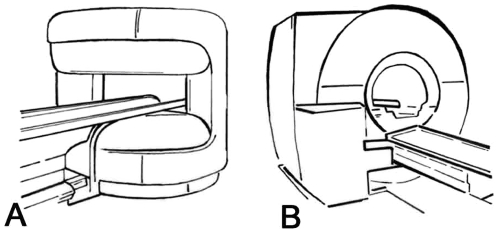
Claustrophobia is a common problem precluding MR imaging. The purpose of the present study was to assess whether a short-bore or an open magnetic resonance (MR) scanner is superior in alleviating claustrophobia.
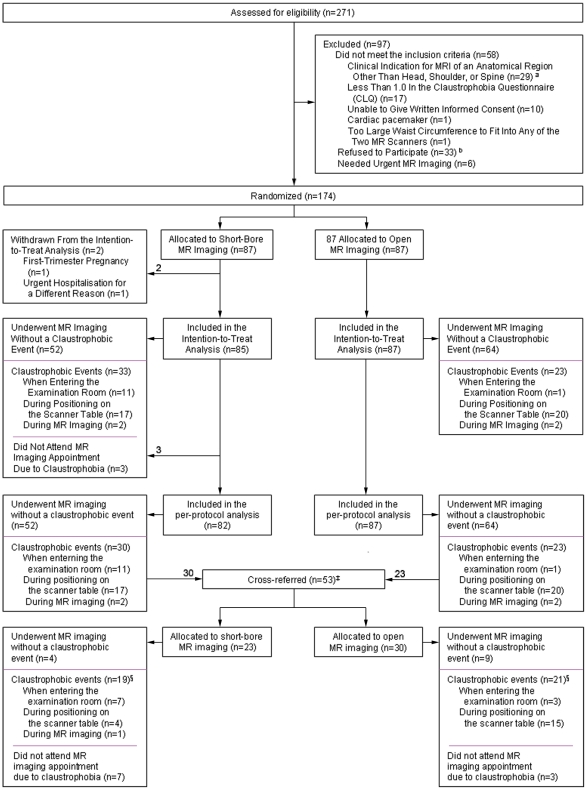
Institutional review board approval and patient informed consent were obtained to compare short-bore versus open MR. From June 2008 to August 2009, 174 patients (139 women; mean age = 53.1 [SD 12.8]) with an overall mean score of 2.4 (SD 0.7, range 0 to 4) on the Claustrophobia Questionnaire (CLQ) and a clinical indication for imaging, were randomly assigned to receive evaluation by open or by short-bore MR. The primary outcomes were incomplete MR examinations due to a claustrophobic event. Follow-up was conducted 7 months after MR imaging. The primary analysis was performed according to the intention-to-treat strategy.
With 33 claustrophobic events in the short-bore group (39% [95% confidence interval [CI] 28% to 50%) versus 23 in the open scanner group (26% [95% CI 18% to 37%]; P = 0.08) the difference was not significant. Patients with an event were in the examination room for 3.8 min (SD 4.4) in the short-bore and for 8.5 min (SD 7) in the open group (P = 0.004). This was due to an earlier occurrence of events in the short-bore group. The CLQ suffocation subscale was significantly associated with the occurrence of claustrophobic events (P = 0.003). New findings that explained symptoms were found in 69% of MR examinations and led to changes in medical treatment in 47% and surgery in 10% of patients. After 7 months, perceived claustrophobia increased in 32% of patients with events versus in only 11% of patients without events (P = 0.004).
Even recent MR cannot prevent claustrophobia suggesting that further developments to create a more patient-centered MR scanner environment are needed.
ClinicalTrials.gov NCT00715806.
幽闭恐惧症是一种常见的问题,会妨碍磁共振成像(MR)检查。本研究的目的是评估短磁体孔或开放式磁共振(MR)扫描仪在缓解幽闭恐惧症方面是否更优。
本研究获得机构审查委员会批准和患者知情同意,比较短磁体孔和开放式 MR。2008 年 6 月至 2009 年 8 月,共有 174 名患者(139 名女性;平均年龄 53.1[12.8]岁),幽闭恐惧症问卷(CLQ)的平均得分为 2.4(0.7[0 至 4]分),且有影像学检查适应证,随机分配至开放式或短磁体孔 MR 检查。主要结局为因幽闭恐惧症事件而导致的 MR 检查不完整。在 MR 成像后 7 个月进行随访。主要分析按照意向治疗策略进行。
在短磁体孔组中,有 33 例(39%[95%置信区间(CI)28%至 50%])发生幽闭恐惧症事件,在开放式扫描仪组中有 23 例(26%[95% CI 18%至 37%]);P=0.08),差异无统计学意义。发生事件的患者在短磁体孔组的检查室中停留 3.8 分钟(标准差[SD] 4.4),在开放式组停留 8.5 分钟(SD 7)(P=0.004)。这是由于短磁体孔组更早发生事件。CLQ 窒息分量表与幽闭恐惧症事件的发生显著相关(P=0.003)。在 69%的 MR 检查中发现了解释症状的新发现,这导致 47%的患者改变了治疗方案,10%的患者进行了手术。7 个月后,有事件的患者中有 32%的患者感到幽闭恐惧症加重,而无事件的患者中只有 11%的患者感到幽闭恐惧症加重(P=0.004)。
即使是最近的 MR 也无法预防幽闭恐惧症,这表明需要进一步开发更以患者为中心的 MR 扫描仪环境。
ClinicalTrials.gov NCT00715806。