Department of Veterinary Science, The University of Melbourne, Parkville, Victoria, Australia.
PLoS One. 2011;6(8):e23590. doi: 10.1371/journal.pone.0023590. Epub 2011 Aug 24.
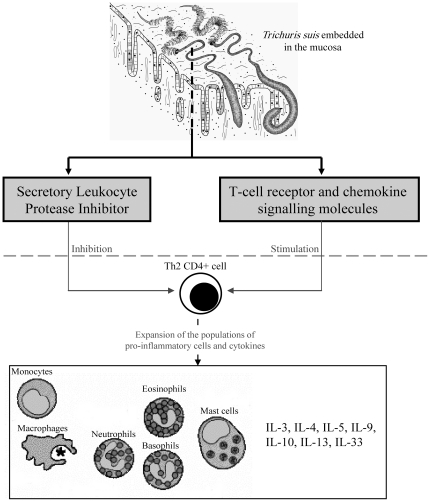
Iatrogenic infection of humans with Trichuris suis (a parasitic nematode of swine) is being evaluated or promoted as a biological, curative treatment of immune diseases, such as inflammatory bowel disease (IBD) and ulcerative colitis, in humans. Although it is understood that short-term T. suis infection in people with such diseases usually induces a modified Th2-immune response, nothing is known about the molecules in the parasite that induce this response.
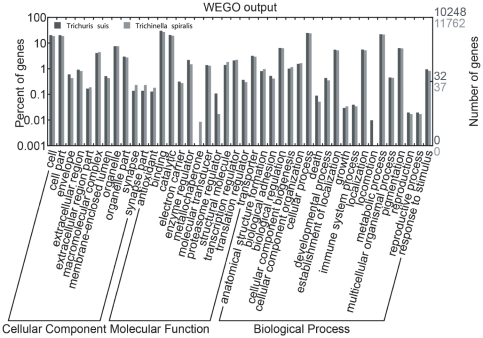
METHODOLOGY/PRINCIPAL FINDINGS: As a first step toward filling the gaps in our knowledge of the molecular biology of T. suis, we characterised the transcriptome of the adult stage of this nematode employing next-generation sequencing and bioinformatic techniques. A total of ∼65,000,000 reads were generated and assembled into ∼20,000 contiguous sequences ( = contigs); ∼17,000 peptides were predicted and classified based on homology searches, protein motifs and gene ontology and biological pathway mapping.
These analyses provided interesting insights into a number of molecular groups, particularly predicted excreted/secreted molecules (n = 1,288), likely to be involved in the parasite-host interactions, and also various molecules (n = 120) linked to chemokine, T-cell receptor and TGF-β signalling as well as leukocyte transendothelial migration and natural killer cell-mediated cytotoxicity, which are likely to be immuno-regulatory or -modulatory in the infected host. This information provides a conceptual framework within which to test the immunobiological basis for the curative effect of T. suis infection in humans against some immune diseases. Importantly, the T. suis transcriptome characterised herein provides a curated resource for detailed studies of the immuno-molecular biology of this parasite, and will underpin future genomic and proteomic explorations.
将猪的寄生性线虫——猪鞭虫感染人类,正被评估或推广为治疗人类免疫性疾病(如炎症性肠病和溃疡性结肠炎)的生物疗法。虽然人们知道,患有这些疾病的人感染短时间的猪鞭虫通常会引发一种改良的 Th2 免疫反应,但对于这种反应所诱导的寄生虫分子仍一无所知。
方法/主要发现:为了初步了解猪鞭虫分子生物学的知识空白,我们采用新一代测序和生物信息学技术对该线虫的成虫阶段进行了转录组学分析。共生成了约 6500 万条读数,并组装成约 20000 条连续序列(= 连续序列);根据同源性搜索、蛋白质基序和基因本体以及生物途径映射,预测并分类了约 17000 个肽。
这些分析为许多分子群提供了有趣的见解,特别是预测的分泌/分泌分子(n=1288),这些分子可能与寄生虫-宿主相互作用有关,以及各种与趋化因子、T 细胞受体和 TGF-β信号转导以及白细胞跨内皮迁移和自然杀伤细胞介导的细胞毒性有关的分子(n=120),这些分子可能在感染宿主中具有免疫调节或调节作用。这些信息为测试猪鞭虫感染人类对某些免疫性疾病的治疗效果的免疫生物学基础提供了一个概念框架。重要的是,本文所述的猪鞭虫转录组为该寄生虫免疫分子生物学的详细研究提供了一个经过整理的资源,并将为未来的基因组和蛋白质组探索提供基础。