Key Laboratory of Animal Ecology and Conservation Biology, Institute of Zoology, Chinese Academy of Sciences, Beijing, China.
PLoS One. 2011;6(8):e23623. doi: 10.1371/journal.pone.0023623. Epub 2011 Aug 24.
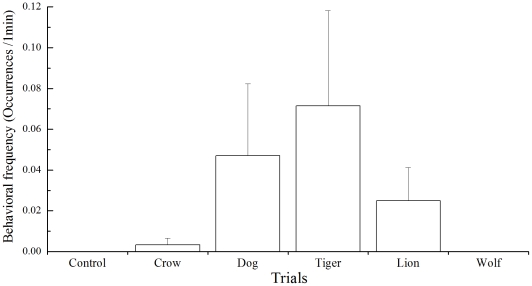
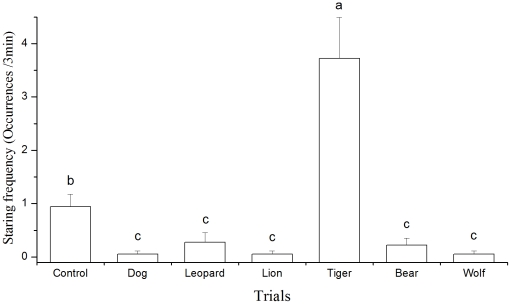
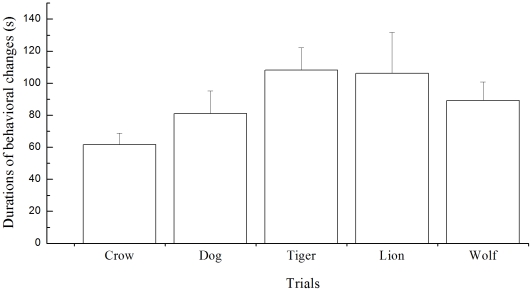
Whether prey retains antipredator behavior after a long period of predator relaxation is an important question in predator-prey evolution. Père David's deer have been raised in enclosures for more than 1200 years and this isolation provides an opportunity to study whether Père David's deer still respond to the cues of their ancestral predators or to novel predators. We played back the sounds of crows (familiar sound) and domestic dogs (familiar non-predators), of tigers and wolves (ancestral predators), and of lions (potential naïve predator) to Père David's deer in paddocks, and blank sounds to the control group, and videoed the behavior of the deer during the experiment. We also showed life-size photo models of dog, leopard, bear, tiger, wolf, and lion to the deer and video taped their responses after seeing these models. Père David's deer stared at and approached the hidden loudspeaker when they heard the roars of tiger or lion. The deer listened to tiger roars longer, approached to tiger roars more and spent more time staring at the tiger model. The stags were also found to forage less in the trials of tiger roars than that of other sound playbacks. Additionally, it took longer for the deer to restore their normal behavior after they heard tiger roars, which was longer than that after the trial of other sound playbacks. Moreover, the deer were only found to walk away after hearing the sounds of tiger and wolf. Therefore, the tiger was probably the main predator for Père David's deer in ancient time. Our study implies that Père David's deer still retain the memories of the acoustic and visual cues of their ancestral predators in spite of the long term isolation from natural habitat.
长期的捕食者放松后,猎物是否保留防御捕食者的行为是捕食者-猎物进化中的一个重要问题。麋鹿已经在围栏中饲养了 1200 多年,这种隔离为研究麋鹿是否仍然对其祖先捕食者的线索或新的捕食者做出反应提供了机会。我们在围场中向麋鹿播放乌鸦(熟悉的声音)和家犬(熟悉的非捕食者)、老虎和狼(祖先的捕食者)以及狮子(潜在的天真捕食者)的声音,对照组播放空白声音,并在实验过程中拍摄鹿的行为。我们还向麋鹿展示了狗、豹、熊、虎、狼和狮子的等身照片模型,并在看到这些模型后拍摄了它们的反应视频。当麋鹿听到老虎或狮子的咆哮时,它们会盯着并靠近隐藏的扬声器。麋鹿对老虎的咆哮听得时间更长,靠近得更多,盯着老虎模型的时间也更长。在老虎咆哮的试验中,雄鹿的觅食也比其他声音回放的试验少。此外,麋鹿在听到老虎咆哮后需要更长的时间才能恢复正常行为,比其他声音回放试验后需要的时间更长。而且,只有在听到老虎和狼的声音后,鹿才会离开。因此,老虎可能是古代麋鹿的主要捕食者。我们的研究表明,尽管麋鹿长期与自然栖息地隔离,但它们仍然保留着祖先捕食者的声音和视觉线索的记忆。