Women's Reproductive Health Research Center, Vanderbilt University School of Medicine, 1161 21st Avenue South MCN B-1100, Nashville, TN 37232, USA.
Expert Rev Clin Immunol. 2011 Sep;7(5):611-26. doi: 10.1586/eci.11.53.
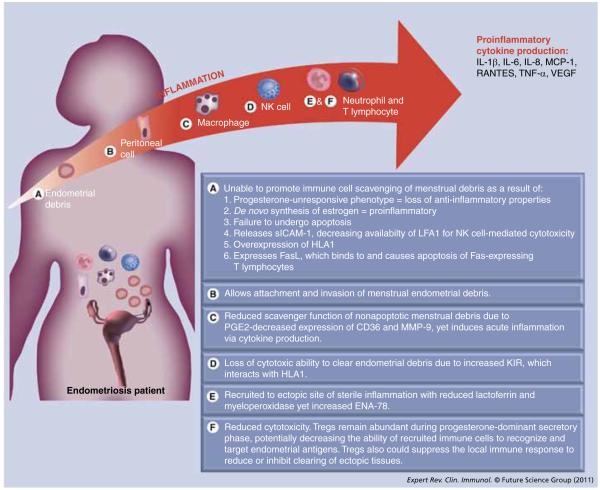
Endometriosis is a common, complex gynecologic disorder characterized by the presence of endometrial glands and stroma at extrauterine (ectopic) sites. In women who develop this disease, alterations in specific biological processes involving both the endocrine and immune systems have been observed, which may explain the survival and growth of displaced endometrial tissue in affected women. In the past decade, a considerable amount of research has implicated a role for alterations in progesterone action at both eutopic and ectopic sites of endometrial growth which may contribute to the excessive inflammation associated with progression of endometriosis; however, it remains unclear whether these anomalies induce the condition or are simply a consequence of the disease process. In this article, we summarize current knowledge of alterations within the immune system of endometriosis patients and discuss how endometrial cells from women with this disease not only have the capacity to escape immunosurveillance, but also use inflammatory mechanisms to promote their growth within the peritoneal cavity. Finally, we discuss evidence that exposure to an environmental endocrine disruptor, such as 2,3,7,8-tetrachlorodibenzo-p-dioxin, can mediate the development of an endometrial phenotype that exhibits both reduced progesterone responsiveness and hypersensitivity to proinflammatory stimuli mimicking the endometriosis phenotype. Future studies in women with endometriosis should consider whether a heightened inflammatory response within the peritoneal microenvironment contributes to the development and persistence of this disease.
子宫内膜异位症是一种常见且复杂的妇科疾病,其特征是在子宫外(异位)部位存在子宫内膜腺体和基质。在患有这种疾病的女性中,观察到涉及内分泌和免疫系统的特定生物学过程的改变,这可能解释了受影响女性中移位子宫内膜组织的存活和生长。在过去的十年中,大量研究表明,孕激素作用在子宫内膜生长的内位和异位部位的改变可能与子宫内膜异位症进展相关的过度炎症有关;然而,目前尚不清楚这些异常是导致该疾病的原因,还是仅仅是疾病过程的结果。在本文中,我们总结了子宫内膜异位症患者免疫系统内改变的现有知识,并讨论了患有这种疾病的女性的子宫内膜细胞不仅具有逃避免疫监视的能力,而且还利用炎症机制促进其在腹腔内的生长。最后,我们讨论了暴露于环境内分泌干扰物(如 2,3,7,8-四氯二苯并对二恶英)是否可以介导表现出孕激素反应降低和对模拟子宫内膜异位症表型的促炎刺激物过度敏感的子宫内膜表型的发展的证据。未来对子宫内膜异位症患者的研究应考虑腹腔微环境中是否存在增强的炎症反应是否有助于该疾病的发展和持续存在。