Department of Integrated Pulmonology, Tokyo Medical and Dental University, Tokyo, Japan.
Immunology. 2011 Oct;134(2):140-50. doi: 10.1111/j.1365-2567.2011.03473.x.
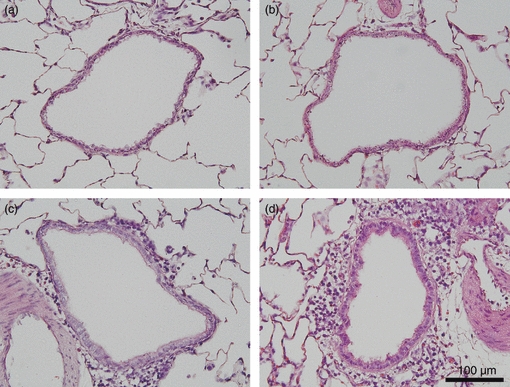
Respiratory viral infections are frequently associated with exacerbations of asthma. Double-stranded RNA (dsRNA) produced during viral infections may be one of the stimuli for exacerbation. We aimed to assess the potential effect of dsRNA on certain aspects of chronic asthma through the administration of polyinosine-polycytidylic acid (poly I:C), synthetic dsRNA, to a rat model of asthma. Brown Norway rats were sensitized to ovalbumin and challenged three times to evoke airway remodelling. The effect of poly I:C on the ovalbumin-induced airway inflammation and structural changes was assessed from bronchoalveolar lavage fluid and histological findings. The expression of cytokines and chemokines was evaluated by real-time quantitative reverse transcription PCR and ELISA. Ovalbumin-challenged animals showed an increased number of total cells and eosinophils in bronchoalveolar lavage fluid compared with PBS-challenged controls. Ovalbumin-challenged animals treated with poly I:C showed an increased number of total cells and neutrophils in bronchoalveolar lavage fluid compared with those without poly I:C treatment. Ovalbumin-challenged animals showed goblet cell hyperplasia, increased airway smooth muscle mass, and proliferation of both airway epithelial cells and airway smooth muscle cells. Treatment with poly I:C enhanced these structural changes. Among the cytokines and chemokines examined, the expression of interleukins 12 and 17 and of transforming growth factor-β(1) in ovalbumin-challenged animals treated with poly I:C was significantly increased compared with those of the other groups. Double-stranded RNA enhanced airway inflammation and remodelling in a rat model of bronchial asthma. These observations suggest that viral infections may promote airway remodelling.
呼吸道病毒感染常与哮喘加重有关。病毒感染期间产生的双链 RNA(dsRNA)可能是加重的刺激因素之一。我们旨在通过给予双链 RNA 合成物聚肌苷酸-聚胞苷酸(poly I:C)来评估 dsRNA 对哮喘慢性期某些方面的潜在影响,将其应用于哮喘大鼠模型中。棕色挪威大鼠对卵清蛋白致敏,并进行三次激发以诱发气道重塑。通过支气管肺泡灌洗液和组织学发现评估 poly I:C 对卵清蛋白诱导的气道炎症和结构变化的影响。通过实时定量逆转录 PCR 和 ELISA 评估细胞因子和趋化因子的表达。与 PBS 激发对照组相比,卵清蛋白激发的动物的支气管肺泡灌洗液中的总细胞和嗜酸性粒细胞数量增加。与没有 poly I:C 治疗的动物相比,用 poly I:C 治疗的卵清蛋白激发的动物的支气管肺泡灌洗液中的总细胞和中性粒细胞数量增加。卵清蛋白激发的动物表现出杯状细胞增生、气道平滑肌质量增加以及气道上皮细胞和气道平滑肌细胞的增殖。用 poly I:C 治疗增强了这些结构变化。在所检查的细胞因子和趋化因子中,与其他组相比,poly I:C 治疗的卵清蛋白激发的动物中白细胞介素 12 和 17 以及转化生长因子-β(1)的表达显著增加。双链 RNA 增强了支气管哮喘大鼠模型中的气道炎症和重塑。这些观察结果表明,病毒感染可能促进气道重塑。