Gupta Rajni, Verma Reetu, Bogra Jaishri, Kohli Monica, Raman Rajesh, Kushwaha Jitendra Kumar
Department of Anaesthesia, Chhatrapati Shahuji Maharaj Medical University, Uttar Pradesh, Lucknow, India.
J Anaesthesiol Clin Pharmacol. 2011 Jul;27(3):339-43. doi: 10.4103/0970-9185.83678.
Various adjuvants have been used with local anesthetics in spinal anesthesia to avoid intraoperative visceral and somatic pain and to provide prolonged postoperative analgesia. Dexmedetomidine, the new highly selective α2-agonist drug, is now being used as a neuraxial adjuvant. The aim of this study was to evaluate the onset and duration of sensory and motor block, hemodynamic effect, postoperative analgesia, and adverse effects of dexmedetomidine or fentanyl given intrathecally with hyperbaric 0.5% bupivacaine.
Sixty patients classified in American Society of Anesthesiologists classes I and II scheduled for lower abdominal surgeries were studied. Patients were randomly allocated to receive either 12.5 mg hyperbaric bupivacaine plus 5 μg dexmedetomidine (group D, n = 30) or 12.5 mg hyperbaric bupivacaine plus 25 μg fentanyl (group F, n = 30) intrathecal.
Patients in dexmedetomidine group (D) had a significantly longer sensory and motor block time than patients in fentanyl group (F). The mean time of sensory regression to S1 was 476±23 min in group D and 187±12 min in group F (P<0.001). The regression time of motor block to reach modified Bromage 0 was 421±21 min in group D and 149±18 min in group F (P<0.001).
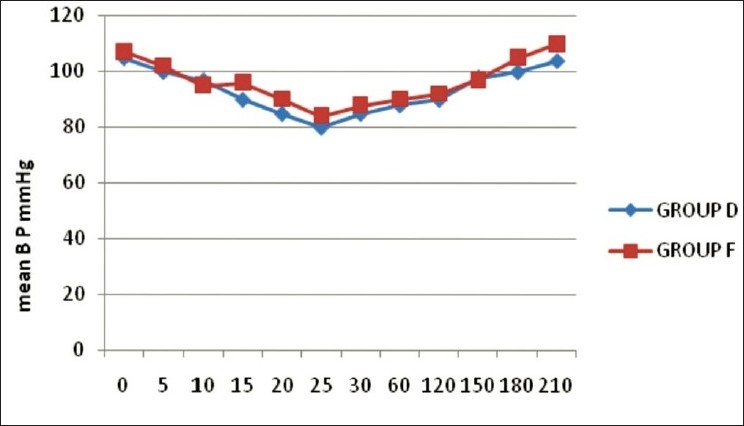
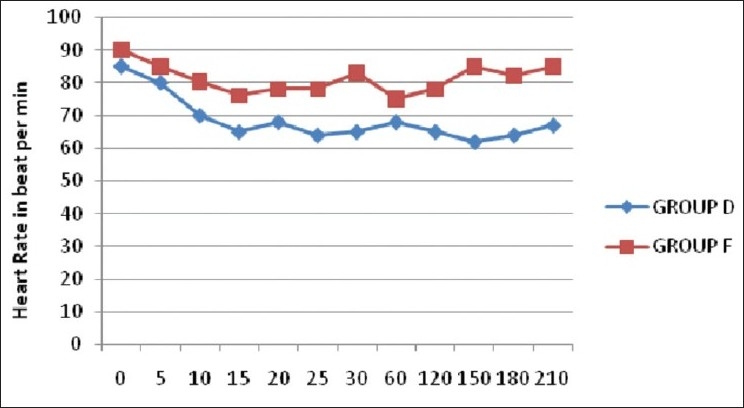
Intrathecal dexmedetomidine is associated with prolonged motor and sensory block, hemodynamic stability, and reduced demand for rescue analgesics in 24 h as compared to fentanyl.
在脊髓麻醉中,多种佐剂已与局部麻醉药联合使用,以避免术中内脏和躯体疼痛,并提供延长的术后镇痛效果。右美托咪定是一种新型的高选择性α2激动剂药物,目前正被用作神经轴佐剂。本研究的目的是评估右美托咪定或芬太尼与0.5%重比重布比卡因鞘内注射时的感觉和运动阻滞的起效时间和持续时间、血流动力学效应、术后镇痛及不良反应。
研究对象为60例美国麻醉医师协会分级为Ⅰ级和Ⅱ级、计划行下腹部手术的患者。患者被随机分为两组,分别接受鞘内注射12.5mg重比重布比卡因加5μg右美托咪定(D组,n = 30)或12.5mg重比重布比卡因加25μg芬太尼(F组,n = 30)。
右美托咪定组(D组)患者的感觉和运动阻滞时间明显长于芬太尼组(F组)。D组感觉恢复至S1的平均时间为476±23分钟,F组为187±12分钟(P<0.001)。D组运动阻滞恢复至改良Bromage 0级的时间为421±21分钟,F组为149±18分钟(P<0.001)。
与芬太尼相比,鞘内注射右美托咪定可延长运动和感觉阻滞时间,维持血流动力学稳定,并减少24小时内的补救性镇痛需求。