Department of Medical Statistics and Epidemiology, School of Public Health, Sun-Yat-sen University, Guangzhou, PR China.
BMC Public Health. 2011 Sep 7;11:693. doi: 10.1186/1471-2458-11-693.
Many injection drug users (IDUs) in China have high risk sexual behaviors that contribute to the spread of HIV infection. Although many IDUs in China move through drug rehabilitation centers, this opportunity for sexual health education has largely been overlooked.
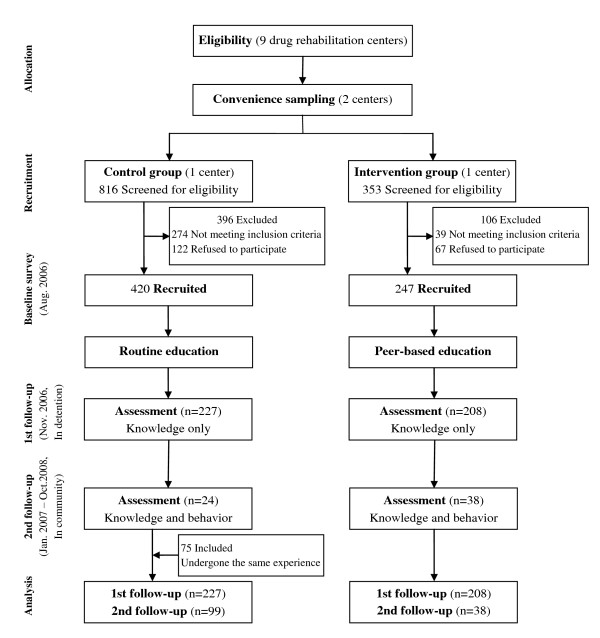
A convenience sample of 667 drug users from two rehabilitation centers in South China was recruited in the study. Two hundred and forty seven drug users from a single Guangdong Province rehabilitation center received the peer-based education intervention, while 420 drug users from another rehabilitation center received routine HIV/STI education and was used as the control. One hundred and eighty nine (22.1%) individuals refused to participate in the study. HIV/STI behavioral and knowledge domains were assessed at 3 months in rehabilitation centers after the intervention (first follow-up) and at 2-23 months in the community after release (second follow-up).
Drug users who completed the intervention reported more frequent condom use with casual sex partners (60.0% vs. 12.5% condom use every time, p = 0.011) and less frequent injection (56.7% vs. 26.4% no injection per day, p = 0.008) at the second follow-up compared to those in the routine education group. Loss to follow up was substantial in both control and intervention groups, and was associated with living far from the detention center and having poor HIV knowledge at baseline.
This study shows that rehabilitation centers may be a useful location for providing behavioral HIV/STI prevention services and referral of individuals to community-based programs upon release. More research is needed on behalf of detained drug users in China who have complex social, medical, and legal needs.
中国许多注射吸毒者(IDU)存在高风险性行为,这导致了 HIV 感染的传播。尽管中国的许多 IDU 都曾出入过戒毒康复中心,但针对他们的性健康教育培训却很大程度上被忽视了。
本研究招募了来自中国南方两个康复中心的 667 名吸毒者作为研究对象。其中,247 名吸毒者来自广东省的一个康复中心,接受了基于同伴的教育干预,而另外 420 名吸毒者则来自另一个康复中心,他们接受了常规的 HIV/性传播感染(STI)教育,并作为对照组。189 人(22.1%)拒绝参与研究。在康复中心接受干预后 3 个月(第一次随访)和释放后 2-23 个月(第二次随访),评估了 HIV/STI 行为和知识领域。
完成干预的吸毒者报告称,在第二次随访时,他们与偶然发生性行为的伴侣之间更频繁地使用安全套(60.0% vs. 12.5%每次都使用安全套,p=0.011),而且更少地进行注射(56.7% vs. 26.4%每天不注射,p=0.008)。与常规教育组相比,对照组和干预组的失访率都很高,而且与居住地点远离拘留中心以及基线时 HIV 知识较差有关。
本研究表明,康复中心可能是提供行为 HIV/STI 预防服务的有用场所,并在释放后将个人转介到社区项目中。需要更多的研究来满足中国那些具有复杂社会、医疗和法律需求的被拘留吸毒者。