Department of Biomedical Engineering, Robert M. Berne Cardiovascular Research Center, University of Virginia, Charlottesville, Virginia, United States of America.
PLoS One. 2011;6(8):e23795. doi: 10.1371/journal.pone.0023795. Epub 2011 Aug 25.
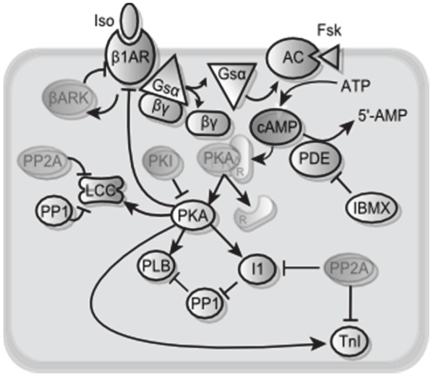
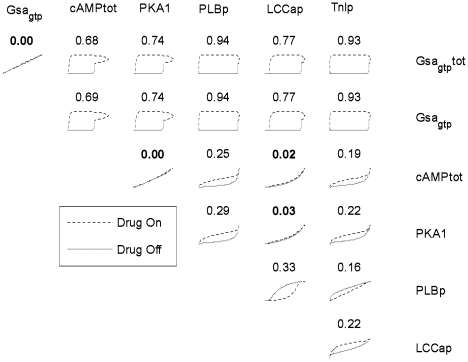
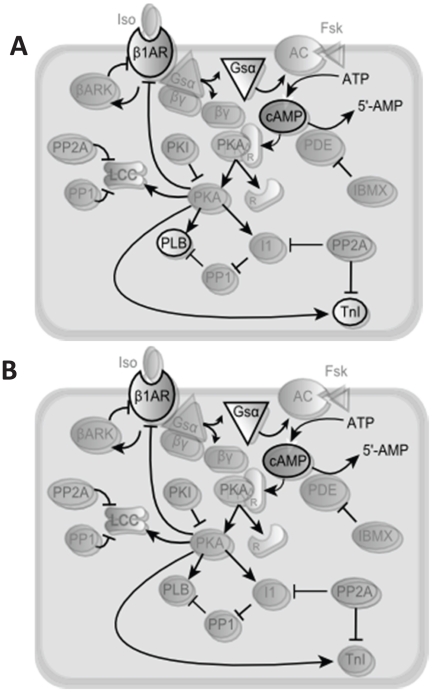
Model reduction is a central challenge to the development and analysis of multiscale physiology models. Advances in model reduction are needed not only for computational feasibility but also for obtaining conceptual insights from complex systems. Here, we introduce an intuitive graphical approach to model reduction based on phase plane analysis. Timescale separation is identified by the degree of hysteresis observed in phase-loops, which guides a "concentration-clamp" procedure for estimating explicit algebraic relationships between species equilibrating on fast timescales. The primary advantages of this approach over Jacobian-based timescale decomposition are that: 1) it incorporates nonlinear system dynamics, and 2) it can be easily visualized, even directly from experimental data. We tested this graphical model reduction approach using a 25-variable model of cardiac β(1)-adrenergic signaling, obtaining 6- and 4-variable reduced models that retain good predictive capabilities even in response to new perturbations. These 6 signaling species appear to be optimal "kinetic biomarkers" of the overall β(1)-adrenergic pathway. The 6-variable reduced model is well suited for integration into multiscale models of heart function, and more generally, this graphical model reduction approach is readily applicable to a variety of other complex biological systems.
模型简化是开发和分析多尺度生理模型的核心挑战。模型简化的进展不仅需要计算可行性,还需要从复杂系统中获得概念性的见解。在这里,我们介绍了一种基于相平面分析的直观图形模型简化方法。时标分离是通过在相环中观察到的滞后程度来确定的,这指导了一种“浓度钳制”程序,用于估计在快速时标上平衡的物种之间的显式代数关系。与基于雅可比的时标分解相比,该方法的主要优点在于:1)它包含非线性系统动力学,并且 2)它可以很容易地可视化,甚至可以直接从实验数据中进行可视化。我们使用心脏β(1)肾上腺素能信号的 25 变量模型测试了这种图形模型简化方法,得到了 6 变量和 4 变量的简化模型,即使在响应新的扰动时,这些模型也具有良好的预测能力。这 6 种信号物质似乎是整体β(1)肾上腺素能途径的最佳“动力学生物标志物”。6 变量简化模型非常适合集成到心脏功能的多尺度模型中,更一般地说,这种图形模型简化方法很容易应用于各种其他复杂的生物系统。