Department of Social and Environmental Health Research, Faculty of Public Health and Policy, London School of Hygiene and Tropical Medicine, London WC1H 9SH, UK.
BMJ. 2011 Sep 7;343:d5604. doi: 10.1136/bmj.d5604.
To explore compliance with the UK blood services' criterion that excludes men who have had penetrative sex with a man from donating blood, and to assess the possible effects of revising this policy.
A random location, cross sectional survey followed by qualitative interviews.
Britain.
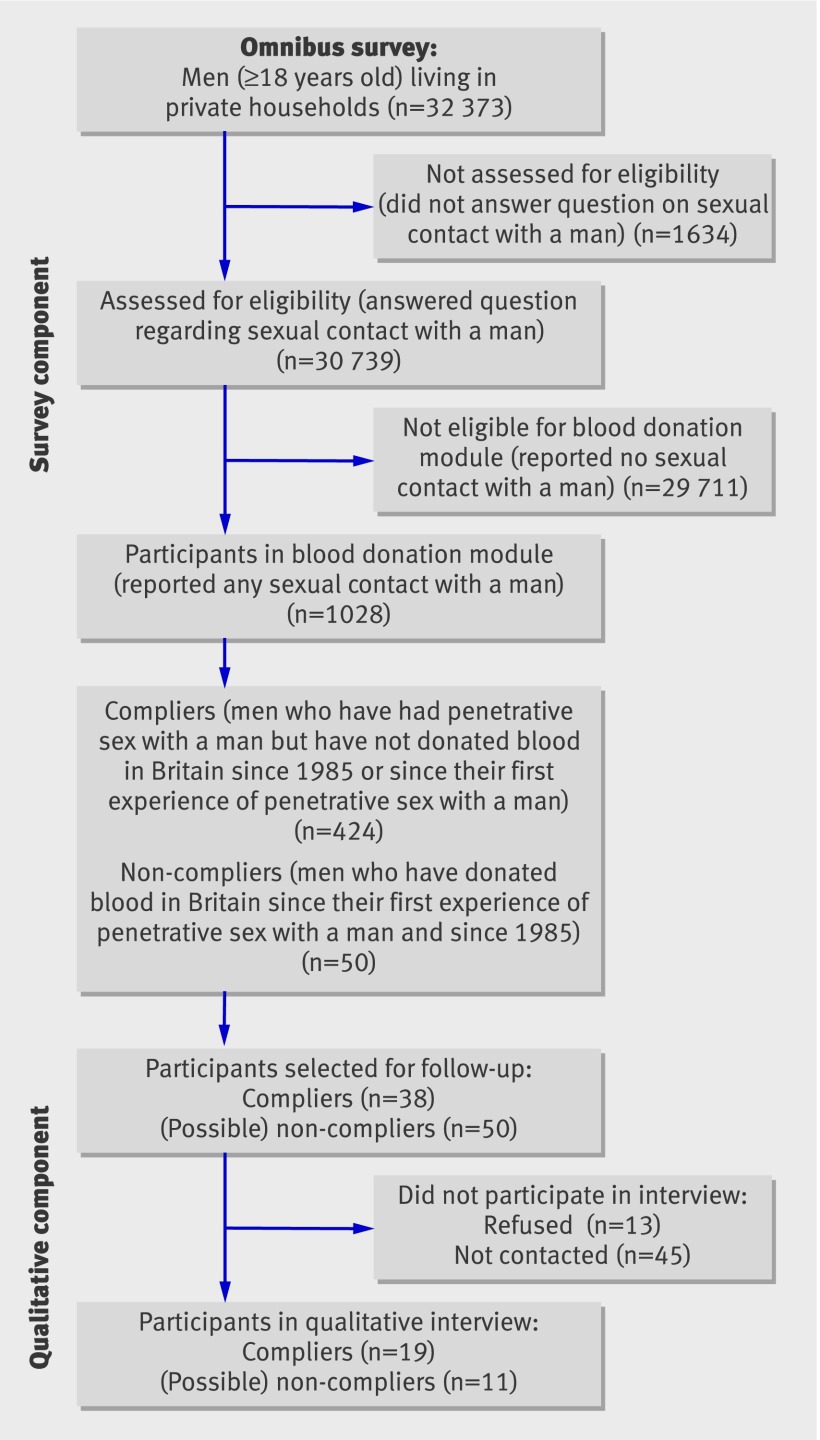
1028 of 32,373 men in the general population reporting any male sexual contact completed the survey. Additional questions were asked of a general population sample (n=3914). Thirty men who had had penetrative sex with a man participated in the qualitative interviews (19 who had complied with the blood services' exclusion criterion and 11 who had not complied). Main outcome measure Compliance with the blood services' lifetime exclusion criterion for men who have had penetrative sex with a man.
10.6% of men with experience of penetrative sex with a man reported having donated blood in Britain while ineligible under the exclusion criterion, and 2.5% had donated in the previous 12 months. Ineligible donation was less common among men who had had penetrative sex with a man recently (in previous 12 months) than among men for whom this last occurred longer ago. Reasons for non-compliance with the exclusion included self categorisation as low risk, discounting the sexual experience that barred donation, belief in the infallibility of blood screening, concerns about confidentiality, and misunderstanding or perceived inequity of the rule. Although blood donation was rarely viewed as a "right," potential donors were seen as entitled to a considered assessment of risk. A one year deferral since last male penetrative sex was considered by study participants to be generally feasible, equitable, and acceptable.
A minority of men who have sex with men who are ineligible to donate blood under the current donor exclusion in Britain have nevertheless done so in the past 12 months. Many of the reasons identified for non-compliance seem amenable to intervention. A clearly rationalised and communicated one year donor deferral is likely to be welcomed by most men who have sex with men.
探讨英国血液服务机构排除曾与男性发生过插入式性行为的男性献血的标准的遵守情况,并评估修订该政策的可能影响。
随机地点、横断面调查后进行定性访谈。
英国。
报告有任何男性性接触的普通人群中的 32373 名男性中的 1028 名完成了调查。另外还向普通人群样本(n=3914)提出了额外的问题。30 名曾与男性发生过插入式性行为的男性参加了定性访谈(19 名遵守了血液服务机构的排除标准,11 名不遵守)。
遵守英国血液服务机构对曾与男性发生过插入式性行为的男性的终身排除标准。
10.6%有过与男性发生过插入式性行为经历的男性报告在英国献血时不符合排除标准,其中 2.5%是在过去 12 个月内献血的。最近(过去 12 个月内)与男性发生过插入式性行为的男性不遵守排除规定的情况较少,而与男性发生插入式性行为的时间较长的男性不遵守的情况较多。不遵守排除规定的原因包括自我归类为低风险、对禁止献血的性行为经历不予考虑、对血液筛查的可靠性的信任、对保密性的关注、以及对规则的误解或认为不公平。尽管献血很少被视为“权利”,但潜在的献血者被视为有权对风险进行审慎评估。研究参与者认为,自上次与男性发生插入式性行为以来,一年的延迟是可行的、公平的和可接受的。
英国目前的献血者排除标准下,有少数曾与男性发生过性行为的男性在过去 12 个月内仍有献血行为。许多被确定为不遵守规定的原因似乎可以通过干预来解决。一个明确合理化和沟通良好的一年献血者延迟可能会受到大多数与男性发生过性行为的男性的欢迎。