Department of Molecular Medicine, Mayo Clinic College of Medicine, Rochester, Minnesota, USA.
Nat Methods. 2011 Sep 11;8(10):853-9. doi: 10.1038/nmeth.1703.
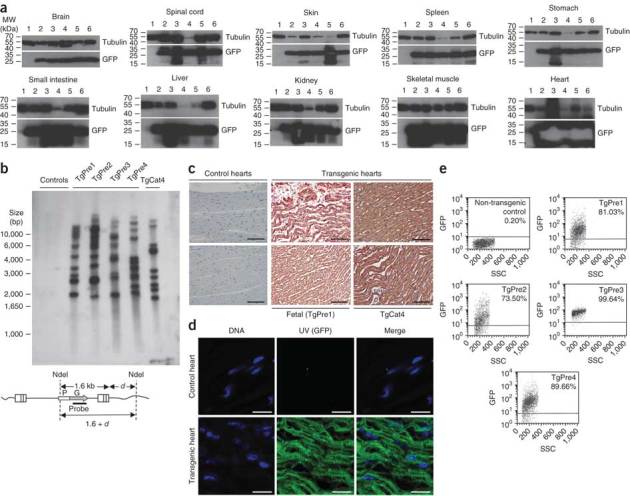
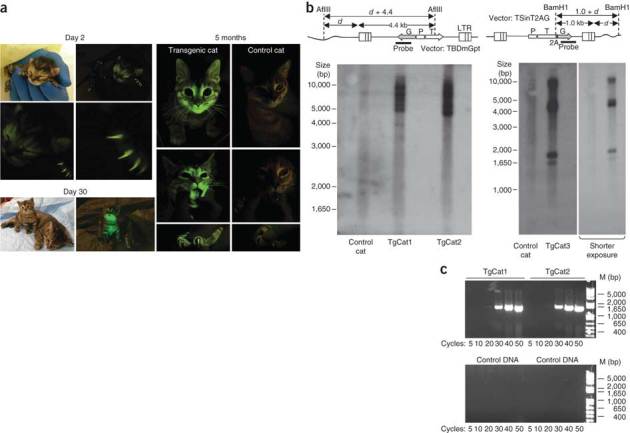
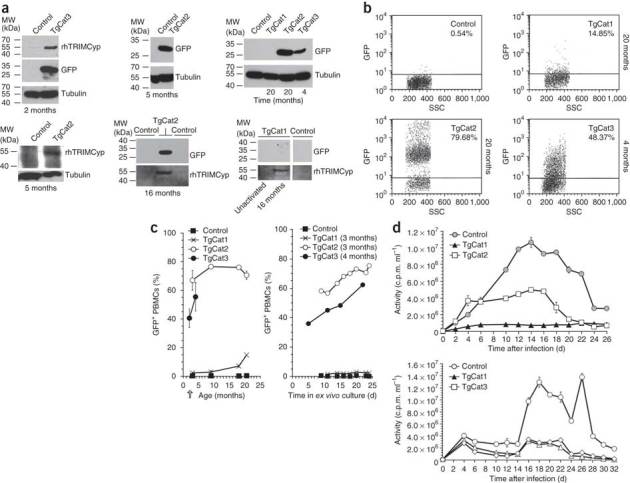
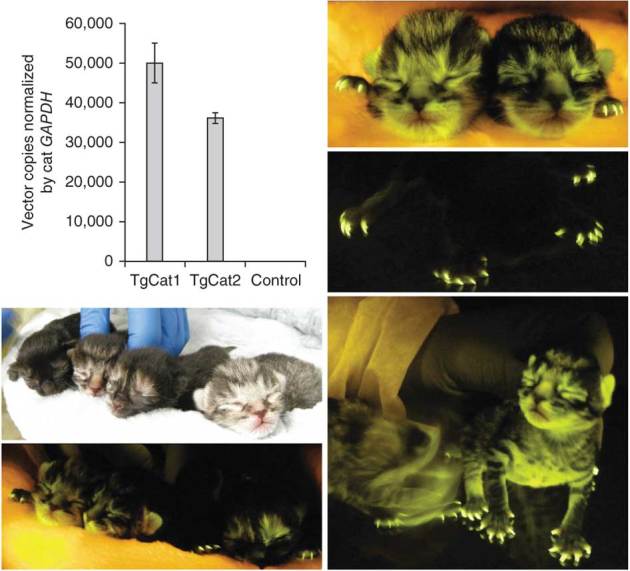
Studies of the domestic cat have contributed to many scientific advances, including the present understanding of the mammalian cerebral cortex. A practical capability for cat transgenesis is needed to realize the distinctive potential of research on this neurobehaviorally complex, accessible species for advancing human and feline health. For example, humans and cats are afflicted with pandemic AIDS lentiviruses that are susceptible to species-specific restriction factors. Here we introduced genes encoding such a factor, rhesus macaque TRIMCyp, and eGFP, into the cat germline. The method establishes gamete-targeted transgenesis for the first time in a carnivore. We observed uniformly transgenic outcomes, widespread expression, no mosaicism and no F1 silencing. TRIMCyp transgenic cat lymphocytes resisted feline immunodeficiency virus replication. This capability to experimentally manipulate the genome of an AIDS-susceptible species can be used to test the potential of restriction factors for HIV gene therapy and to build models of other infectious and noninfectious diseases.
对家猫的研究促进了许多科学进展,包括目前对哺乳动物大脑皮层的理解。为了实现对这种神经行为复杂、易于研究的物种的研究潜力,需要有一种实用的猫转基因能力,以推进人类和猫的健康。例如,人类和猫都患有易受物种特异性限制因素影响的大流行艾滋病慢病毒。在这里,我们将编码这种因子(恒河猴 TRIMCyp 和 eGFP)的基因导入猫的生殖系。该方法首次在肉食动物中建立了配子靶向转基因。我们观察到均匀的转基因结果、广泛的表达、没有嵌合体和没有 F1 沉默。TRIMCyp 转基因猫淋巴细胞抵抗猫免疫缺陷病毒的复制。这种对艾滋病易感物种基因组进行实验操作的能力可用于测试限制因子在 HIV 基因治疗中的潜力,并构建其他传染性和非传染性疾病的模型。