Department of Physical Education, University of Las Palmas de Gran Canaria, Campus Universitario de Tafira s/n, Las Palmas de Gran Canaria, Spain.
PLoS One. 2011;6(9):e24453. doi: 10.1371/journal.pone.0024453. Epub 2011 Sep 1.
Excessive time in front of a single or several screens could explain a displacement of physical activity. The present study aimed at determining whether screen-time is associated with a reduced level of moderate to vigorous physical activity (MVPA) in Spanish adolescents living in favorable environmental conditions.
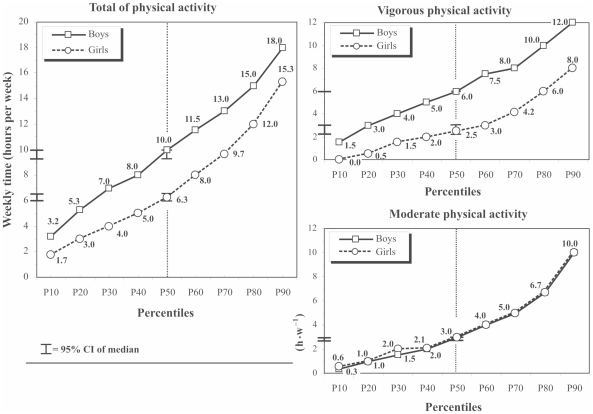
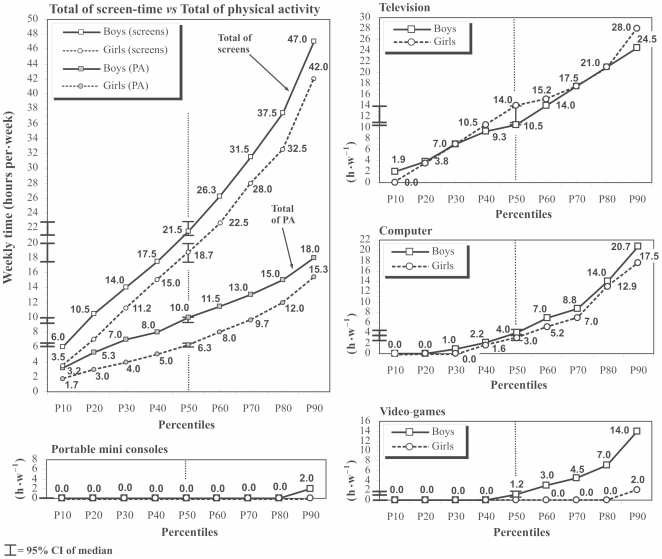
METHODOLOGY/PRINCIPAL FINDINGS: A multi-stage stratified random sampling method was used to select 3503 adolescents (12-18 years old) from the school population of Gran Canaria, Spain. MVPA, screen-time in front of television, computer, video game console and portable console was assessed in the classroom by fulfilling a standardized questionnaire. Bivariate and multivariate logistic regression analyses adjusted by a set of social-environmental variables were carried out. Forty-six percent of girls (95% CI±2.3%) and 26% of boys (95% CI±2.1%) did not meet the MVPA recommendations for adolescents. Major gender differences were observed in the time devoted to vigorous PA, video games and the total time spent on screen-based activities. Boys who reported 4 hours•week(-1) or more to total screen-time showed a 64% (OR = 0.61, 95% CI, 0.44-0.86) increased risk of failing to achieve the recommended adolescent MVPA level. Participation in organized physical activities and sports competitions were more strongly associated with MVPA than screen-related behaviors.
CONCLUSIONS/SIGNIFICANCE: No single screen-related behavior explained the reduction of MVPA in adolescents. However, the total time accumulated through several screen-related behaviors was negatively associated with MVPA level in boys. This association could be due to lower availability of time for exercise as the time devoted to sedentary screen-time activities increases. Participation in organized physical activities seems to counteract the negative impact of excessive time in front of screens on physical activity.
长时间盯着单一或多个屏幕可能会导致体力活动减少。本研究旨在确定在环境条件有利的情况下,屏幕时间是否与西班牙青少年中中等到剧烈体力活动(MVPA)水平降低有关。
方法/主要发现:采用多阶段分层随机抽样方法,从西班牙加那利群岛的学校人群中选择了 3503 名青少年(12-18 岁)。在课堂上通过填写标准化问卷评估了 MVPA、电视、电脑、视频游戏和便携式游戏机前的屏幕时间。进行了双变量和多变量逻辑回归分析,并调整了一系列社会环境变量。46%的女孩(95%CI±2.3%)和 26%的男孩(95%CI±2.1%)不符合青少年的 MVPA 建议。在剧烈 PA、视频游戏和基于屏幕的活动总时间上,男女之间存在明显的性别差异。报告每周总屏幕时间达到 4 小时或更多的男孩,达到青少年推荐 MVPA 水平的风险增加 64%(OR=0.61,95%CI,0.44-0.86)。有组织的体育活动和体育竞赛的参与与 MVPA 的相关性比屏幕相关行为更强。
结论/意义:没有单一的屏幕相关行为可以解释青少年中 MVPA 的减少。然而,几种屏幕相关行为累计的总时间与男孩的 MVPA 水平呈负相关。这种关联可能是由于花在久坐的屏幕时间活动上的时间增加,导致锻炼的时间减少。有组织的体育活动的参与似乎可以抵消长时间盯着屏幕对身体活动的负面影响。