Department of Clinical Pathology, The University Hospital of North Norway, Tromsø, Norway.
PLoS One. 2011;6(8):e24083. doi: 10.1371/journal.pone.0024083. Epub 2011 Aug 30.
In Norway, women with low-grade squamous intraepithelial lesions (LSIL) are followed up after six months in order to decide whether they should undergo further follow-up or be referred back to the screening interval of three years. A high specificity and positive predictive value (PPV) of the triage test is important to avoid unnecessary diagnostic and therapeutic procedures.
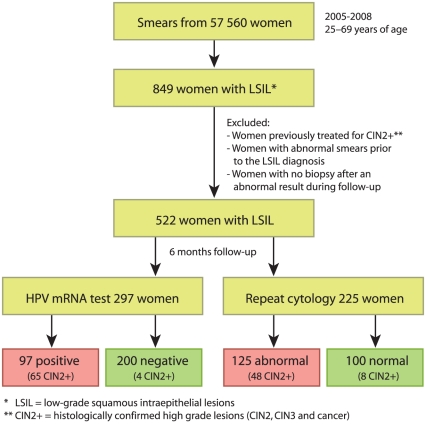
At the University Hospital of North Norway, repeat cytology and the HPV mRNA test PreTect HPV-Proofer, detecting E6/E7 mRNA from HPV types 16, 18, 31, 33 and 45, are used in triage of women with ASC-US and LSIL. In this study, women with LSIL cytology in the period 2005-2008 were included (n = 522). Two triage methods were evaluated in two separate groups: repeat cytology only (n = 225) and HPV mRNA testing in addition to repeat cytology (n = 297). Histologically confirmed cervical intraepithelial neoplasia of grade 2 or worse (CIN2+) was used as the study endpoint.
Of 522 women with LSIL, 207 had biopsies and 125 of them had CIN2+. The sensitivity and specificity of repeat cytology (ASC-US or worse) were 85.7% (95% confidence interval (CI): 72.1, 92.2) and 54.4 % (95% CI: 46.9, 61.9), respectively. The sensitivity and specificity of the HPV mRNA test were 94.2% (95% CI: 88.7, 99.7) and 86.0% (95% CI: 81.5, 90.5), respectively. The PPV of repeat cytology was 38.4% (95% CI: 29.9, 46.9) compared to 67.0% (95% CI: 57.7, 76.4) of the HPV mRNA test.
HPV mRNA testing was more sensitive and specific than repeat cytology in triage of women with LSIL cytology. In addition, the HPV mRNA test showed higher PPV. These data indicate that the HPV mRNA test is a better triage test for women with LSIL than repeat cytology.
在挪威,对低度鳞状上皮内病变(LSIL)的女性在六个月后进行随访,以决定是否需要进一步随访或重新回到三年一次的筛查间隔。对分流试验具有高特异性和阳性预测值(PPV)非常重要,可以避免不必要的诊断和治疗程序。
在挪威北大学医院,对 ASC-US 和 LSIL 患者进行重复细胞学检查和 HPV mRNA 检测 PreTect HPV-Proofer,检测 HPV 类型 16、18、31、33 和 45 的 E6/E7 mRNA。在这项研究中,纳入了 2005-2008 年 LSIL 细胞学患者(n=522)。对两种分流方法进行了两项独立的分组评估:仅重复细胞学检查(n=225)和 HPV mRNA 检测联合重复细胞学检查(n=297)。组织学证实的宫颈上皮内瘤变 2 级或更高级别(CIN2+)用作研究终点。
在 522 名 LSIL 女性中,有 207 人进行了活检,其中 125 人患有 CIN2+。重复细胞学检查(ASC-US 或更差)的敏感性和特异性分别为 85.7%(95%可信区间:72.1%,92.2%)和 54.4%(95%可信区间:46.9%,61.9%)。HPV mRNA 检测的敏感性和特异性分别为 94.2%(95%可信区间:88.7%,99.7%)和 86.0%(95%可信区间:81.5%,90.5%)。重复细胞学检查的 PPV 为 38.4%(95%可信区间:29.9%,46.9%),而 HPV mRNA 检测的 PPV 为 67.0%(95%可信区间:57.7%,76.4%)。
HPV mRNA 检测在 LSIL 细胞学患者的分流中比重复细胞学检查更敏感和特异。此外,HPV mRNA 检测显示出更高的 PPV。这些数据表明,与重复细胞学检查相比,HPV mRNA 检测是 LSIL 患者更好的分流试验。