Department of Clinical Pathology, The University Hospital of North Norway, Tromsø, Norway.
PLoS One. 2011;6(10):e26022. doi: 10.1371/journal.pone.0026022. Epub 2011 Oct 6.
In Norway, women with negative or low-grade cervical biopsies (normal/CIN1) are followed up after six months in order to decide on further follow-up or recall for screening at three-year intervals. A high specificity and positive predictive value (PPV) of the triage test is important to avoid unnecessary diagnostic and therapeutic procedures whereas a low risk of high-grade disease among triage negative women assures safety.
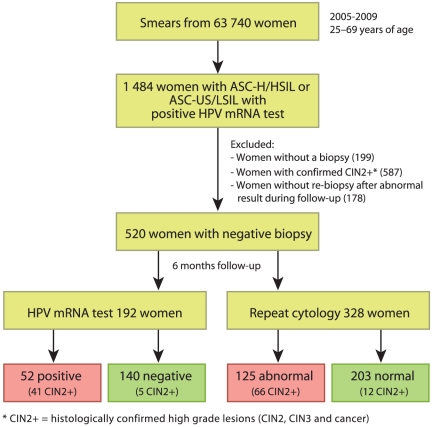
At the University Hospital of North Norway, cytology and the HPV mRNA test PreTect HPV-Proofer, detecting E6/E7 mRNA from HPV types 16, 18, 31, 33 and 45, are used in post-colposcopy follow-up of women with negative or low-grade biopsy. In this study, women with negative biopsy after high grade cytology (ASC-H/HSIL) and/or positive HPV mRNA test in the period 2005-2009 were included (n = 520). Histologically confirmed cervical intraepithelial neoplasia of grade 2 or worse (CIN2+) was used as study endpoint.
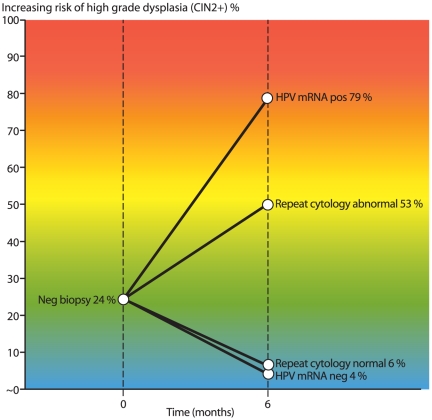
Of 520 women with negative or low-grade biopsy, 124 women (23.8%) had CIN2+ in follow-up biopsy. The sensitivity and specificity of the HPV mRNA test were 89.1% (95% CI, 80.1-98.1) and 92.5% (95% CI, 88.2-96.7), respectively. The ratios of sensitivity, specificity and PPV of HPV mRNA testing compared to repeat cytology for finding CIN2+ was 1.05 (95% CI: 0.92-1.21), 1.21 (95% CI: 1.12-1.32), and 1.49 (95% CI: 1.20-1.86), respectively. The PPV of mRNA was 77.3% (95% CI, 59.8-94.8) in women aged 40 or older.
Women with negative cervical biopsy require follow-up before resumption of routine screening. Post-colposcopy HPV mRNA testing was as sensitive but more specific than post-colposcopy cytology. In addition, the HPV mRNA test showed higher PPV. A positive mRNA test post-colposcopy could justify treatment in women above 40 years.
在挪威,对于宫颈活检为阴性或低级别病变(正常/CIN1)的女性,在六个月后进行随访,以决定是否需要进一步随访或每三年进行一次筛查。对分流检测具有较高的特异性和阳性预测值(PPV)非常重要,这样可以避免不必要的诊断和治疗程序,而分流阴性女性中高级别疾病的低风险则保证了安全性。
在挪威北特伦德拉格大学医院,细胞学和 HPV mRNA 检测 PreTect HPV-Proofer(可检测 HPV 类型 16、18、31、33 和 45 的 E6/E7 mRNA)用于高级别细胞学(ASC-H/HSIL)后阴性或低级别活检的女性的阴道镜检查后随访。在这项研究中,纳入了 2005-2009 年期间高级别细胞学阳性且 HPV mRNA 检测阳性的阴性活检女性(n=520)。组织学证实为宫颈上皮内瘤变 2 级或更高级别(CIN2+)作为研究终点。
在 520 例阴性或低级别活检的女性中,124 例(23.8%)在随访活检中出现 CIN2+。HPV mRNA 检测的敏感性和特异性分别为 89.1%(95%CI,80.1-98.1)和 92.5%(95%CI,88.2-96.7)。HPV mRNA 检测在发现 CIN2+方面的敏感性、特异性和 PPV 比值与重复细胞学检查相比分别为 1.05(95%CI:0.92-1.21)、1.21(95%CI:1.12-1.32)和 1.49(95%CI:1.20-1.86)。在 40 岁及以上的女性中,mRNA 的 PPV 为 77.3%(95%CI,59.8-94.8)。
宫颈活检阴性的女性需要在恢复常规筛查之前进行随访。阴道镜检查后 HPV mRNA 检测与阴道镜检查后细胞学检查相比,敏感性相同,但特异性更高。此外,HPV mRNA 检测具有更高的 PPV。阴道镜检查后 HPV mRNA 检测阳性可使 40 岁以上女性获益。