Medical Chronobiology Program, Division of Sleep Medicine, Brigham and Women's Hospital, Boston, Massachusetts, United States of America.
PLoS One. 2011;6(9):e24549. doi: 10.1371/journal.pone.0024549. Epub 2011 Sep 8.
Platelets are involved in the thromboses that are central to myocardial infarctions and ischemic strokes. Such adverse cardiovascular events have day/night patterns with peaks in the morning (~9 AM), potentially related to endogenous circadian clock control of platelet activation. The objective was to test if the human endogenous circadian system influences (1) platelet function and (2) platelet response to standardized behavioral stressors. We also aimed to compare the magnitude of any effects on platelet function caused by the circadian system with that caused by varied standardized behavioral stressors, including mental arithmetic, passive postural tilt and mild cycling exercise.
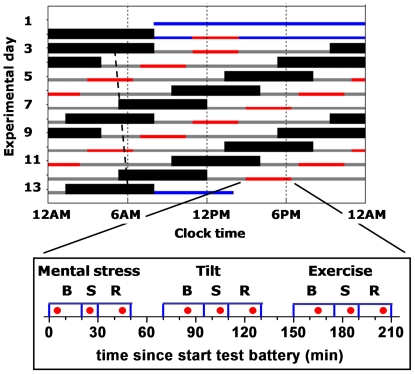
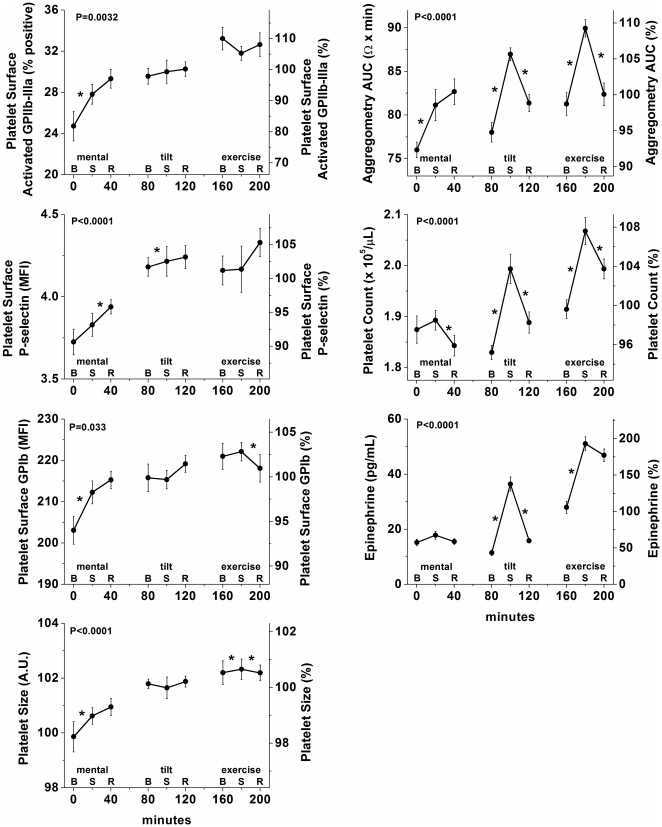
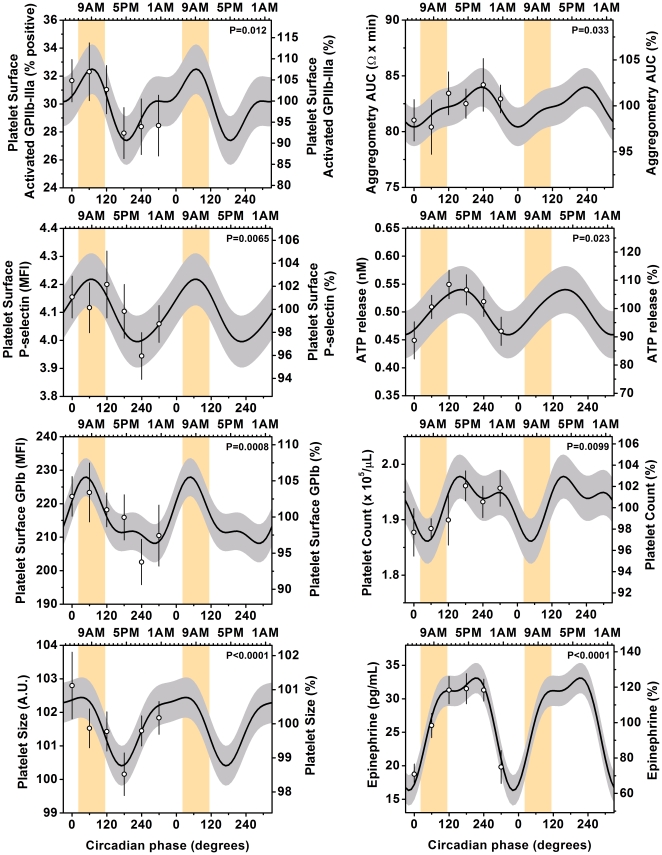
METHODOLOGY/PRINCIPAL FINDINGS: We studied 12 healthy adults (6 female) who lived in individual laboratory suites in dim light for 240 h, with all behaviors scheduled on a 20-h recurring cycle to permit assessment of endogenous circadian function independent from environmental and behavioral effects including the sleep/wake cycle. Circadian phase was assessed from core body temperature. There were highly significant endogenous circadian rhythms in platelet surface activated glycoprotein (GP) IIb-IIIa, GPIb and P-selectin (6-17% peak-trough amplitudes; p ≤ 0.01). These circadian peaks occurred at a circadian phase corresponding to 8-9 AM. Platelet count, ATP release, aggregability, and plasma epinephrine also had significant circadian rhythms but with later peaks (corresponding to 3-8 PM). The circadian effects on the platelet activation markers were always larger than that of any of the three behavioral stressors.
CONCLUSIONS/SIGNIFICANCE: These data demonstrate robust effects of the endogenous circadian system on platelet activation in humans--independent of the sleep/wake cycle, other behavioral influences and the environment. The 9 AM timing of the circadian peaks of the three platelet surface markers, including platelet surface activated GPIIb-IIIa, the final common pathway of platelet aggregation, suggests that endogenous circadian influences on platelet function could contribute to the morning peak in adverse cardiovascular events as seen in many epidemiological studies.
血小板参与到心肌梗死和缺血性中风的血栓形成中。这种不良心血管事件具有昼夜模式,峰值出现在早上(约 9 点),这可能与血小板激活的内源性生物钟控制有关。目的是测试人体内源性生物钟系统是否会影响(1)血小板功能和(2)血小板对标准化行为应激的反应。我们还旨在比较内源性生物钟系统对血小板功能的影响与各种标准化行为应激(包括心算、被动体位倾斜和轻度循环运动)的影响程度。
方法/主要发现:我们研究了 12 名健康成年人(6 名女性),他们在暗光下的单独实验室套房中生活了 240 小时,所有行为都按照 20 小时重复周期进行安排,以便在独立于环境和行为影响(包括睡眠/觉醒周期)的情况下评估内源性生物钟功能。核心体温评估了生物钟相位。血小板表面激活糖蛋白(GP)IIb-IIIa、GPIb 和 P-选择素的内源性昼夜节律具有高度显著性(6-17%的峰-谷振幅;p≤0.01)。这些昼夜节律峰值出现在生物钟相位对应于 8-9 点的时间。血小板计数、ATP 释放、聚集性和血浆肾上腺素也具有显著的昼夜节律,但峰值较晚(对应于 3-8 点)。生物钟对血小板激活标志物的影响始终大于三种行为应激之一的影响。
结论/意义:这些数据表明,内源性生物钟系统对人类血小板激活具有强大的影响——独立于睡眠/觉醒周期、其他行为影响和环境。三种血小板表面标志物(包括血小板表面激活的 GPIIb-IIIa,血小板聚集的最终共同途径)的昼夜节律峰值出现在 9 点,表明内源性生物钟对血小板功能的影响可能导致许多流行病学研究中观察到的不良心血管事件的早晨高峰。