Division of Pediatric Endocrinology and Diabetes, The Children’s Hospital of Philadelphia, PA, USA.
Diabetes Care. 2011 Nov;34(11):2442-7. doi: 10.2337/dc11-1093. Epub 2011 Sep 20.
Sleep deprivation is associated with increased risk of adult type 2 diabetes mellitus (T2DM). It is uncertain whether sleep deprivation and/or altered sleep architecture affects glycemic regulation or insulin sensitivity or secretion. We hypothesized that in obese adolescents, sleep disturbances would associate with altered glucose and insulin homeostasis.
This cross-sectional observational study of 62 obese adolescents took place at the Clinical and Translational Research Center and Sleep Laboratory in a tertiary care children's hospital. Subjects underwent oral glucose tolerance test (OGTT), anthropometric measurements, overnight polysomnography, and frequently sampled intravenous glucose tolerance test (FSIGT). Hemoglobin A(1c) (HbA(1c)) and serial insulin and glucose levels were obtained, indices of insulin sensitivity and secretion were calculated, and sleep architecture was assessed. Correlation and regression analyses were performed to assess the association of total sleep and sleep stages with measures of insulin and glucose homeostasis, adjusted for confounding variables.
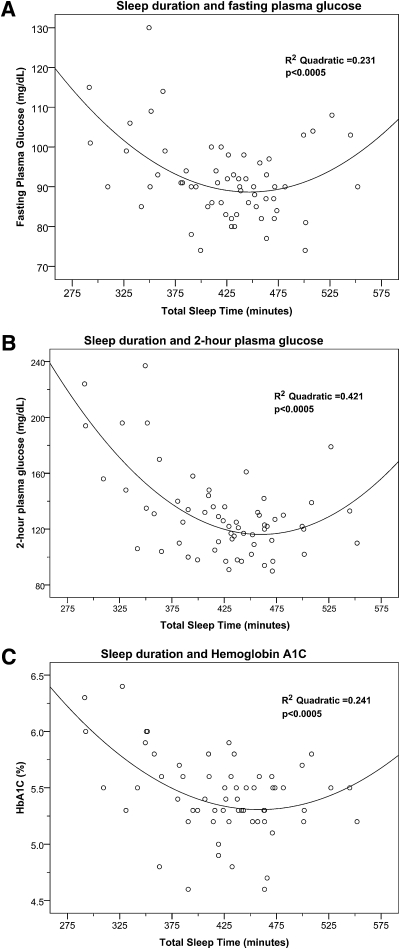
We found significant U-shaped (quadratic) associations between sleep duration and both HbA(1c) and serial glucose levels on OGTT and positive associations between slow-wave sleep (N3) duration and insulin secretory measures, independent of degree of obesity, pubertal stage, sex, and obstructive sleep apnea measures.
Insufficient and excessive sleep was associated with short-term and long-term hyperglycemia in our obese adolescents. Decreased N3 was associated with decreased insulin secretion. These effects may be related, with reduced insulin secretory capacity leading to hyperglycemia. We speculate that optimizing sleep may stave off the development of T2DM in obese adolescents.
睡眠剥夺与成人 2 型糖尿病(T2DM)风险增加有关。目前尚不确定睡眠剥夺和/或睡眠结构改变是否会影响血糖调节或胰岛素敏感性或分泌。我们假设在肥胖青少年中,睡眠障碍与葡萄糖和胰岛素稳态的改变有关。
这项横断面观察性研究在一家三级儿童医院的临床和转化研究中心及睡眠实验室对 62 名肥胖青少年进行。受试者接受口服葡萄糖耐量试验(OGTT)、人体测量学测量、整夜多导睡眠图和频繁采样静脉葡萄糖耐量试验(FSIGT)。检测血红蛋白 A1c(HbA1c)和连续的胰岛素和血糖水平,计算胰岛素敏感性和分泌指数,并评估睡眠结构。进行相关性和回归分析,以评估总睡眠时间和睡眠阶段与胰岛素和葡萄糖稳态测量值的关联,同时调整混杂变量。
我们发现睡眠时间与 OGTT 期间的 HbA1c 和连续血糖水平呈显著的 U 形(二次)关联,与慢波睡眠(N3)时间呈正相关,与胰岛素分泌指标独立,与肥胖程度、青春期阶段、性别和阻塞性睡眠呼吸暂停测量无关。
在我们的肥胖青少年中,睡眠不足和过多与短期和长期高血糖有关。N3 减少与胰岛素分泌减少有关。这些影响可能相关,胰岛素分泌能力降低导致高血糖。我们推测,优化睡眠可能会延缓肥胖青少年 2 型糖尿病的发展。