York University, Toronto, Ontario, Canada.
Clin Rehabil. 2012 Feb;26(2):152-64. doi: 10.1177/0269215511410579. Epub 2011 Sep 21.
The purpose of this study was to investigate the factor structure and psychometric properties of the Cardiac Rehabilitation Barriers Scale (CRBS).
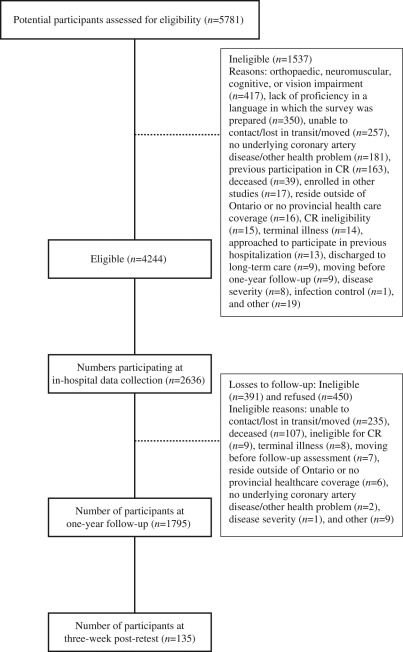
DESIGN, SETTING, AND PARTICIPANTS: In total, 2636 cardiac inpatients from 11 hospitals completed a survey. One year later, participants completed a follow-up survey, which included the CRBS. A subsample of patients also completed a third survey which included the CRBS, the Cardiac Rehabilitation Enrolment Obstacles scale, and the Beliefs About Cardiac Rehabilitation scale three weeks later. The CRBS asked participants to rate 21 cardiac rehabilitation barriers on a five-point Likert scale regardless of cardiac rehabilitation referral or enrolment.
Maximum likelihood factor analysis with oblique rotation resulted in a four-factor solution: perceived need/healthcare factors (eigenvalue = 6.13, Cronbach's α = .89), logistical factors (eigenvalue = 5.83, Cronbach's α = .88), work/time conflicts (eigenvalue = 3.78, Cronbach's α = .71), and comorbidities/functional status (eigenvalue = 4.85, Cronbach's α = .83). Mean total perceived barriers were significantly greater among non-enrollees than cardiac rehabilitation enrollees (P < .001). Convergent validity with the Beliefs About Cardiac Rehabilitation and Cardiac Rehabilitation Enrolment Obstacles scales was also demonstrated. Test-retest reliability of the CRBS was acceptable (intraclass correlation coefficient = .64).
The CRBS consists of four subscales and has sound psychometric properties. The extent to which identified barriers can be addressed to facilitate greater cardiac rehabilitation utilization warrants future study.
本研究旨在探讨心脏康复障碍量表(CRBS)的结构因素和心理测量特性。
设计、地点和参与者:共有来自 11 家医院的 2636 名住院心脏病患者完成了一项调查。一年后,参与者完成了一项随访调查,其中包括 CRBS。部分患者还在三周后完成了第三次调查,其中包括 CRBS、心脏康复登记障碍量表和对心脏康复的信念量表。CRBS 要求参与者在五点李克特量表上对 21 个心脏康复障碍进行评分,无论是否有心脏康复推荐或登记。
采用斜交旋转的最大似然因子分析得到了一个四因素解决方案:感知需求/医疗保健因素(特征值=6.13,Cronbach's α=.89)、逻辑因素(特征值=5.83,Cronbach's α=.88)、工作/时间冲突(特征值=3.78,Cronbach's α=.71)和合并症/功能状态(特征值=4.85,Cronbach's α=.83)。未登记患者的总感知障碍明显高于心脏康复登记患者(P<0.001)。与对心脏康复的信念和心脏康复登记障碍量表的收敛效度也得到了证明。CRBS 的重测信度是可以接受的(组内相关系数=0.64)。
CRBS 由四个分量表组成,具有良好的心理测量特性。未来需要进一步研究识别出的障碍在多大程度上可以得到解决,以促进更多的心脏康复利用。