Department of Public Health, Faculty of Medicine, Masaryk University, 62500 Brno, Czech Republic.
Department of Rehabilitation, University Hospital Brno, 62500 Brno, Czech Republic.
Int J Environ Res Public Health. 2021 Dec 12;18(24):13113. doi: 10.3390/ijerph182413113.
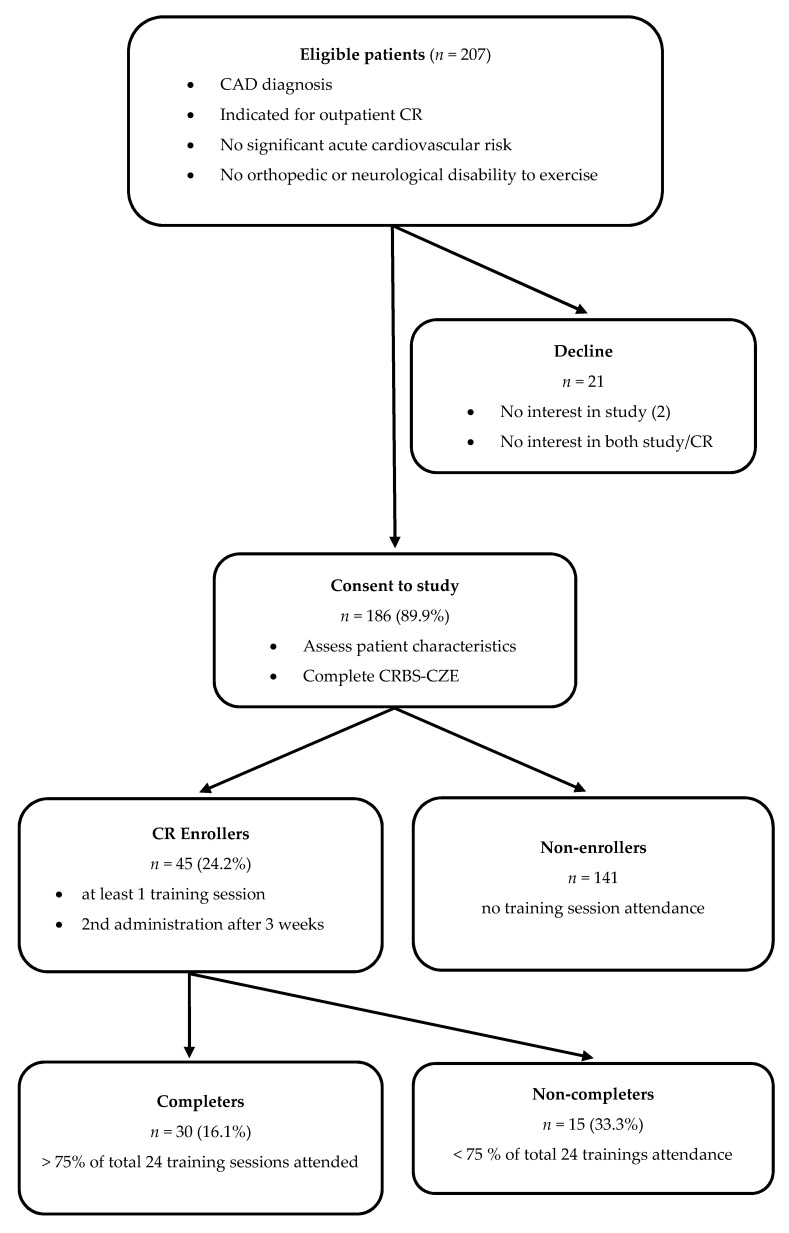
Cardiovascular rehabilitation (CR) is an effective secondary preventive model of care. However, the use of CR is insufficient, and the reasons for this are not well-characterized in East-Central Europe. This prospective observational study psychometrically validated the recently translated Cardiac Rehabilitation Barriers Scale for the Czech language (CRBS-CZE) and identified the main CR barriers. Consecutive cardiac in/out-patients were approached from January 2020 for 18 months, of whom 186 (89.9%) consented. In addition to sociodemographic characteristics, participants completed the 21-item CRBS-CZE (response options 1-5, with higher scores representing greater barriers), and their CR utilization was tracked. Forty-five (24.2%) participants enrolled in CR, of whom 42 completed the CRBS a second time thereafter. Factor analysis revealed four factors, consistent with other CRBS translations. Internal reliability was acceptable for all but one factor (Cronbach's alpha range = 0.44-0.77). Mean total barrier scores were significantly higher in non-enrollers ( < 0.001), decreased from first and second administration in these enrollers ( < 0.001), and were lower in CR completers ( < 0.001), supporting criterion validity. There were also significant differences in barrier scores by education, geography, tobacco use, among other variables, further supporting validity. The biggest barriers to enrolment were distance, work responsibilities, lack of time, transportation problems, and comorbidities; and the greatest barriers to adherence were distance and travel. Several items were considered irrelevant at first and second administration. Other barriers included wearing a mask during the COVID-19 pandemic. The study demonstrated sufficient validity and reliability of CRBS-CZE, which supports its use in future research.
心血管康复(CR)是一种有效的二级预防护理模式。然而,在中东欧地区,CR 的使用率不足,其原因尚不清楚。本前瞻性观察研究对最近翻译的捷克语版心脏康复障碍量表(CRBS-CZE)进行了心理测量学验证,并确定了主要的 CR 障碍。2020 年 1 月开始,对连续的心脏内外科门诊患者进行了为期 18 个月的调查,其中 186 人(89.9%)同意参与。除了社会人口统计学特征外,参与者还完成了 21 项 CRBS-CZE(回答选项 1-5,分数越高表示障碍越大),并跟踪了他们的 CR 使用情况。45 名(24.2%)参与者参加了 CR,其中 42 名参与者随后完成了第二次 CRBS。因子分析显示有四个因子,与其他 CRBS 翻译一致。除了一个因子(Cronbach's alpha 范围=0.44-0.77)外,其他所有因子的内部信度都可以接受。未参加者的总障碍评分显著较高(<0.001),参加者的评分在第一次和第二次测量时都有所下降(<0.001),而完成 CR 的患者的评分较低(<0.001),这支持了效标效度。在教育、地理位置、吸烟等变量方面,障碍评分也存在显著差异,进一步支持了有效性。参加者的主要障碍是距离、工作责任、缺乏时间、交通问题和合并症;而坚持的最大障碍是距离和旅行。最初的两次测量中有几个项目被认为不相关。其他障碍包括在 COVID-19 大流行期间戴口罩。研究表明,CRBS-CZE 具有足够的有效性和可靠性,支持其在未来的研究中使用。