López-Pedrera Chary, Pérez-Sánchez Carlos, Ramos-Casals Manuel, Santos-Gonzalez Monica, Rodriguez-Ariza Antonio, Cuadrado Ma José
Unidad de Investigación e Instituto Maimónides de Investigación Biomédica de Córdoba (IMIBIC), Hospital Universitario Reina Sofía, Avda. Menéndez Pidal s/n, 14004 Córdoba, Spain.
Clin Dev Immunol. 2012;2012:974648. doi: 10.1155/2012/974648. Epub 2011 Sep 14.
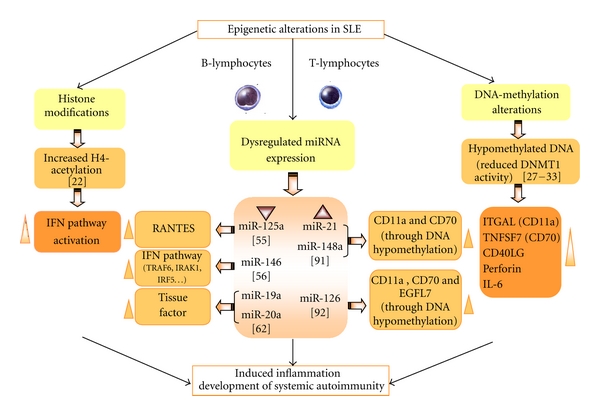
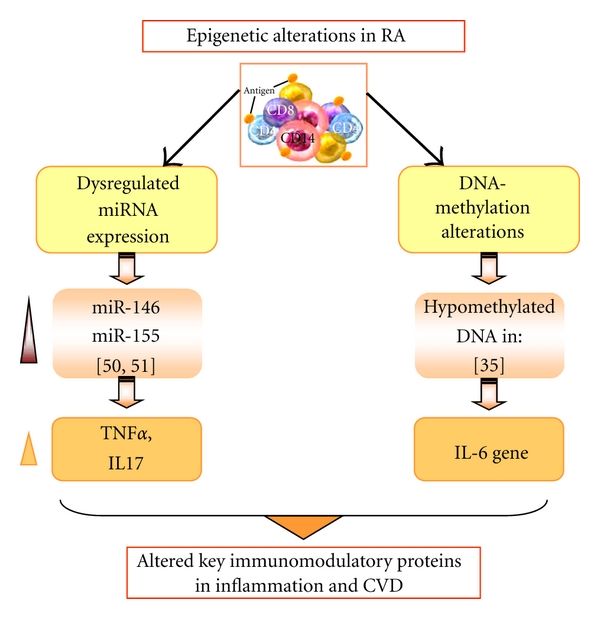
Autoimmune diseases (AIDs) have been associated with accelerated atherosclerosis (AT) leading to increased cardio- and cerebrovascular disease risk. Traditional risk factors, as well as systemic inflammation mediators, including cytokines, chemokines, proteases, autoantibodies, adhesion receptors, and others, have been implicated in the development of these vascular pathologies. Yet, the characteristics of vasculopathies may significantly differ depending on the underlying disease. In recent years, many new genes and signalling pathways involved in autoimmunity with often overlapping patterns between different disease entities have been further detected. Epigenetics, the control of gene packaging and expression independent of alterations in the DNA sequence, is providing new directions linking genetics and environmental factors. Epigenetic regulatory mechanisms comprise DNA methylation, histone modifications, and microRNA activity, all of which act upon gene and protein expression levels. Recent findings have contributed to our understanding of how epigenetic modifications could influence AID development, not only showing differences between AID patients and healthy controls, but also showing how one disease differs from another and even how the expression of key proteins involved in the development of each disease is regulated.
自身免疫性疾病(AIDs)与动脉粥样硬化(AT)加速有关,导致心血管和脑血管疾病风险增加。传统风险因素以及包括细胞因子、趋化因子、蛋白酶、自身抗体、黏附受体等在内的全身炎症介质,都与这些血管病变的发展有关。然而,血管病变的特征可能因潜在疾病的不同而有显著差异。近年来,许多参与自身免疫的新基因和信号通路被进一步发现,不同疾病实体之间往往存在重叠模式。表观遗传学,即独立于DNA序列改变的基因包装和表达控制,正在为连接遗传和环境因素提供新方向。表观遗传调控机制包括DNA甲基化、组蛋白修饰和微小RNA活性,所有这些都作用于基因和蛋白质表达水平。最近的研究结果有助于我们理解表观遗传修饰如何影响自身免疫性疾病的发展,不仅显示了自身免疫性疾病患者与健康对照之间的差异,还显示了一种疾病与另一种疾病的不同之处,甚至显示了参与每种疾病发展的关键蛋白质的表达是如何被调控的。