Rheumatology Service, Reina Sofia Hospital/Maimonides Institute for Research in Biomedicine of Cordoba (IMIBIC)/University of Cordoba, E-14004 Córdoba, Spain.
Int J Mol Sci. 2020 Mar 16;21(6):2012. doi: 10.3390/ijms21062012.
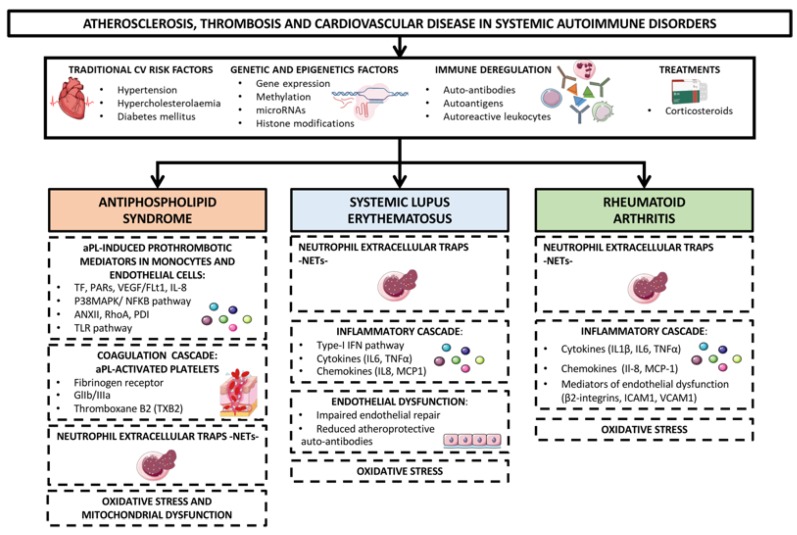
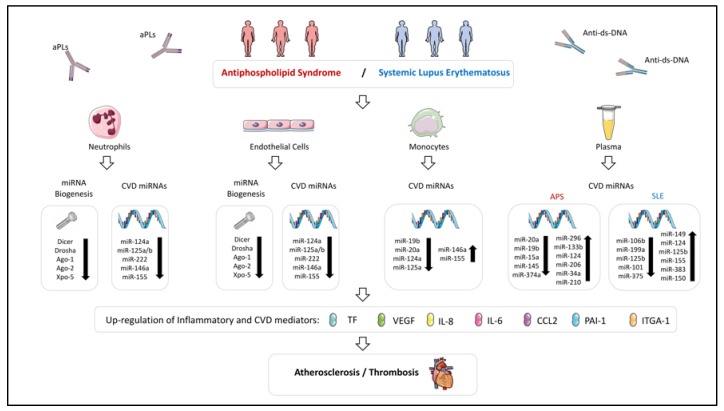
Rheumatoid Arthritis (RA), Systemic lupus erythematosus (SLE) and antiphospholipid syndrome (APS) are the systemic autoimmune diseases (SADs) most associated with an increased risk of developing cardiovascular (CV) events. Cardiovascular disease (CVD) in SADs results from a complex interaction between traditional CV-risk factors, immune deregulation and disease activity. Oxidative stress, dyslipidemia, endothelial dysfunction, inflammatory/prothrombotic mediators (cytokines/chemokines, adipokines, proteases, adhesion-receptors, NETosis-derived-products, and intracellular-signaling molecules) have been implicated in these vascular pathologies. Genetic and genomic analyses further allowed the identification of signatures explaining the pro-atherothrombotic profiles in RA, SLE and APS. However, gene modulation has left significant gaps in our understanding of CV co-morbidities in SADs. MicroRNAs (miRNAs) are emerging as key post-transcriptional regulators of a suite of signaling pathways and pathophysiological effects. Abnormalities in high number of miRNA and their associated functions have been described in several SADs, suggesting their involvement in the development of atherosclerosis and thrombosis in the setting of RA, SLE and APS. This review focusses on recent insights into the potential role of miRNAs both, as clinical biomarkers of atherosclerosis and thrombosis in SADs, and as therapeutic targets in the regulation of the most influential processes that govern those disorders, highlighting the potential diagnostic and therapeutic properties of miRNAs in the management of CVD.
类风湿关节炎 (RA)、系统性红斑狼疮 (SLE) 和抗磷脂综合征 (APS) 是与发生心血管 (CV) 事件风险增加最相关的系统性自身免疫性疾病 (SAD)。SAD 中的心血管疾病 (CVD) 是由传统 CV 危险因素、免疫失调和疾病活动之间的复杂相互作用引起的。氧化应激、血脂异常、内皮功能障碍、炎症/促血栓形成介质 (细胞因子/趋化因子、脂肪因子、蛋白酶、黏附受体、NETosis 衍生产物和细胞内信号分子) 与这些血管病理学有关。遗传和基因组分析进一步确定了 RA、SLE 和 APS 中解释促动脉粥样硬化特征的特征。然而,基因调节在我们对 SAD 中 CV 合并症的理解方面留下了很大的空白。微小 RNA (miRNA) 作为一系列信号通路和病理生理效应的关键转录后调节剂而出现。在几种 SAD 中描述了大量 miRNA 及其相关功能的异常,表明它们参与了 RA、SLE 和 APS 中动脉粥样硬化和血栓形成的发生。这篇综述重点介绍了 miRNA 在 SAD 中动脉粥样硬化和血栓形成的临床生物标志物以及调节控制这些疾病的最具影响力的过程的治疗靶点方面的潜在作用的最新见解,突出了 miRNA 在 CVD 管理中的潜在诊断和治疗特性。