Sydney School of Public Health, University of Sydney, Sydney NSW 2006, Australia.
Popul Health Metr. 2011 Sep 25;9:53. doi: 10.1186/1478-7954-9-53.
Many studies have documented the bias in body mass index (BMI) determined from self-reported data on height and weight, but few have examined the change in bias over time.
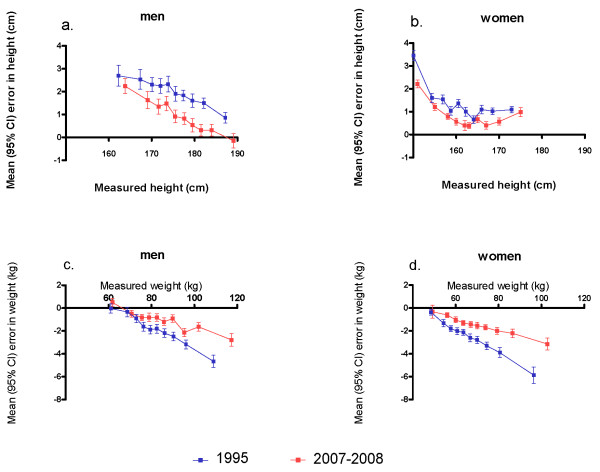
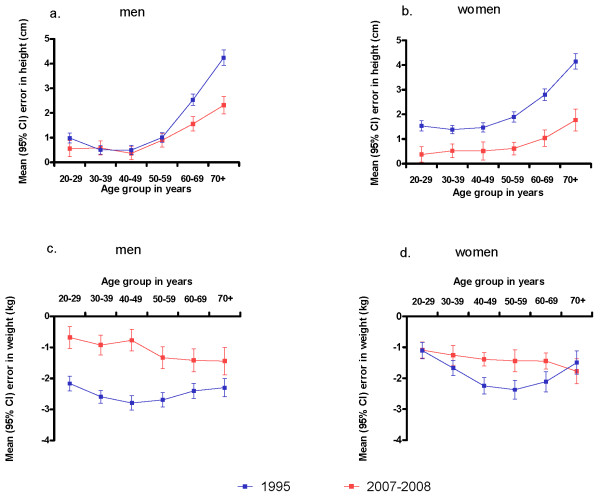
Using data from large, nationally-representative population health surveys, we examined change in bias in height and weight reporting among Australian adults between 1995 and 2008. Our study dataset included 9,635 men and women in 1995 and 9,141 in 2007-2008. We investigated the determinants of the bias and derived correction equations using 2007-2008 data, which can be applied when only self-reported anthropometric data are available.
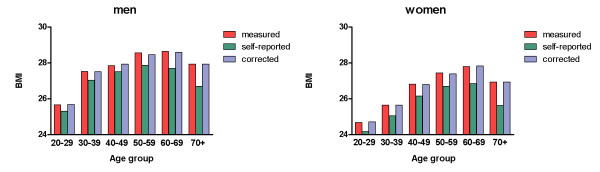
In 1995, self-reported BMI (derived from height and weight) was 1.2 units (men) and 1.4 units (women) lower than measured BMI. In 2007-2008, there was still underreporting, but the amount had declined to 0.6 units (men) and 0.7 units (women) below measured BMI. The major determinants of reporting error in 2007-2008 were age, sex, measured BMI, and education of the respondent. Correction equations for height and weight derived from 2007-2008 data and applied to self-reported data were able to adjust for the bias and were accurate across all age and sex strata.
The diminishing reporting bias in BMI in Australia means that correction equations derived from 2007-2008 data may not be transferable to earlier self-reported data. Second, predictions of future overweight and obesity in Australia based on trends in self-reported information are likely to be inaccurate, as the change in reporting bias will affect the apparent increase in self-reported obesity prevalence.
许多研究记录了基于身高和体重自我报告数据确定的体重指数(BMI)存在偏差,但很少有研究检查这种偏差随时间的变化。
我们利用来自大型全国代表性人群健康调查的数据,检查了澳大利亚成年人在 1995 年至 2008 年间身高和体重报告偏差的变化。我们的研究数据集包括 1995 年的 9635 名男性和女性,以及 2007-2008 年的 9141 名男性和女性。我们调查了偏差的决定因素,并使用 2007-2008 年的数据得出了校正方程,这些方程可用于仅获得自我报告的人体测量数据的情况。
1995 年,自我报告的 BMI(根据身高和体重计算得出)比实测 BMI 低 1.2 个单位(男性)和 1.4 个单位(女性)。2007-2008 年,仍然存在低报,但数量已降至实测 BMI 以下 0.6 个单位(男性)和 0.7 个单位(女性)。2007-2008 年报告错误的主要决定因素是年龄、性别、实测 BMI 和受访者的教育程度。从 2007-2008 年数据中得出的身高和体重校正方程,并应用于自我报告数据,可以校正偏差,并且在所有年龄和性别层次上都是准确的。
澳大利亚 BMI 报告偏差的减少意味着,从 2007-2008 年数据中得出的校正方程可能不适用于更早的自我报告数据。其次,基于自我报告信息趋势预测澳大利亚未来的超重和肥胖情况可能不准确,因为报告偏差的变化将影响自我报告肥胖患病率的明显增加。