Stroke and Ageing Research Centre, Southern Clinical School, Monash University, Clayton 3168, Vic, Australia.
Int J Behav Nutr Phys Act. 2011 Sep 24;8:99. doi: 10.1186/1479-5868-8-99.
Physical inactivity has major impacts on health and productivity. Our aim was to estimate the health and economic benefits of reducing the prevalence of physical inactivity in the 2008 Australian adult population. The economic benefits were estimated as 'opportunity cost savings', which represent resources utilized in the treatment of preventable disease that are potentially available for re-direction to another purpose from fewer incident cases of disease occurring in communities.
Simulation models were developed to show the effect of a 10% feasible, reduction target for physical inactivity from current Australian levels (70%). Lifetime cohort health benefits were estimated as fewer incident cases of inactivity-related diseases; deaths; and Disability Adjusted Life Years (DALYs) by age and sex. Opportunity costs were estimated as health sector cost impacts, as well as paid and unpaid production gains and leisure impacts from fewer disease events associated with reduced physical inactivity. Workforce production gains were estimated by comparing surveyed participation and absenteeism rates of physically active and inactive adults, and valued using the friction cost approach. The impact of an improvement in health status on unpaid household production and leisure time were modeled from time use survey data, as applied to the exposed and non-exposed population subgroups and valued by suitable proxy. Potential costs associated with interventions to increase physical activity were not included. Multivariable uncertainty analyses and univariate sensitivity analyses were undertaken to provide information on the strength of the conclusions.
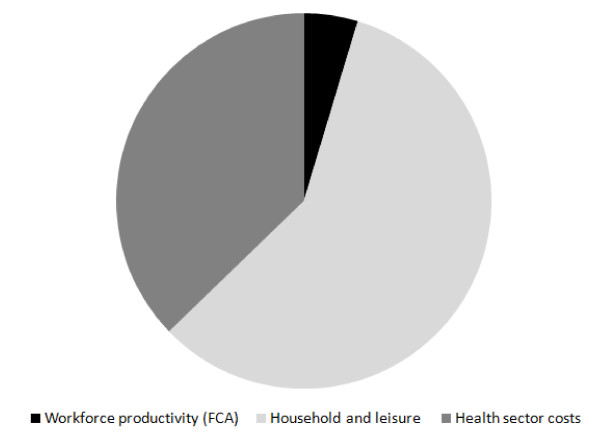
A 10% reduction in physical inactivity would result in 6,000 fewer incident cases of disease, 2,000 fewer deaths, 25,000 fewer DALYs and provide gains in working days (114,000), days of home-based production (180,000) while conferring a AUD96 million reduction in health sector costs. Lifetime potential opportunity cost savings in workforce production (AUD12 million), home-based production (AUD71 million) and leisure-based production (AUD79 million) was estimated (total AUD162 million 95% uncertainty interval AUD136 million, AUD196 million).
Opportunity cost savings and health benefits conservatively estimated from a reduction in population-level physical inactivity may be substantial. The largest savings will benefit individuals in the form of unpaid production and leisure gains, followed by the health sector, business and government.
身体活动不足对健康和生产力有重大影响。我们的目的是估计减少 2008 年澳大利亚成年人中身体活动不足的流行率对健康和经济的益处。经济效益被估计为“机会成本节约”,这代表了在治疗可预防疾病方面利用的资源,这些资源有可能从社区中发生的较少疾病病例中重新用于其他目的。
开发了模拟模型,以显示从目前澳大利亚水平(70%)降低 10%的身体活动不足可行目标的效果。通过按年龄和性别计算与不活动相关的疾病、死亡和残疾调整生命年(DALY)减少的更少发病例数来估计终生队列健康收益。机会成本是通过比较与减少身体活动相关的疾病事件相关的健康部门成本影响、带薪和无薪生产收益以及休闲影响来估计的。通过比较积极和不积极的成年人的调查参与率和缺勤率来估计劳动力生产收益,并使用摩擦成本方法进行评估。根据时间使用调查数据,对暴露和未暴露人群亚组进行建模,将健康状况改善对无薪家庭生产和休闲时间的影响,以及通过适当的代理进行评估。不包括增加身体活动的干预措施的潜在成本。进行了多变量不确定性分析和单变量敏感性分析,以提供有关结论强度的信息。
身体活动减少 10%将导致发病减少 6000 例,死亡减少 2000 例,残疾调整生命年减少 25000 例,并增加工作日(114000 天)和家庭生产天数(180000 天),同时减少卫生部门 9600 万澳元的成本。估计劳动力生产(1200 万澳元)、家庭生产(7100 万澳元)和休闲生产(7900 万澳元)的终身潜在机会成本节约(总计 1.62 亿澳元,95%置信区间 1.36 亿澳元,1.96 亿澳元)。
从降低人群身体活动水平中保守估计的机会成本节约和健康收益可能是巨大的。最大的节约将以无薪生产和休闲收益的形式使个人受益,其次是卫生部门、企业和政府。