• 文献检索
  • 文档翻译
  • 深度研究
  • 学术资讯
  • Suppr Zotero 插件Zotero 插件
  • 邀请有礼
  • 套餐&价格
  • 历史记录
应用&插件
Suppr Zotero 插件Zotero 插件浏览器插件Mac 客户端Windows 客户端微信小程序
定价
高级版会员购买积分包购买API积分包
服务
文献检索文档翻译深度研究API 文档MCP 服务
关于我们
关于 Suppr公司介绍联系我们用户协议隐私条款
关注我们

Suppr 超能文献

核心技术专利:CN118964589B侵权必究
粤ICP备2023148730 号-1Suppr @ 2026

文献检索

告别复杂PubMed语法,用中文像聊天一样搜索,搜遍4000万医学文献。AI智能推荐,让科研检索更轻松。

立即免费搜索

文件翻译

保留排版,准确专业,支持PDF/Word/PPT等文件格式,支持 12+语言互译。

免费翻译文档

深度研究

AI帮你快速写综述,25分钟生成高质量综述,智能提取关键信息,辅助科研写作。

立即免费体验

三维运动后效揭示了通过深度进行运动的双眼处理的不同方向选择机制。

Three-dimensional motion aftereffects reveal distinct direction-selective mechanisms for binocular processing of motion through depth.

作者信息

Czuba Thaddeus B, Rokers Bas, Guillet Kyle, Huk Alexander C, Cormack Lawrence K

机构信息

Center for Perceptual Systems, Department of Psychology & Section of Neurobiology, The University of Texas at Austin, Austin, TX 78712-0189, USA.

出版信息

J Vis. 2011 Sep 26;11(10):18. doi: 10.1167/11.10.18.

DOI:10.1167/11.10.18
PMID:21945967
原文链接:https://pmc.ncbi.nlm.nih.gov/articles/PMC3628603/
Abstract

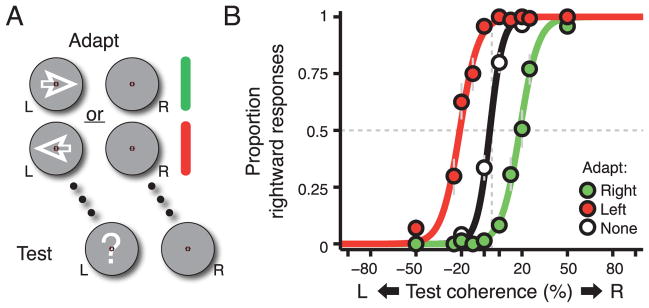
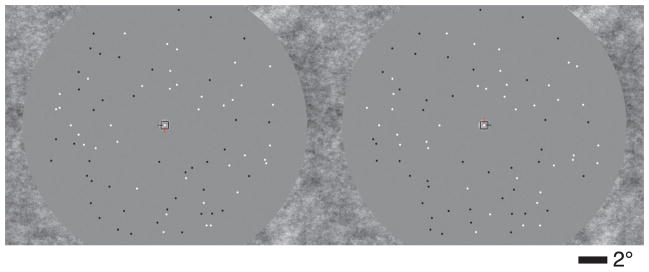
Motion aftereffects are historically considered evidence for neuronal populations tuned to specific directions of motion. Despite a wealth of motion aftereffect studies investigating 2D (frontoparallel) motion mechanisms, there is a remarkable dearth of psychophysical evidence for neuronal populations selective for the direction of motion through depth (i.e., tuned to 3D motion). We compared the effects of prolonged viewing of unidirectional motion under dichoptic and monocular conditions and found large 3D motion aftereffects that could not be explained by simple inheritance of 2D monocular aftereffects. These results (1) demonstrate the existence of neurons tuned to 3D motion as distinct from monocular 2D mechanisms, (2) show that distinct 3D direction selectivity arises from both interocular velocity differences and changing disparities over time, and (3) provide a straightforward psychophysical tool for further probing 3D motion mechanisms.

摘要

运动后效在历史上被视为神经元群体针对特定运动方向进行调谐的证据。尽管有大量关于二维(额面平行)运动机制的运动后效研究,但对于通过深度方向的运动具有选择性的神经元群体,却显著缺乏心理物理学证据(即调谐至三维运动)。我们比较了双眼和单眼条件下长时间观看单向运动的效果,发现了无法用二维单眼后效的简单遗传来解释的大型三维运动后效。这些结果(1)证明了存在与单眼二维机制不同的调谐至三维运动的神经元,(2)表明不同的三维方向选择性源于双眼间速度差异和随时间变化的视差,(3)为进一步探究三维运动机制提供了一种直接的心理物理学工具。
https://cdn.ncbi.nlm.nih.gov/pmc/blobs/d5a8/3628603/07e688347b30/nihms453519f14.jpg
https://cdn.ncbi.nlm.nih.gov/pmc/blobs/d5a8/3628603/05bc38a40fe3/nihms453519f1.jpg
https://cdn.ncbi.nlm.nih.gov/pmc/blobs/d5a8/3628603/702795d6e456/nihms453519f2.jpg
https://cdn.ncbi.nlm.nih.gov/pmc/blobs/d5a8/3628603/28b047bc4591/nihms453519f3.jpg
https://cdn.ncbi.nlm.nih.gov/pmc/blobs/d5a8/3628603/f6cf37aec5ed/nihms453519f4.jpg
https://cdn.ncbi.nlm.nih.gov/pmc/blobs/d5a8/3628603/51d97c43a142/nihms453519f5.jpg
https://cdn.ncbi.nlm.nih.gov/pmc/blobs/d5a8/3628603/d16fcbcfbf0a/nihms453519f6.jpg
https://cdn.ncbi.nlm.nih.gov/pmc/blobs/d5a8/3628603/9ad2ec37e6fb/nihms453519f7.jpg
https://cdn.ncbi.nlm.nih.gov/pmc/blobs/d5a8/3628603/2ad50a269543/nihms453519f8.jpg
https://cdn.ncbi.nlm.nih.gov/pmc/blobs/d5a8/3628603/db244192a20a/nihms453519f9.jpg
https://cdn.ncbi.nlm.nih.gov/pmc/blobs/d5a8/3628603/25904abb9f1b/nihms453519f10.jpg
https://cdn.ncbi.nlm.nih.gov/pmc/blobs/d5a8/3628603/876cf3cab04c/nihms453519f11.jpg
https://cdn.ncbi.nlm.nih.gov/pmc/blobs/d5a8/3628603/4bbd218cad56/nihms453519f12.jpg
https://cdn.ncbi.nlm.nih.gov/pmc/blobs/d5a8/3628603/c0ebf874bd4b/nihms453519f13.jpg
https://cdn.ncbi.nlm.nih.gov/pmc/blobs/d5a8/3628603/07e688347b30/nihms453519f14.jpg
https://cdn.ncbi.nlm.nih.gov/pmc/blobs/d5a8/3628603/05bc38a40fe3/nihms453519f1.jpg
https://cdn.ncbi.nlm.nih.gov/pmc/blobs/d5a8/3628603/702795d6e456/nihms453519f2.jpg
https://cdn.ncbi.nlm.nih.gov/pmc/blobs/d5a8/3628603/28b047bc4591/nihms453519f3.jpg
https://cdn.ncbi.nlm.nih.gov/pmc/blobs/d5a8/3628603/f6cf37aec5ed/nihms453519f4.jpg
https://cdn.ncbi.nlm.nih.gov/pmc/blobs/d5a8/3628603/51d97c43a142/nihms453519f5.jpg
https://cdn.ncbi.nlm.nih.gov/pmc/blobs/d5a8/3628603/d16fcbcfbf0a/nihms453519f6.jpg
https://cdn.ncbi.nlm.nih.gov/pmc/blobs/d5a8/3628603/9ad2ec37e6fb/nihms453519f7.jpg
https://cdn.ncbi.nlm.nih.gov/pmc/blobs/d5a8/3628603/2ad50a269543/nihms453519f8.jpg
https://cdn.ncbi.nlm.nih.gov/pmc/blobs/d5a8/3628603/db244192a20a/nihms453519f9.jpg
https://cdn.ncbi.nlm.nih.gov/pmc/blobs/d5a8/3628603/25904abb9f1b/nihms453519f10.jpg
https://cdn.ncbi.nlm.nih.gov/pmc/blobs/d5a8/3628603/876cf3cab04c/nihms453519f11.jpg
https://cdn.ncbi.nlm.nih.gov/pmc/blobs/d5a8/3628603/4bbd218cad56/nihms453519f12.jpg
https://cdn.ncbi.nlm.nih.gov/pmc/blobs/d5a8/3628603/c0ebf874bd4b/nihms453519f13.jpg
https://cdn.ncbi.nlm.nih.gov/pmc/blobs/d5a8/3628603/07e688347b30/nihms453519f14.jpg

相似文献

1
Three-dimensional motion aftereffects reveal distinct direction-selective mechanisms for binocular processing of motion through depth.三维运动后效揭示了通过深度进行运动的双眼处理的不同方向选择机制。
J Vis. 2011 Sep 26;11(10):18. doi: 10.1167/11.10.18.
2
Seeing motion in depth using inter-ocular velocity differences.利用眼间速度差异感知深度运动。
Vision Res. 2005 Oct;45(21):2786-98. doi: 10.1016/j.visres.2005.05.021.
3
Separate Perceptual and Neural Processing of Velocity- and Disparity-Based 3D Motion Signals.基于速度和视差的3D运动信号的感知与神经处理分离
J Neurosci. 2016 Oct 19;36(42):10791-10802. doi: 10.1523/JNEUROSCI.1298-16.2016.
4
Motion aftereffect in depth based on binocular information.基于双目信息的深度运动后效
J Vis. 2012 Jan 17;12(1):11. doi: 10.1167/12.1.11.
5
Aftereffect of motion-in-depth based on binocular cues: Effects of adaptation duration, interocular correlation, and temporal correlation.基于双眼线索的深度运动后效:适应持续时间、双眼相关性和时间相关性的影响。
J Vis. 2014 Jul 24;14(8):21. doi: 10.1167/14.8.21.
6
Low-level motion analysis of color and luminance for perception of 2D and 3D motion.用于二维和三维运动感知的颜色和亮度的低水平运动分析。
J Vis. 2012 Jun 26;12(6):33. doi: 10.1167/12.6.33.
7
Sensitivity and bias in the discrimination of two-dimensional and three-dimensional motion direction.二维和三维运动方向辨别中的敏感性与偏差
J Vis. 2016 Aug 1;16(10):5. doi: 10.1167/16.10.5.
8
Motion-induced position shift in stereoscopic and dichoptic viewing.立体视觉和双眼分视中运动诱发的位置偏移。
J Vis. 2016 Oct 1;16(13):3. doi: 10.1167/16.13.3.
9
Adaptation to vertical disparity induced-depth: implications for disparity processing.对垂直视差诱导深度的适应:对视差处理的影响。
Vision Res. 2003 Jan;43(2):135-47. doi: 10.1016/s0042-6989(02)00492-3.
10
Motion processing with two eyes in three dimensions.三维空间中双眼的运动处理
J Vis. 2011 Feb 11;11(2):10. doi: 10.1167/11.2.10.

引用本文的文献

1
Hierarchical computation of 3D motion across macaque areas MT and FST.猴 MT 和 FST 区的 3D 运动的分层计算。
Cell Rep. 2023 Dec 26;42(12):113524. doi: 10.1016/j.celrep.2023.113524. Epub 2023 Dec 6.
2
Identifying cortical areas that underlie the transformation from 2D retinal to 3D head-centric motion signals.确定将二维视网膜运动信号转换为三维以头部为中心的运动信号的皮层区域。
Neuroimage. 2023 Apr 15;270:119909. doi: 10.1016/j.neuroimage.2023.119909. Epub 2023 Feb 17.
3
Decoding Neural Responses to Motion-in-Depth Using EEG.

本文引用的文献

1
Aftereffect of motion-in-depth based on binocular cues: Effects of adaptation duration, interocular correlation, and temporal correlation.基于双眼线索的深度运动后效:适应持续时间、双眼相关性和时间相关性的影响。
J Vis. 2014 Jul 24;14(8):21. doi: 10.1167/14.8.21.
2
Motion psychophysics: 1985-2010.运动心理物理学:1985 - 2010年
Vision Res. 2011 Jul 1;51(13):1431-56. doi: 10.1016/j.visres.2011.02.008. Epub 2011 Feb 13.
3
The motion aftereffect.运动后效。
利用脑电图解码对深度运动的神经反应。
Front Neurosci. 2020 Dec 10;14:581706. doi: 10.3389/fnins.2020.581706. eCollection 2020.
4
Cue-dependent effects of VR experience on motion-in-depth sensitivity.虚拟现实体验对深度运动敏感性的依 cue 效应。
PLoS One. 2020 Mar 9;15(3):e0229929. doi: 10.1371/journal.pone.0229929. eCollection 2020.
5
Eye-specific pattern-motion signals support the perception of three-dimensional motion.特定于眼睛的模式运动信号支持对三维运动的感知。
J Vis. 2019 Apr 1;19(4):27. doi: 10.1167/19.4.27.
6
Motion Discrimination and the Motion Aftereffect in Mouse Vision.运动辨别与运动后效在鼠类视觉中的作用。
eNeuro. 2018 Dec 21;5(6). doi: 10.1523/ENEURO.0065-18.2018. eCollection 2018 Nov-Dec.
7
Binocular Mechanisms of 3D Motion Processing.双眼三维运动处理机制。
Annu Rev Vis Sci. 2017 Sep 15;3:297-318. doi: 10.1146/annurev-vision-102016-061259. Epub 2017 Jul 26.
8
Dynamic mechanisms of visually guided 3D motion tracking.视觉引导的三维运动跟踪的动态机制
J Neurophysiol. 2017 Sep 1;118(3):1515-1531. doi: 10.1152/jn.00831.2016. Epub 2017 Jun 21.
9
Separate Perceptual and Neural Processing of Velocity- and Disparity-Based 3D Motion Signals.基于速度和视差的3D运动信号的感知与神经处理分离
J Neurosci. 2016 Oct 19;36(42):10791-10802. doi: 10.1523/JNEUROSCI.1298-16.2016.
10
Area MT encodes three-dimensional motion.体感区 MT 编码三维运动。
J Neurosci. 2014 Nov 19;34(47):15522-33. doi: 10.1523/JNEUROSCI.1081-14.2014.
Trends Cogn Sci. 1998 Mar 1;2(3):111-7. doi: 10.1016/s1364-6613(98)01142-5.
4
Speed and eccentricity tuning reveal a central role for the velocity-based cue to 3D visual motion.速度和偏心率调节揭示了基于速度的线索在 3D 视觉运动中的核心作用。
J Neurophysiol. 2010 Nov;104(5):2886-99. doi: 10.1152/jn.00585.2009. Epub 2010 Sep 29.
5
Integration of monocular motion signals and the analysis of interocular velocity differences for the perception of motion-in-depth.单眼运动信号的整合以及双眼速度差异分析用于深度运动感知。
J Vis. 2009 Dec 9;9(13):10.1-17. doi: 10.1167/9.13.10.
6
Disparity- and velocity-based signals for three-dimensional motion perception in human MT+.基于视差和速度的信号用于人类MT+区的三维运动感知
Nat Neurosci. 2009 Aug;12(8):1050-5. doi: 10.1038/nn.2343. Epub 2009 Jul 5.
7
Binocular processing of motion: some unresolved questions.运动的双眼处理:一些未解决的问题。
Spat Vis. 2009;22(1):1-43. doi: 10.1163/156856809786618501.
8
Binocular vision and motion-in-depth.双眼视觉与深度运动
Spat Vis. 2008;21(6):531-47. doi: 10.1163/156856808786451462.
9
Bayesian motion estimation accounts for a surprising bias in 3D vision.贝叶斯运动估计解释了3D视觉中一种惊人的偏差。
Proc Natl Acad Sci U S A. 2008 Aug 19;105(33):12087-92. doi: 10.1073/pnas.0804378105. Epub 2008 Aug 12.
10
Strong percepts of motion through depth without strong percepts of position in depth.通过深度产生强烈的运动感知,但没有强烈的深度位置感知。
J Vis. 2008 Apr 15;8(4):6.1-10. doi: 10.1167/8.4.6.