Biological Oceanography, Leibniz-Institute of Marine Sciences (IFM-GEOMAR), Kiel, Germany.
PLoS One. 2011;6(9):e24223. doi: 10.1371/journal.pone.0024223. Epub 2011 Sep 16.
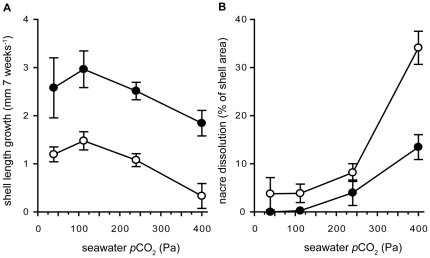
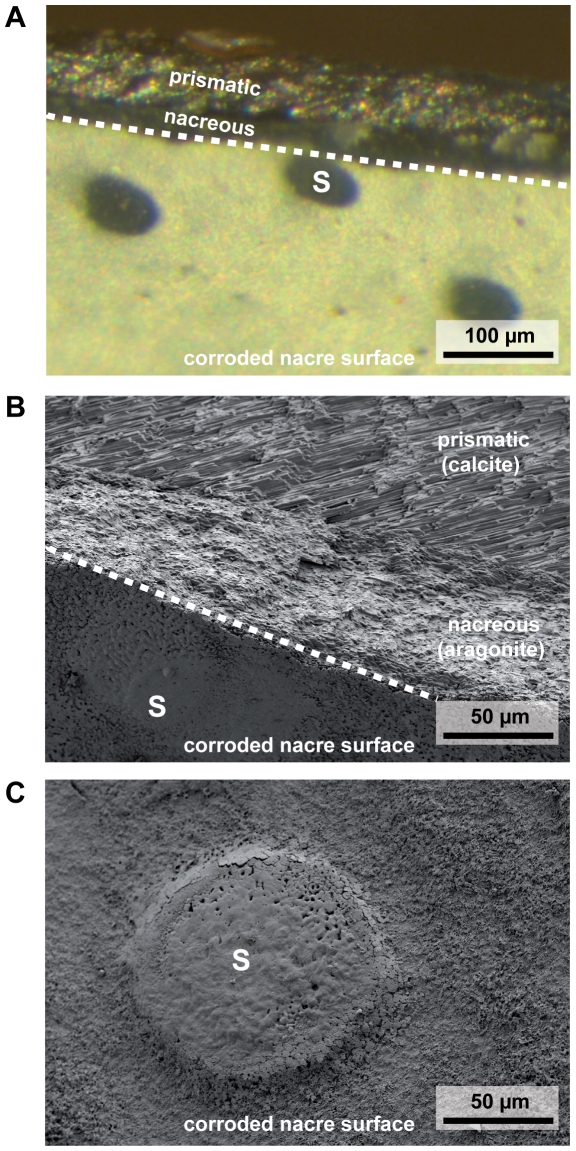
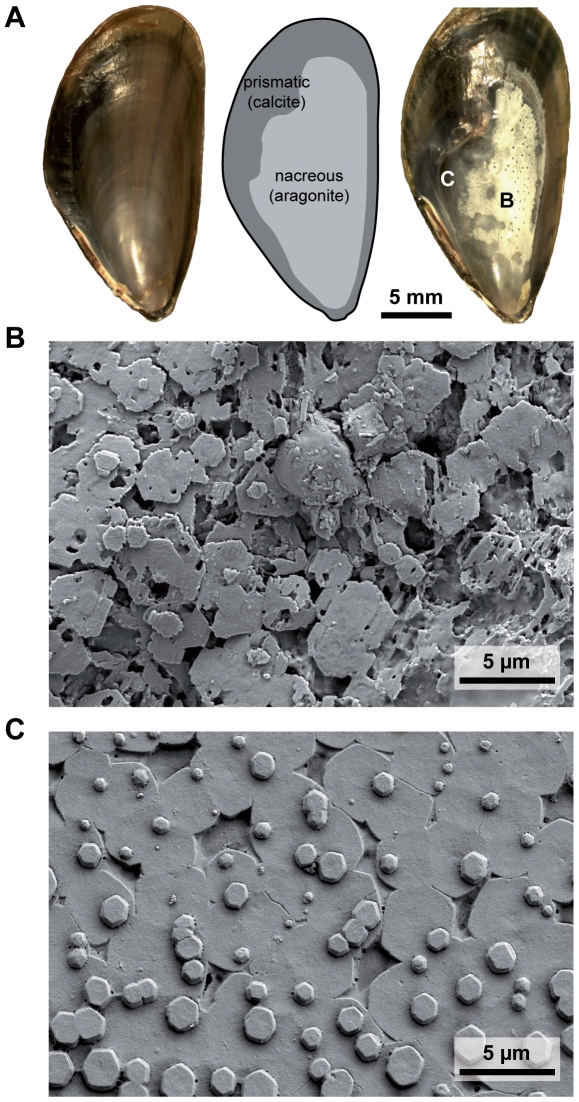
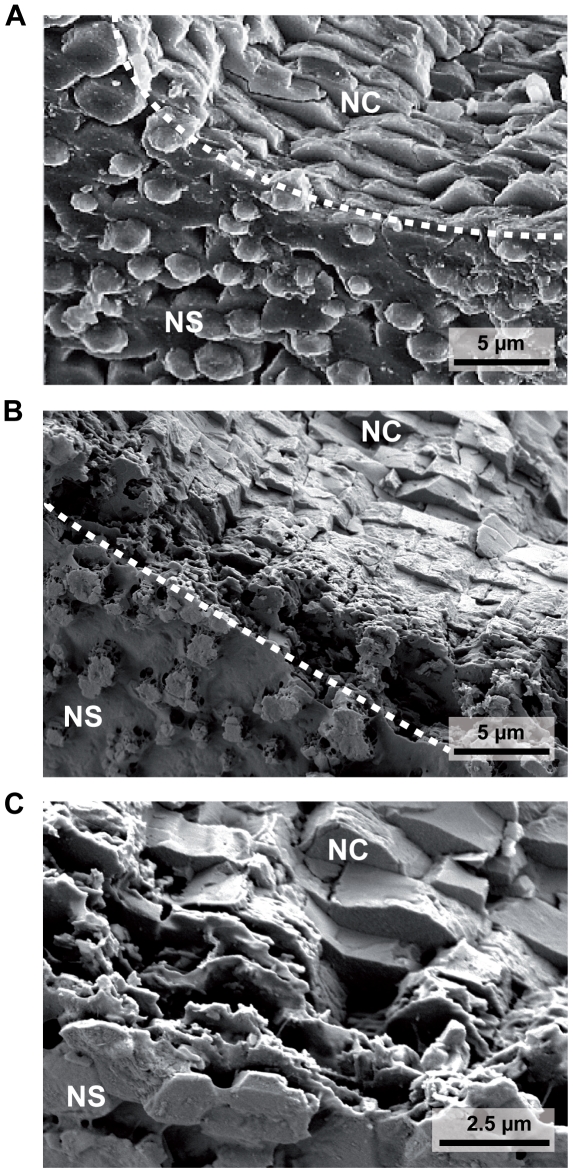
Progressive ocean acidification due to anthropogenic CO(2) emissions will alter marine ecosystem processes. Calcifying organisms might be particularly vulnerable to these alterations in the speciation of the marine carbonate system. While previous research efforts have mainly focused on external dissolution of shells in seawater under saturated with respect to calcium carbonate, the internal shell interface might be more vulnerable to acidification. In the case of the blue mussel Mytilus edulis, high body fluid pCO(2) causes low pH and low carbonate concentrations in the extrapallial fluid, which is in direct contact with the inner shell surface. In order to test whether elevated seawater pCO(2) impacts calcification and inner shell surface integrity we exposed Baltic M. edulis to four different seawater pCO(2) (39, 142, 240, 405 Pa) and two food algae (310-350 cells mL(-1) vs. 1600-2000 cells mL(-1)) concentrations for a period of seven weeks during winter (5°C). We found that low food algae concentrations and high pCO(2) values each significantly decreased shell length growth. Internal shell surface corrosion of nacreous ( = aragonite) layers was documented via stereomicroscopy and SEM at the two highest pCO(2) treatments in the high food group, while it was found in all treatments in the low food group. Both factors, food and pCO(2), significantly influenced the magnitude of inner shell surface dissolution. Our findings illustrate for the first time that integrity of inner shell surfaces is tightly coupled to the animals' energy budget under conditions of CO(2) stress. It is likely that under food limited conditions, energy is allocated to more vital processes (e.g. somatic mass maintenance) instead of shell conservation. It is evident from our results that mussels exert significant biological control over the structural integrity of their inner shell surfaces.
由于人为 CO(2)排放导致的海洋酸化将改变海洋生态系统过程。钙化生物可能特别容易受到海洋碳酸盐系统物种形成变化的影响。虽然以前的研究工作主要集中在碳酸钙饱和海水中外壳溶解方面,但壳内界面可能更容易受到酸化的影响。在贻贝 Mytilus edulis 的情况下,高体液 pCO(2)导致外套腔液中 pH 值低且碳酸盐浓度低,外套腔液与内壳表面直接接触。为了测试升高的海水 pCO(2 是否会影响钙化和内壳表面完整性,我们将波罗的海贻贝暴露在四种不同的海水 pCO(2(39、142、240、405 Pa)和两种食物藻类(310-350 个细胞 mL(-1) 与 1600-2000 个细胞 mL(-1))浓度下,为期七周在冬季(5°C)期间。我们发现低食物藻类浓度和高 pCO(2)值都显著降低了壳长生长。通过立体显微镜和 SEM 在高食物组的两个最高 pCO(2)处理中记录了珍珠层( = 方解石)层的内部壳面腐蚀,而在低食物组的所有处理中都发现了这种情况。食物和 pCO(2)这两个因素都显著影响了内壳面溶解的程度。我们的研究结果首次表明,在 CO(2)胁迫条件下,内壳面的完整性与动物的能量预算密切相关。在食物有限的条件下,能量可能被分配到更重要的过程(例如,体质量维持),而不是壳的保护。从我们的结果可以明显看出,贻贝对内壳面结构完整性施加了重要的生物控制。