Department of Psychology, Albert-Ludwigs-University Freiburg, Germany.
Front Psychol. 2011 Sep 22;2:231. doi: 10.3389/fpsyg.2011.00231. eCollection 2011.
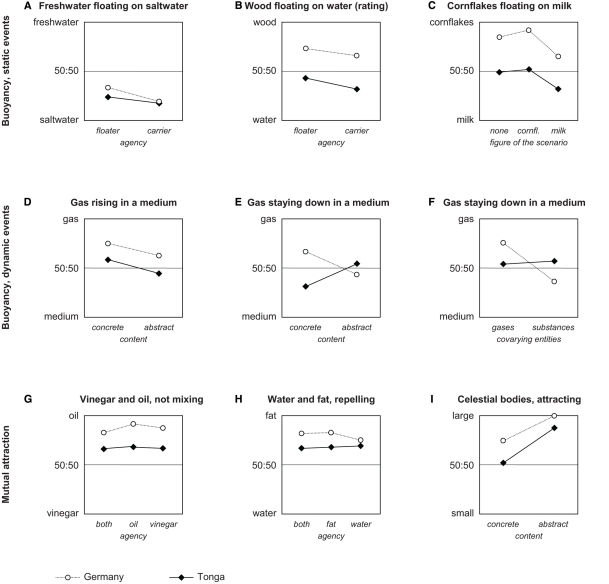
Causal cognition in the physical domain has been treated for a long time as if it were (1) objective and (2) independent of culture. Despite some evidence to the contrary, however, these implicit assumptions have been rarely ever explored systematically. While the pervasive tendency of people to consider one of two equally important entities as more important for bringing about an effect (as reported by White, 2006) meanwhile provides one type of counter-evidence for the first assumption, respective findings remained mute to the second. In order to scrutinize how robust such tendencies are across cultures - and, if not, on which aspects of culture they may depend - we asked German and Tongan participants to assign prime causality in nine symmetric settings. For most settings, strong asymmetries in both cultures were found, but not always in the same direction, depending on the task content and by virtue of the multifaceted character of "culture." This indicates that causal asymmetries, while indeed being a robust phenomenon across cultures, are also modulated by task-specific properties (such as figure-ground relations), and are subject to cultural influences.
长期以来,人们一直认为物理领域的因果认知是(1)客观的,(2)不受文化影响的。然而,尽管有一些相反的证据,但这些隐含的假设很少被系统地探索过。虽然人们普遍倾向于认为两个同样重要的实体中,有一个对产生影响更为重要(如 White,2006 年所报告的),这为第一个假设提供了一种反证,但各自的发现对第二个假设仍然保持沉默。为了研究这种趋势在不同文化中是多么稳健——如果不是,它们可能取决于文化的哪些方面——我们要求德国和汤加的参与者在九个对称的情境中分配主要因果关系。对于大多数情境,两种文化都存在强烈的不对称性,但并不总是朝着同一方向,这取决于任务内容,并得益于“文化”的多方面特征。这表明,因果不对称性虽然确实是一种跨文化的稳健现象,但也受到特定任务属性(如图形-背景关系)的调节,并且受到文化影响。